





“Most well-known people who talk about climate change are in North America and Europe,” says Kenyan rugby sevens star Kevin Wekesa, “but for us this is a very relevant conversation. It is not only about future tournaments or big international pledges. In Kenya, we see the effects in rising heat, cracked pitches and changing weather in communities where young athletes are growing up.”
A year before competing in his first Olympic Games at Paris 2024, Wekesa responded to Kenya’s relegation from the top tier of international sevens by offering free rugby coaching in schools across Kenya. After travelling to a school in Kirinyaga on the slopes of Mount Kenya, a wet and verdant region, Wekesa found an unplayable dry field and was forced to cancel the session. One of the students told Wekesa that conditions had been similar for two months, while another suggested the unfamiliar weather was because of climate change.
“I thought to myself, if it’s already affecting this level of sport, what about at the highest level?” That same year, he founded Play Green, an organisation that connects sport with climate action. Wekesa went on to win a 2025 IOC Climate Action Award, recognised his success with Play Green, including leading the Kenyan men’s and women’s national sevens teams to use reusable water bottles, saving approximately 1,000 plastic bottles every week.
Wekesa hopes to extend his influence beyond Kenya’s national setup and make banning single-use plastic a policy in Kenyan rugby clubs and tournaments. “If I can eliminate plastic directly from all the clubs in Kenya, it can eventually grow organically to other sports in the country.” In April, Wekesa met Inger Andersen, executive director of the United Nations Environment Programme, to discuss reducing single-use plastic at the Africa Cup of Nations (Afcon) in 2027, which Kenya will host alongside Uganda and Tanzania.
Play Green also focuses on climate change education in Kenyan schools. “We work with children because they are inheriting the climate crisis, not because they are causing it,” Wekesa says. “Kenyan children have a very small carbon footprint compared to children growing up in high-carbon economies like northern Europe, yet they are often more exposed to the consequences: drought, floods, heat, water shortages, food insecurity, illness and missed school. I am not blaming European children but I must highlight climate injustices.”
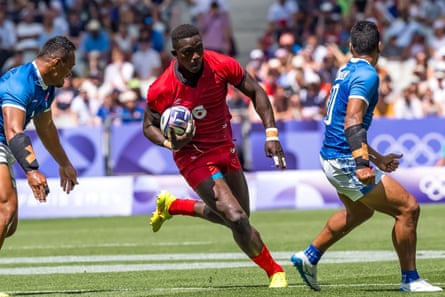
Play Green does not only treat children as victims of climate change, but as active participants in protecting their environment. “For me, climate action is practical, visible, and rooted in community, just like rugby. It takes a community to tackle climate action; it is not about pointing fingers.” Wekesa explains that many children in vulnerable communities are aware of climate change, but education empowers them to take small actions that reduce its impacts, such as conserving water.
After giving climate change talks and playing rugby with students, Wekesa tasks them with adopting trees planted by Play Green, writing their names on a label along with the year the sapling was planted. When Wekesa realised that children were sometimes too hungry to play rugby after school, Play Green primarily plants fruit trees — avocado, mango, guava and other indigenous species — to provide nourishment. Wekesa is also piloting a scheme that provides children with wholegrain porridge.
The trees planted in each school depend on the climate of each location, which Wekesa learned about after visiting the Kenya Forest Reserve. He acknowledges that there are more effective ways to reduce carbon emissions than planting trees, but in addition to providing nutrition, explains that they give students “a sense of belonging” to their surroundings while providing shade that can be used as outdoor classrooms. “I remember many times doing a literature lesson under a tree when it was too hot to be in a classroom.”
Throughout May, Wekesa is teaching rugby, distributing pre-used rugby balls and planting fruit trees in 10 schools that have expressed interest in joining Play Green. So far, he has held workshops in over 40 Kenyan schools and planted over 6,200 trees. Some students who participated in the first workshops have even introduced Play Green initiatives to new schools while progressing through their education.
Wekesa, who is still only 25 and recently finished his mechanical engineering degree, recognises that travelling to play rugby has its own carbon footprint and tries to minimise what he can. But he says that other people’s pledges, such as using sustainable transport to attend sports events, motivate him to do more, because it is evidence that people engage with climate change through sport. “It creates a wider group of people who are like a Play Green team around the world.”
-
This is an extract from our newsletter, The Hotspot. To subscribe just visit this page and follow the instructions.