



惯性聚合 高效追踪和阅读你感兴趣的博客、新闻、科技资讯
阅读原文 在惯性聚合中打开

推荐订阅源

S
Securelist
有赞技术团队
有赞技术团队
WordPress大学
WordPress大学
V
V2EX
Google DeepMind News
B
Blog RSS Feed
The Register - Security
Recorded Future
Recorded Future
Y
Y Combinator Blog
小众软件
小众软件
Jina AI
Jina AI
V2EX - 技术
V2EX - 技术
钛媒体:引领未来商业与生活新知
钛媒体:引领未来商业与生活新知
P
Proofpoint News Feed
Engineering at Meta
Engineering at Meta
宝玉的分享
宝玉的分享
The Hacker News
The Hacker News
C
Cybersecurity and Infrastructure Security Agency CISA
K
Kaspersky official blog
博客园 - 三生石上(FineUI控件)
T
Threatpost
博客园 - 聂微东
Scott Helme
Scott Helme
IT之家
IT之家
N
Netflix TechBlog - Medium
T
The Exploit Database - CXSecurity.com
S
Schneier on Security
MongoDB | Blog
MongoDB | Blog
T
Tor Project blog
C
CXSECURITY Database RSS Feed - CXSecurity.com
A
About on SuperTechFans
酷 壳 – CoolShell
酷 壳 – CoolShell
C
CERT Recently Published Vulnerability Notes
P
Palo Alto Networks Blog
Spread Privacy
Spread Privacy
C
Check Point Blog
L
LINUX DO - 最新话题
D
Darknet – Hacking Tools, Hacker News & Cyber Security
Last Week in AI
Last Week in AI
Attack and Defense Labs
T
Tailwind CSS Blog
罗磊的独立博客
让小产品的独立变现更简单 - ezindie.com
Webroot Blog
Webroot Blog
Help Net Security
Help Net Security
cs.AI updates on arXiv.org
OSCHINA 社区最新新闻
OSCHINA 社区最新新闻
爱范儿
爱范儿
PCI Perspectives
PCI Perspectives
Security Latest
Security Latest

The Guardian

Rory McIlroy surges into six-shot Masters lead with stunning second-round flourish ‘That’ll be the end’: actor Sam Neill joins fight to stop controversial goldmine near his New Zealand vineyard Roberto De Zerbi targets ‘Ange-ball’ revival to save Spurs from relegation Bath hit back to reach semi-final after stunning Northampton in 11-try epic Secret Garden to Outcome: the week in rave reviews Zebras, wealth and power: Hungary’s election tests Orbán’s grip on power ‘TikTok effect’ brings sellout crowds and younger fans to Grand National meeting The war over Omagh’s gold: the £21bn mine plan tearing a community apart Britain’s shadow workforce is paid as little as 65p an hour. Who cares for the carers? From You, Me & Tuscany to Euphoria: your complete entertainment guide to the week ahead Six great reads: the man who let snakes bite him, masked heavy metal and the brutal reality for foreign students in the UK American Classic review – I defy you not to fall in love with Kevin Kline and Laura Linney’s tender comedy Cuba’s doctors were a lifeline for the world. Now the Caribbean is shamefully complicit in the US drive to expel them An environmental disaster in Moldova has Russia’s fingerprints all over it RMIT drops misconduct case against student who accused university of being ‘complicit in Gaza genocide’ Ichiro Suzuki statue unveiling goes awry as bronze bat snaps during ceremony Survivors of Epstein’s abuse accuse Melania Trump of ‘shifting burden’ on to victims European football: Real Madrid held at home by Girona to extend winless run Arne Slot insists he is ‘aligned’ with Liverpool board and fans as squad is rebuilt Kamala Harris ‘thinking about’ running for president again in 2028 JD Vance warns Iran against trying to ‘play’ the US in peace talks West Ham double up twice to thrash Wolves and put Spurs in relegation zone Trump administration releases new renderings of so-called ‘Arc de Trump’ Crispin Odey drops £79m libel claim against FT over sexual misconduct allegations Bafta apologises for events surrounding John Davidson’s Tourette’s outburst Cocktail of the week: Bar Shrimp’s la rosita – recipe New drug may extend survival in aggressive ovarian cancer, trial shows One dead and 27 injured after bus with British passengers crashes in Canary Islands Pope adds to Smith’s mass of Surrey runs with England woes a world away OpenAI CEO Sam Altman’s home targeted with molotov cocktail Reform UK local election candidate was twice disciplined by Tories over ‘racist comments’ Remaining in Nato is in best interests of US, says Keir Starmer Prince Harry sued for defamation by charity he co-founded Anthropic’s new AI tool has implications for us all – whether we can use it or not Concerns raised about motorbike tourist trail after death of British teenager in Vietnam The Guardian view on Trump’s civilisational threats: the words that fuel war must be condemned The Guardian view on dystopias for our times: the American nightmare Doctors’ leader claims new reduced pay offer killed chances of ending strikes in England Netanyahu-ism has achieved nothing for Israelis – and come at a monstrously high price Deborah Levy: ‘CS Lewis’s White Witch terrified me – but I wanted to meet her’ How I Shop with Michelle Ogundehin: ‘We grownups have enough stuff already’ Trump’s war and Melania’s Epstein statement, with US editor Betsy Reed – The Latest We have to stop killer motorists on Britain’s roads UK starts crackdown on EU citizens’ post-Brexit rights Londoners aren’t unfriendly – but don’t compare us to New Yorkers The religious right and the perversion of faith Artemis II images reignite moon mission memories Orbán and Magyar trade accusations in last days of Hungary election campaign Reckonwrong: How Long Has It Been? review | Safi Bugel's experimental album of the month Martin Rowson on Middle East peace talks – cartoon Masters magic, the Grand National and Premier League drama – follow with us Fears of UK and EU flight cancellations as airports warn of jet fuel shortages Reform’s petulance over slavery reparations shows it just doesn’t grasp Britain’s place in the modern world Peers vote to ban pornography depicting sex acts between stepfamily members Starbucks’s retail arm gets £13.7m tax credit even as sales increase Flyby review – interstellar musical is a voyage of epic strangeness Grand National preview: Jagwar can deny Irish cohort in Aintree classic Week in wildlife: an ostrich on the lam, a tortoise crossing a road and surfing seals Anger as swifts’ nesting holes in Derbyshire rail viaduct ‘blocked up’ Peter Mandelson faces fixed-penalty notice for urinating in public ‘There’s no shortage of terrifying technology’: how AI became TV drama’s new go-to villain ‘Fresher than anything in a shop’: the best recipe boxes and meal kits for time-poor foodies, tested Who was Hilma? Af Klint exhibition to highlight exclusion of women from abstract art Critics assemble! Here’s my list of the greatest superhero movies of all time US inflation soars in March as war on Iran drives economy into uncertainty Amazon to finally launch Leo satellite internet in ‘mid-2026’, says CEO Grand National 2026: horse-by-horse guide to all the runners Pete Hegseth’s holy war: the militant Christian theology animating the US attack on Iran Add to playlist: the beautifully dazed, countrified indie-rock of Tracey Nelson and the week’s best new tracks Not just about Gaza: the Muslim voters turning from Labour to the Greens ‘I’m worried there’s too much of me,’ says a birch: inside the interspecies council giving nature a voice Why is anyone surprised by the US and Israel’s latest war? It’s only what the world allowed them to do in Gaza Tori Amos review – fans hang on every note of this dramatic deep dive into her back catalogue Coachella 2026: Justin Bieber launches a major comeback in the desert Super Mario what?! The seven best obscure Mario games ‘An abomination’: the Lancashire town kicking up a stink over reopened landfill Pillion to Roofman: the seven best films to watch on TV this week Holly Humberstone: Cruel World review – Taylor Swift fave trades gothic melancholy for pop glow-up Thrash review – cursed shark thriller sinks like a stone on Netflix Gulf states rethink security in light of US-Israel war on Iran Go Gentle by Maria Semple review – a joyfully clever New York romcom Welcome to Y’all Street: bullish Dallas aims to steal New York’s financial crown Margo’s Got Money Troubles to Beef: the seven best shows to stream this week I baulked at the idea of ‘friction-maxxing’. But there’s more to it than meets the eye Reich: The Sextets album review – Colin Currie celebrates the minimalist master’s joy of six Benjamina Ebuehi’s sweet and salty chocolate chip cookies recipe Experience: my house was taken over by 70,000 bees Malcolm in the Middle: Life’s Still Unfair review – the TV magic they’ve created here is absolutely miraculous Lava bursts forth as Hawaii’s Kilauea volcano erupts Sonos review: Are these the best portable speakers that money can buy? I tested to find out Buy bread in the evening, hit the sales on a Tuesday: retail workers’ top tips to cut your shopping bill The best water flossers in the UK, tested for that dentist-clean feeling Where to start with: Muriel Spark You be the judge: should my girlfriend stop mixing gold and silver jewellery? The best carry-on luggage in the UK, tested on an assault course How games capture the awe and terror of cosmic isolation I never text back – and it’s ruining my relationships The pet I’ll never forget: Beau, the labrador who saved my life Life Is Strange: Reunion review – a decade-long story comes to an impassioned close Why is gaming becoming so expensive? The answer is found in AI
Next stop – infinity! My transcendental experience on Japan’s ‘art island’ guided by its master Lee Ufan
Alex Needham · 2026-05-04 · via The Guardian

The island of Naoshima used to be heavily polluted and dominated by a Mitsubishi plant. Now, after being redeveloped by the billionaire Sōichirō Fukutake in 1989, it’s known as Japan’s “art island”. Boasting 3,000 inhabitants and rising up out of Seto Inland Sea, the island is studded with dim, concrete-walled galleries sunk into the hillsides. Designed by architect Tadao Andō, these have a contemplative, almost worshipful ambience and are filled with extraordinary paintings, sculptures and installations by artists ranging from Claude Monet to land artist Walter De Maria, although the real Instagram bait is the giant yellow-and-black spotted pumpkin deposited on a pier by Yayoi Kusama in 1994.

As all the retired American couples treating themselves to a trip of a lifetime would attest, Naoshima has become the ultimate destination for those seeking a transcendental visual experience. For many, this comes as they walk downhill to the coast and see a huge steel arch, 11m tall and 13m wide, pinned between two sand-coloured boulders. Underneath it is a long steel plate acting as a kind of runway, enticing visitors to walk through the arch towards the sea.

The sculpture – called Porte Vers l’Infini, or Gate to Infinity – seems to intensify the beautify of its surroundings. The sky appears bluer, the birdsong louder, the pine tree-covered hills lusher and more dramatic. As its creator, Korea-born artist Lee Ufan, says at his studio in the coastal city of Kamakura back on the mainland the following day: “I want my work to take you to a place where you can feel the deep breath of the universe.”
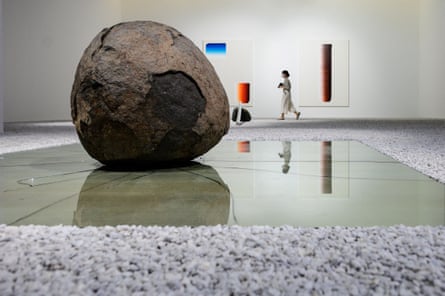
‘More about violence’ … the boulder and cracked glass.
‘More about violence’ … the boulder and cracked glass. Photograph: Philip Fong/AFP/Getty Images

The artist, who is respectfully referred to as “Mr Lee” by those around him, turns 90 next month. As well as having two museums dedicated to him, one in Naoshima and another in Arles, France, he is about to open two major shows. In Venice, to coincide with the Biennale, he has a retrospective covering his career from the late 1960s to the present. It will include early sculptures he made as part of the Mono-ha movement. Mono-ha, which roughly translates as School of Things, were interested in the way objects relate to one another in nature. They are often compared to the American land artists, post-minimalists and the Italian arte povera school, whose favourite materials were soil, rock and sand.

“I was in my early 30s,” Lee says. “At that time, in the late 60s, America, Europe, and Japan were in a period of rebellion.” His first 3D work – titled Phenomenon and Perception B but now, like his other sculptures, retitled Relatum – was a pane of glass that had been cracked by the weight of a boulder. It was a nod to Marcel Duchamp, an exploration of the clash between industry and nature. “In the beginning,” says Lee, “my work wasn’t about being slow or quiet. It was more about violence and resistance.”

Lee didn’t always use heavy objects: in one 1969 work, then called Things and Words, Lee chased three enormous sheets of paper being blown around a square in front of Tokyo Metropolitan Art Museum on a windy day. “I wanted to show how we have a dialogue with material,” Lee says. “Over time, the paper gets wrinkled and I become exhausted.” The work was named after Michel Foucault’s book Les Mots et les Choses, philosophy providing one of Lee’s primary inspirations. Did people understand what he was trying to do? “Maybe not.”
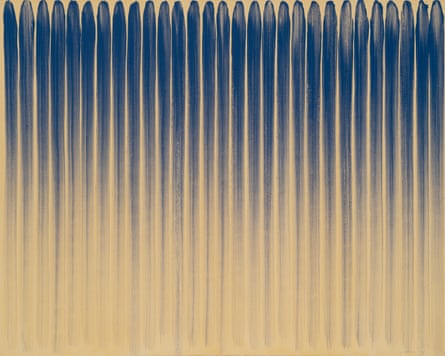
Meticulous … Ufan’s From Line, 1978.
Meticulous … From Line, 1978. Photograph: Bill Jacobson Studio/Photo: Bill Jacobson Studio, New York, courtesy Dia Art Foundation

The day before his Venice show opens, Dia Beacon in upstate New York will display eight works: three sculptures and five paintings, some from the 1970s series From Line, in which meticulously straight stripes are painted down or across the canvas, fading as the dark blue oil paint runs out. (Lee had to stop making these physically challenging works in the 1980s as his hand had started to tremble too much.) Others are from the 90s series With Winds, in which the lines swirl.

Eight works might not seem like much for an exhibition, but there are only 17 in the entire Lee Ufan Museum in Naoshima – and it’s forbidden to photograph the ones inside. Although he doesn’t regard himself as a minimalist, Lee stands against the idea of overproduction, in both art and in life, and is a master at paring things down. He once said: “I want viewers to perceive the things I did not paint as much as the things I did.”
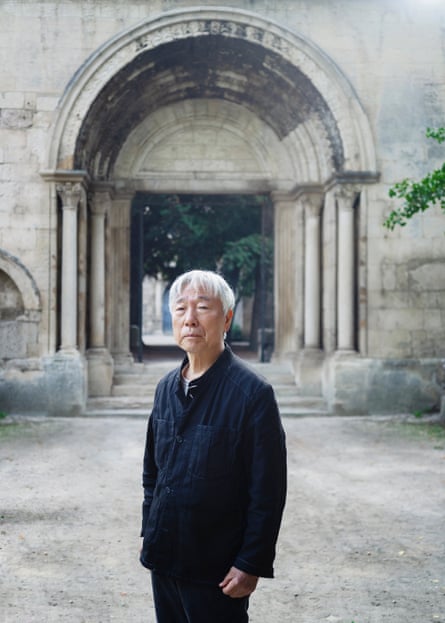
‘I want to know more. That keeps me young’ … Ufan, who turns 90 next month.
‘I want to know more. That keeps me young’ … Ufan, who turns 90 next month. Photograph: Claire Dorn/Studio Lee Ufan

At Naoshima, the visitor’s experience concludes in a room with a curved white ceiling and a pale wooden floor. Shoes must be removed, then you’re invited to sit down and contemplate three works painted directly on to the wall, part of Lee’s Dialogue series. Each features a lozenge of grey paint that goes from a paler to a darker shade. Although it looks like one simple brushstroke, it’s made up of many much smaller ones, built up over a week, with each layer allowed to dry before another is applied. It’s deeply calming to slow down and examine the way the grey line crumbles into the white paint underneath, sensing how meticulous human care has struck a balance with natural human imperfection. “My work is very powerful,” Lee says. “It’s not my power, but it’s a vibration that happens in the relationship with the person who views it.”

The following day, three other journalists and I take a train to Kamakura, an hour from Tokyo, then a bus to Lee’s studio. It takes slightly longer than anticipated, meaning we’re in danger of being a few minutes late. Lee’s studio manager starts running frantically up the hill and exhorts us to do the same. It’s unclear as to whether this is due to the general Japanese taboo around lateness, or because Mr Lee specifically hates it. But he greets us cheerfully as he emerges from the door into a gravel garden where more of his sculptures are placed – including curving pieces of rusted steel next to a boulder.

Lee is wearing jeans, black leather slippers and a rust-coloured quarter-zip knit under a grey cardigan. He looks nowhere near his great age. “I just work hard,” Lee says when I ask for the secret of his youthfulness. “I call myself a nomad – I travel a lot, visiting many other places and meeting many people. I still don’t understand the world and I want to know more. That probably gives me energy to stay young.”

He rises at 7am every day, walks for an hour, goes to buy fresh vegetables and has acupuncture. When he wants to start painting, he does breath exercises to get in the zone. “I always have 10 to 15 minutes of tuning my breath, then trying to achieve quietness, to calm down my body. In a way, I think I’m using the silence as a medium.”
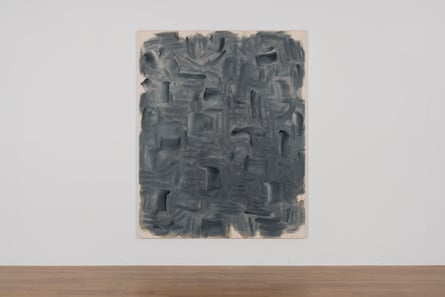
'My work always bridges to something’ … a painting from the With Winds series.
'My work always bridges to something’ … a painting from the With Winds series. Photograph: ToLoLo studio/© Lee Ufan / Artists Rights Society (ARS), New York/ADAGP, Paris

Before being interviewed, Lee sits everyone down with tea, served in cups and saucers that bear his unmistakeable brush stroke. The studio has brushes of every conceivable thickness to hand, and there are shelves full of books on artists including Richard Serra, Jasper Johns and the land art movement. Lee’s From Line paintings hang on the walls – and in the loo. I’m joined by an interpreter and one of the artist’s three daughters. Later, he ruefully suggests that he hasn’t always been the greatest husband and father. “I think my family had to make some sacrifices for my work,” he says. “I always talk about connecting to nature and through that, connecting to the art. But then I am, in a way, self-centred, so there’s an irony in that.”

Lee was born in Kyongsang-namdo, a mountain village in Korea in 1936, when the nation was occupied by the Japanese – an occupation that concluded when Japan was defeated in the second world war, although a brutal civil war followed, leading to the partitioning of the country. As a child, Lee excelled in poetry, art, calligraphy and music, studying the last at university in Seoul, keen to become a composer.

At 20, he was asked to take some medicine to an uncle who lived in Japan, and stayed to study philosophy at Nihon University in Tokyo. He began to make art that, he says, was severely criticised from the word go, so he became a critic, too: “I started to write as a way to defend myself.” After being astonished by a work called Phase: Mother Earth by Nobuo Sekine, which displayed an 8ft tall column of earth in Kobe’s Simu Rikyu Park next to the 8ft deep hole it had been dug from, he joined Mono-ha. As well as his art, he has written 17 books on philosophy, poetry and art history.

His international reputation grew, but in 1970 the organisers of a festival of Japanese art in New York barred him because he was born in Korea, showing the enduring enmity between the two countries. “I was a bit hurt,” Lee says. “But I felt I needed to seek out ways to communicate with people who have opposite positions.” Today he values his internationalist vantage point, unconfined by borders: a Korean in Japan, who speaks several languages and also has a home in Paris.

People may puzzle over the choice of his boulders, their careful placement on the ground, the enigmatic qualities of a large concrete pole displayed on a bed of pebbles at the entrance to his museum. Nonetheless, they have an undeniable impact, serving as conduits to deeper contemplation. Lee says his work expresses something about the relationships between the interior and the exterior, about the awareness of our bodies in nature, and of finding our essential selves amid so much noise. “My work always bridges to something,” he says. “Being open to connecting with others is so important.”