
惯性聚合 高效追踪和阅读你感兴趣的博客、新闻、科技资讯
阅读原文 在惯性聚合中打开

推荐订阅源

人人都是产品经理
人人都是产品经理
博客园_首页
IT之家
IT之家
让小产品的独立变现更简单 - ezindie.com
Vercel News
Vercel News
美团技术团队
D
Docker
WordPress大学
WordPress大学
T
Tailwind CSS Blog
酷 壳 – CoolShell
酷 壳 – CoolShell
The Cloudflare Blog
Y
Y Combinator Blog
F
Fortinet All Blogs
freeCodeCamp Programming Tutorials: Python, JavaScript, Git & More
G
Google Developers Blog
爱范儿
爱范儿
奇客Solidot–传递最新科技情报
奇客Solidot–传递最新科技情报
月光博客
月光博客
MongoDB | Blog
MongoDB | Blog
S
SegmentFault 最新的问题
GbyAI
GbyAI
Hugging Face - Blog
Hugging Face - Blog
Microsoft Azure Blog
A
About on SuperTechFans

The Guardian

Rory McIlroy surges into six-shot Masters lead with stunning second-round flourish ‘That’ll be the end’: actor Sam Neill joins fight to stop controversial goldmine near his New Zealand vineyard Roberto De Zerbi targets ‘Ange-ball’ revival to save Spurs from relegation Bath hit back to reach semi-final after stunning Northampton in 11-try epic Secret Garden to Outcome: the week in rave reviews Zebras, wealth and power: Hungary’s election tests Orbán’s grip on power ‘TikTok effect’ brings sellout crowds and younger fans to Grand National meeting The war over Omagh’s gold: the £21bn mine plan tearing a community apart Britain’s shadow workforce is paid as little as 65p an hour. Who cares for the carers? From You, Me & Tuscany to Euphoria: your complete entertainment guide to the week ahead Six great reads: the man who let snakes bite him, masked heavy metal and the brutal reality for foreign students in the UK American Classic review – I defy you not to fall in love with Kevin Kline and Laura Linney’s tender comedy Cuba’s doctors were a lifeline for the world. Now the Caribbean is shamefully complicit in the US drive to expel them An environmental disaster in Moldova has Russia’s fingerprints all over it RMIT drops misconduct case against student who accused university of being ‘complicit in Gaza genocide’ Ichiro Suzuki statue unveiling goes awry as bronze bat snaps during ceremony Survivors of Epstein’s abuse accuse Melania Trump of ‘shifting burden’ on to victims European football: Real Madrid held at home by Girona to extend winless run Arne Slot insists he is ‘aligned’ with Liverpool board and fans as squad is rebuilt Kamala Harris ‘thinking about’ running for president again in 2028 JD Vance warns Iran against trying to ‘play’ the US in peace talks West Ham double up twice to thrash Wolves and put Spurs in relegation zone Trump administration releases new renderings of so-called ‘Arc de Trump’ Crispin Odey drops £79m libel claim against FT over sexual misconduct allegations Bafta apologises for events surrounding John Davidson’s Tourette’s outburst Cocktail of the week: Bar Shrimp’s la rosita – recipe New drug may extend survival in aggressive ovarian cancer, trial shows One dead and 27 injured after bus with British passengers crashes in Canary Islands Pope adds to Smith’s mass of Surrey runs with England woes a world away OpenAI CEO Sam Altman’s home targeted with molotov cocktail
‘Magical’ objects from iron age hoard found in UK go on d...
Mark Brown N · 2026-05-14 · via The Guardian

Iron age objects that tell a dramatic story of female power and which dispel the myth that northern Britain was a left-behind backwater have gone on display for the first time.

The objects exhibited in York are from the Melsonby hoard, the largest trove of iron age metalwork ever found in the UK, which experts say could alter our understanding of life in Britain 2,000 years ago.

The hoard, which comprises more than 800 items, is almost certainly associated with a tribe called the Brigantes, who controlled most of what is now northern England and whose most famous leader was Queen Cartimandua.

There are fragments of chariots, bridle bits, weapons, a cauldron, a mysterious mirror and much more – all of them deliberately dismantled and burned before they were buried. It was a “crazy amount of effort and work”, said Yorkshire Museum’s senior curator, Glynn Davis.
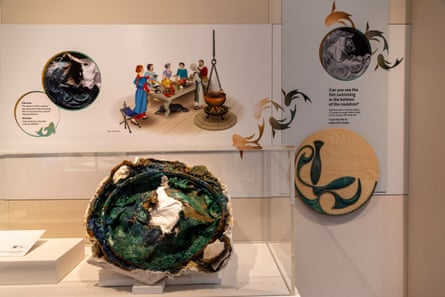
The cauldron in a display case at the museum
The cauldron found in the hoard, which comprises more than 800 objects. Photograph: Gary Calton/The Guardian

The hoard was acquired by the museum after it raised more than £265,000, including £192,000 from the National Heritage Memorial Fund.

It is, everyone associated with the hoard believes, an unprecedented, once-in-a-generation find. Five years after its initial discovery by a metal detectorist, the public will now be able to see what all the fuss is about.

The big question is why the objects were buried: was it to mark an important feast or festival? Did the Brigantes capture treasures after a fight? Was it for the funeral of one of their most important people?

The exhibition asks the questions rather than answering them, although its lead curator, Emily North, points to one rare object going on display – a large, heavily corroded iron mirror.

“The mirror is my absolute favourite object,” North said. “It is spectacular and that’s not because of how it looks, because it doesn’t look like an awful lot at the moment.

“It is the clue that could solve the puzzle of why people buried this hoard.”
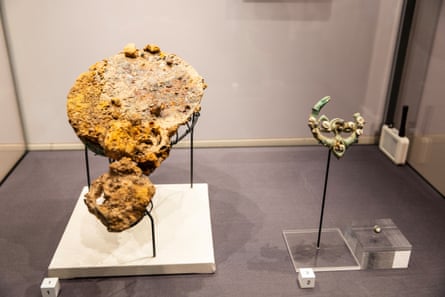
A rusted and corroded mirror on display at the museum
The mirror, left, could have belonged to Cartimandua’s mother or grandmother, said the exhibition’s lead curator, Emily North. Photograph: Gary Calton/The Guardian

Iron age mirrors are exclusively associated with powerful women and have not been found in the graves of men or children.

North said the timing was not quite right for it to have belonged to Cartimandua but that it could have belonged to her mother or grandmother.

“It is a magical object associated with female power,” she said. “This mirror would have given quite a distorted view of the person who was looking into it.”

North said the mirror was less likely to have been an object of vanity and more seen as a “bridge to a past life”. It suggests a story of a powerful older woman “and her connection to a mystical world”.

Just under a fifth of the hoard has gone on display, with more to come in future years.

At the centre of the show is a climate-controlled case containing what has become known as “the block” – a 150kg corroded tangle of objects.

Early on it became clear that to dismantle the block would permanently damage objects in it, curators said.
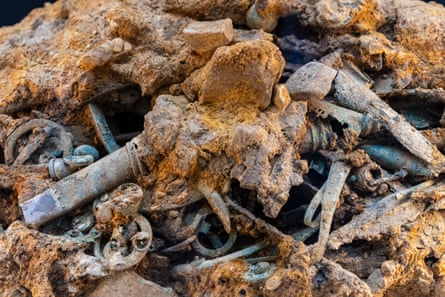
Closeup of 'the block'
Among the objects in ‘the block’ are a ‘stylised boar’s head that’s part of an object and also a man’s face’, North said. Photograph: Gary Calton/The Guardian

“It is an incredibly tantalising object,” said North. “You can peek through the surface at some of the things that are hidden inside. There’s a stylised boar’s head that’s part of an object and also a man’s face … To see the face of an iron age Briton as they depicted themselves is something very, very special.”

From Roman times onwards, iron age life in northern Britain has been seen as less developed and less connected than in the south, but experts say the Melsonby hoard means we need to rethink that.

“The sheer wealth, artistry, skill and international connections that are revealed by the objects in the hoard really show that the iron age north of Britain was a vibrant place to be,” said North. “It was not left behind in any sense of the word.”