





It was a fairytale ending to the World Athletics Relays in Gaborone. In the final strait, Collen Kebinatshipi surged past South Africa’s Zakithi Nene to win the men’s 4x400m relay for Botswana. The home crowd, a sea of light blue, went wild.
“It means so many things to us,” Letsile Tebogo, 22, the reigning 200m Olympic champion, who ran the second leg, told reporters afterwards. “Not just the team … but for the people that always cheer for us behind the TV. Now they had that experience to see first-hand how much effort, how much pressure, how much we give for them.”
In an interview after the championships, the World Athletics president, Sebastian Coe, said: “I put that atmosphere in the top three that I’ve experienced live in athletics. The first was Cathy Freeman winning in Sydney. The second was Mo Farah hitting the front with a lap or so to go in the 10,000 in London, when the wall of noise was deafening … [This] comfortably sits in the top three for me.”
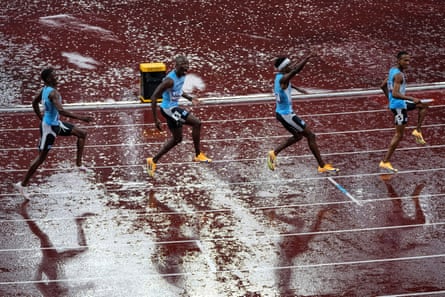
Botswana, a country larger by area than Spain with a population of just 2.5 million, has had a meteoric rise to the top of men’s sprinting. Tebogo’s Olympic gold in Paris in 2024 was the country’s first, and only its fourth medal of any colour. The men’s 4x400m relay team took silver, improving on bronze from three years earlier. Then, at the world championships in Tokyo last year, Kebinatshipi won the 400m while the relay team he anchored also took home gold.
The athletes are superstars in Botswana, their faces plastered on billboards advertising everything from mobile phone contracts to milk. “My life has changed a lot,” Kebinatshipi told a press conference before the relays.
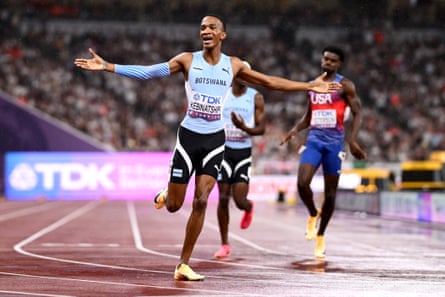
The 22-year-old, who started running at school, said he now allowed half an hour for photos with fans when he went out shopping. “At first I was a bit nervous, because I wasn’t used to it … Nowadays I’m used to it, so it’s cool with me,” he said.
Years-long investment in young athletes is one of the biggest reasons for the southern African country’s recent success, sports officials said. The Botswana Athletics Association’s chief executive, Mabua Mabua, said: “I must thank the school sports programmes that we used to have, because basically all of the athletes that you are seeing, the youthful ones, are coming from that programme.”
He also highlighted the country’s infrastructure. “All of the preparations for the team are done locally. Normally people say ‘no, they should go to Europe, USA, for preparations’. It’s local coaches, a local environment.”

The Botswana National Sports Commission runs programmes for 15 sports to spot and nurture talent. Re Ba Bona Ha, meaning “We See Them Here” in Setswana, is a coaching initiative for children aged five to 13 that was launched for football in 2002, with athletics added in 2008. Up to 300 children attend athletics sessions every year, said Frederick Kebadiretse, the BNSC’s sports development manager.
Then there are twice-yearly holiday camps to identify older students for eight centres of sports excellence, which were founded in 2011. The centres run weekday afternoon and weekend training sessions, with 30 to 40 students picked for athletics annually.
Sports officials warned that without the school sports programme, which was suspended in 2019 due to a dispute between the government and teachers, Botswana’s recent athletics success was at risk. “The pipeline is not there,” said Martin Mokgwathi, who chaired the world relays organising committee. “[Performance] will dip unless something is done very, very quickly.”
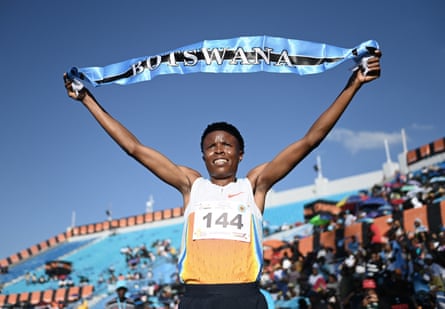
Botswana’s female athletes have not yet matched the men’s results. Oratile Nowe, the seventh fastest woman this year over 800m, is the current highest performer.
The officials admitted more needed to be done to support women and girls. “We need to widen the pipeline so we can get more and more young women to join,” Mokgwathi said. “The other thing, of course, is to encourage more and more women to become coaches and technical officials … And we need to protect young women coming into the sport, so that they stay.”
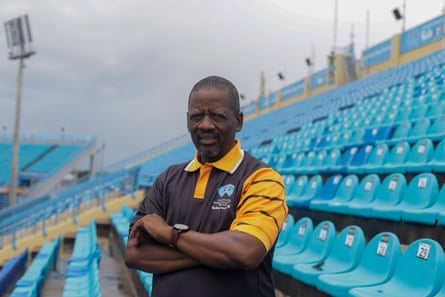
Isaac Makwala is trying to fill the pipelines. Makwala, whom numerous young athletes cite as an inspiration, was the first man to run 400m in under 44 seconds and 200m in under 20 seconds in the same day. The son of farmers from a village in northern Botswana, he started running at school, although he didn’t compete until he was 21.
After retiring in 2024, Makwala founded the Isaac Makwala Athletics Academy, putting about 50 12- to 16-year-olds through sprinting drills five afternoons a week. “I have a daughter here, she drives me to be a coach,” he said. “I want to see how well she will run after. Did she take her talent from me?”

Earlier this year his daughter, Resego Kelly Makwala, became Botswana’s under-18 girls champion in 400m, aged just 14. “I do really like it,” she said. “The times. When I make good times, PBs [personal bests].”
Makwala’s centre relies on motivated parents who can afford the 100 pula (£5.50) registration and 500 pula monthly fees. Tuduetso Gaboutloeloe, a tax collector, is one. “I want to be honest with you, the way the economy is bad, I want to see her going places, maybe getting a scholarship so she can progress very well,” she said. “Because right now, it’s a struggle.”
Her 13-year-old daughter, Leloba, who runs 800m and wants to try 400m too, dreams of Olympic success. “I do imagine myself winning medals,” she said.