


The US has launched Donald Trump’s operation to open a route through the strait of Hormuz for hundreds of ships trapped with their crews in the Gulf, in a move that brought the region back to the brink of full-scale war as Iran sought to reassert its blockade.
The US operation, which got under way on Monday after being announced as “Project Freedom” by Trump on Sunday night on his social media site, dramatically raised the stakes in a conflict that had been in a month-long period of uneasy limbo.
Speaking hours after the operation began, the head of US Central Command, (Centcom), Adm Brad Cooper, said that US forces had destroyed six Iranian small boats and intercepted both Iranian cruise missiles and drones. He “strongly advised” Iranian forces to remain clear of US military assets in the region, which include guided-missile destroyers, more than 100 land- and sea-based aircraft, drones and 15,000 troops.
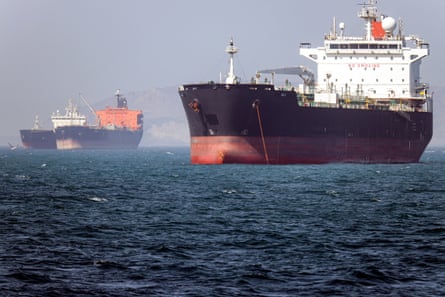
Iran swiftly denied the claim. On a day of successive claims and counter-claims, it also denied Centcom’s assertion that two US-flagged merchant vessels had “successfully transited” the strait, while US navy guided-missile destroyers had crossed in the opposite direction, travelling westwards, and had begun patrolling the Gulf. Late on Monday, the container shipping company Maersk said the Alliance Fairfax – a US-flagged vehicle carrier – exited the Gulf via the strait accompanied by US military assets.
Speaking at a press conference as the standoff became more volatile and dangerous, Trump downplayed tensions, saying Iran had “taken some shots” but had caused no harm apart from damage to a South Korean cargo vessel, which reported an unexplained explosion and fire.
“Other than the South Korean Ship, there has been, at this moment, no damage going through the Strait,” Trump said on his Truth Social platform as oil prices jumped over the renewed hostilities.
In an interview on Monday, however, the US president heightened fears of a fresh escalation. Trump told Fox News that Iran would be “blown off the face of the Earth” if it attacks US vessels carrying out Project Freedom, while also claiming that the regime had become “much more malleable” in peace negotiations.
Iran, where military central command had warned that any US naval vessel approaching the strait would be fired on, earlier claimed to have hit a US frigate in the area with two missiles.
Late on Sunday, after Trump’s announcement, a tanker reported having been hit by “unknown projectiles”. The United Arab Emirates (UAE) later said an oil tanker operated by the Abu Dhabi National Oil Company, the MV Barakah had come under Iranian drone attack off the coast of Oman. No one was injured, it said.
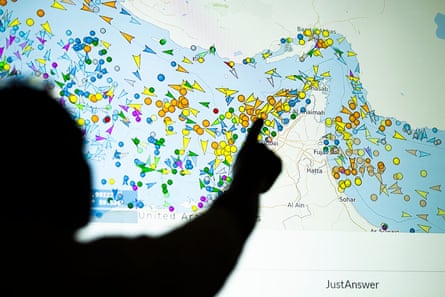
The UAE defence ministry said it had intercepted three missiles fired from Iran over its territorial waters, with a fourth one crashing into the sea.
More than 850 ships are estimated to have been trapped in the Gulf since the US and Israel launched their attack on Iran on 28 February. Iran imposed a blockade on foreign shipping using the strait of Hormuz soon afterwards and Trump imposed a counter-blockade of ships using Iranian ports on 13 April. A Pakistani-brokered ceasefire, announced by Trump in early April, stopped hostilities but failed to open the strait.
An estimated 20,000 sailors are stuck on the tankers, bulk carriers, container ships and other vessels, and there are growing concerns for their welfare. The operation launched by the US does not involve military escorts but aims to provide coordination and guidance for commercial shipping along a southern route through the strait, mostly through Omani territorial waters.
Shipping executives responded cautiously to the move, amid uncertainty over how or if it would work. Richard Hext, the chair of Vanmar Shipping and the Hong Kong Shipowners Association, pointed out that Iran had previously declared that unapproved transit of the strait would be considered a “violation of the ceasefire” agreed last month.
“Under these circumstances we should be cautious,” Hext told CNN.
International response was also circumspect. The French president, Emmanuel Macron, said the only way to reopen the strait of Hormuz was “a coordinated reopening by the United States and Iran”. Macron, speaking at a meeting of European leaders in Armenia, added: “We are not going to take part in any military operation in a framework that to me seems unclear.”
Announcing the project on Truth Social, Trump said the US had been approached by countries for help in getting their ships out of the strait, and that it would use its “best efforts” to do so. Giving no details on how this would be achieved, the president presented it as a humanitarian gesture “on behalf of the United States, Middle Eastern Countries but, in particular, the Country of Iran”.
“I have told my Representatives to inform them that we will use best efforts to get their Ships and Crews safely out of the Strait. In all cases, they said they will not be returning until the area becomes safe for navigation, and everything else,” Trump said.
He added: “If, in any way, this humanitarian process is interfered with, that interference will, unfortunately, have to be dealt with forcefully.”
On Monday morning, a US-led military organisation, the Joint Maritime Information Center (JMIC), said the US had established an “enhanced security area” south of the established prewar shipping lanes through the strait. The route would take ships through Omani territorial waters, the JMIC said, and owing to high anticipated traffic, ship operators were told to coordinate with Omani authorities by radio.
Ships were advised to avoid navigating in or close to the usual shipping lanes which “should be considered extremely hazardous due the presence of mines that have not been fully surveyed and mitigated”.
Iran’s military command insisted that ships passing must coordinate with them.
“We will manage the security of the strait of Hormuz with all might, and inform all commercial ships and tankers to refrain from any attempt to transit without the coordination of the Iranian armed forces stationed in the strait of Hormuz in order not to jeopardise their security,” Maj Gen Ali Abdollahi said, according to Mehr news agency.
Earlier, Abdollahi had said Iran would attack “any foreign armed force” that tried to approach or enter the strait, “especially, the aggressive US army”.