


The top diplomat from the Board of Peace has blamed Hamas for the stalled ceasefire, but critics have said the US-backed board’s lack of even-handedness in implementing the truce risks a return to war.
The “high representative for Gaza”, Nickolay Mladenov, told the UN security council on Thursday that Hamas was the “principal obstacle” to the ceasefire’s continued implementation because “it refused to accept verified decommissioning, relinquish coercive control and allow a genuine civilian transition”.

Hamas rejected the Bulgarian diplomat’s accusations. Its spokesman, Hazem Qassem, said the report “reflects continued adoption of the Israeli position and serves as an attempt to justify further Israeli escalation”.
Critics of the Board of Peace, launched by Donald Trump in January, said the Mladenov report gave a misleading and one-sided account of the ceasefire, in which Israel has been the main violator.
Israeli forces have continued to carry out airstrikes on Gaza. They have also moved forward from the ceasefire line agreed in October, increasing the area under direct Israeli control from the agreed 53% to at least 60%, and have regularly shot at Palestinians who came within a few hundred metres of the shifting line. More than 850 Palestinians have been killed since the ceasefire was declared in October.
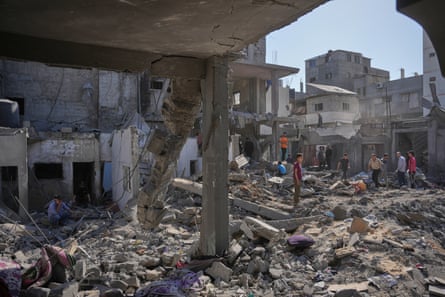
Israel has also fallen short of its obligation to allow in 600 trucks of humanitarian supplies a day, and has refused to relax restrictions on “dual-use” items, which have prevented aid agencies bringing in basic humanitarian supplies, such as water pipes, or heavy machinery to begin clearing rubble.
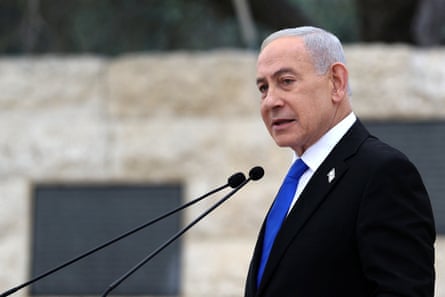
Israel was not directly criticised in Mladenov’s report, only by implication in references to “all parties”. Critics said that by putting the blame solely on Hamas, Mladenov’s report could lend legitimacy to Benjamin Netanyahu to return to war.
“Israel never fulfilled any of its obligations under phase one of the deal, so why would anyone trust they’d live up to phase two, especially once the weapons (Gaza’s only leverage) are gone?” said Muhammad Shehada, a visiting fellow at the Middle East programme at the European Council on Foreign Relations.
“If they say no, then Netanyahu is going to get a free hand in Gaza and basically be absolved of any obligations under the Trump deal and declare war whenever he wants.”

Successive versions of Mladenov’s roadmap were presented to Hamas and other Palestinian factions in March and then April. The April version proposed the creation of an “implementation verification committee” to oversee the disarmament of Hamas and other armed groups, while ensuring Israel took reciprocal steps.
The documents said inventory and collection of weapons would be “implemented gradually in phases”, with “heavy weapons” to be handed in within 90 days, though the definition of “heavy” included assault rifles. The April version of the roadmap said disarmament would be monitored by multilateral bodies, but it added that the “process will be under Palestinian leadership”.
Gershon Baskin, an Israeli analyst who has been involved in past back-channel negotiations with Palestinian groups, welcomed the roadmap, saying: “Israel and Hamas should agree to it and its implementation should begin immediately.”
However Baskin was critical of Mladenov’s characterisation of the stalemate, putting sole blame on Hamas. He said the militant group had “indicated its willingness to begin the process of disarmament and decommissioning of weapons”.
“Hamas’s demand is that it be done in parallel to the commitments that Israel has undertaken and has not fulfilled,” Baskin added.
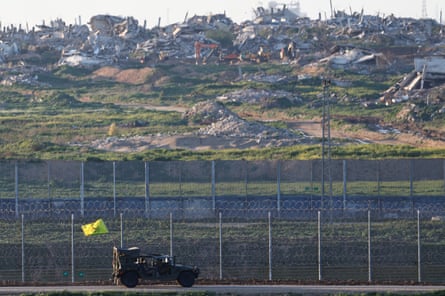
In his report to the UN, Mladenov accused Hamas of tightening its grip on the 40% of Gaza still under its control. However, Hamas has been calling since February for the National Committee for the Administration of Gaza (NCAG), a panel of 12 Palestinian technocrats created by the Board of Peace in January, to be allowed into the territory to begin the transfer of power.
“The Hamas guys inside Gaza are much more pragmatic,” Baskin said. “They don’t have money, they don’t have the resources, and the people in Gaza don’t want them. And they know that they can’t continue like this.”
Under Mladenov’s plan, the NCAG is supposed to oversee the disarmament of armed groups in Gaza, however Baskin said Israel had adamantly refused to allow the committee members to enter Gaza from Egypt, where they have become an administration in waiting.
“It is the Israeli insistence that NCAG not go in,” he said. “Americans have been told by the Israelis that if NCAG is allowed to go in, it will create a situation like Lebanon, where there will be an official government but the real power will be with the guys with guns in the streets.”
“I don’t think that’s the big problem,” Baskin added. “The big problem is that Israel wants to renew the war, and they’re creating the conditions where the Israeli public is being pumped every day, with the media telling them that Hamas is rebuilding itself, Hamas is gaining strength; that’s a really overblown exaggeration of reality.”
Daniel Levy, the British-Israeli head of the US/Middle East Project and former peace negotiator in earlier Israeli-Palestinian talks, said Hamas had not rejected disarmament and the transfer of power.
“It’s well established that they are ready to hand over governance. There’s never been a question about that,” Levy said. “But they’ve also talked in terms of non-rearmament, non-display of weapons, and [surrendering] heavy weapons. They’ve set out some of these things, but they are not going to wave a white flag of surrender.”
The limbo has left the Palestinians officials in the NCAG stuck in a hotel in Cairo. They have attended seminars on governance and state-building, and this week they flew to Brussels to meet EU officials, but they have been prevented from talking to the press.
Shehada said four NCAG members had threatened to resign.
“With the lack of progress in Gaza, they came to realise that they are a distraction to buy Israel more time,” he said, adding that the four members were persuaded to stay by Mladenov.
A source close to the NCAG said its members were aware their reputation for integrity was suffering among Palestinians by their association with the Board of Peace, but he said: “They also know there is no alternative. If there is any hope of stopping the killing in Gaza, this is the only game in town.”