


When Axel Willner went to Stockholm’s Funky Chicken food truck last February, he only expected to leave with a burger. While waiting, Willner – AKA the Field, artisan of looping minimal techno masterpieces – noticed another Axel standing two places behind him. This was unlikely enough given the unpopularity of the grandpa-ish name amid 40-something Swedish men. “I was like, oh, how will they call our burgers now?” says Willner.
Unlikelier still, not least given how out of the way the spot is, the Axel was fellow Scandi club music pioneer Axel Boman, co-founder of the joyous dance label Studio Barnhus. They got chatting during the long wait. “He asked if I had any music, what am I doing, because I had been silent for a very long time,” says Willner. He left with an invitation to send Boman some tracks, which eventually resulted in a new label deal and his first record since 2018, Now You Exist.
Willner’s absence had broken a run of immaculate albums released – almost – every two years, ever since the opulent, emotional, meticulously sampled rush of 2007’s From Here We Go Sublime made him an overnight sensation. He fine-tooled that ricocheting plushness across his six-LP catalogue, from bringing in a live band on 2011’s Looping State of Mind to a darker, sleeker refinement on 2013’s Cupid’s Head. His last record, the tender Infinite Moment, was intended to offer comfort during a hopeless time. By the time he finished touring it in late 2019, he was done with road life. “I realised it’s maybe not the best thing for me, because to be honest, I’m quite shy and I don’t like to be the centre of attention,” says Willner, 48. True to form, he declines to put his camera on as he talks from his home in Berlin, where he’s lived since 2008, and answers questions openly, but efficiently. “And I don’t really like to travel, and I realised quite directly that I’m in the wrong business.”
These days, Willner is in the culinary business: a lifelong food obsessive, he joined a friend’s company to become a kindergarten chef, making dishes like “tofu masala and frittata” for lucky little kids. After 14 years on the road, he needed a break, one that Covid soon universally imposed. He watched as some artists “got super inspired by this dystopian feeling, what’s going to happen with the world,” he says. His focus was on family, including homeschooling his adolescent son. Willner intended to get back to music and always knew that starting a new record was a challenge. But, he says, “when I finally picked up music again, I couldn’t do anything. Felt like the music had left me a bit and it was really hard to get that feeling back.”
As self-doubt tightened its grip, he started to give up. Not being able to make music – something that had brought him “some kind of escape, relief, pleasure” since he was a teenage punk – brought about an identity crisis. “Like, what am I?” says Willner. “And if I can’t do this and get any satisfaction out of it any more, what should I do?” Germany’s intense lockdown restrictions meant he couldn’t see family back in Stockholm (living much freer lives) for almost two years, which didn’t help.
Willner had always recorded at home; for 2016’s The Follower, he added modular synths to the studio in his Neukölln apartment. His creative block “tainted” the space. “It was very charged with anxiety,” he says. “Like, why do I come in here?” Having such a distinctive sound started to feel like a straitjacket: “I felt trapped in what the Field is.” He says openly that any new Field record is only ever tweaking the same basics, “but that was also gone and I couldn’t find anything. It felt like standing doing the same thing again, and also that it sucked.”
When music started coming again, there was no major breakthrough, beyond buying an MPC synthesiser. “That was really inspiring,” says Willner, as was Boman’s interest. He had already left Kompakt, the Cologne-based label that had released all six of his previous records: “I wanted to try something new.” Studio Barnhus had an appealingly relaxed vibe (its releases have the most playful artwork in the business), so Willner sent Boman two songs that had come together around 2019: the wide-eyed, puckish Hey Baby and 333 706, a song that seems to stutter like a human throat catching. “That’s quite an emotional tune for me,” he says.
They became the starting point for the five-track EP Now You Exist. The title alone seems to resound with a sense of awe and plainspoken relief. “Exactly that,” says Willner. “It’s as simple as: the EP exists, and also the music – and, indirectly, me as a musician.” There’s a sort of tentative ecstasy to the music, a delicate rejoicing. “Some tracks really have a sense of relief, and others suck you in,” says Willner. “It’s a feeling that is uncomfortable but also comforting in a way.”
The records Willner made for Kompakt all had uniform artwork: The Field and the album title hand-scrawled on a solid colour. The cover of Now You Exist features a distorted bloom, a squiggly explosion of pink from green. Willner calls it “new beginnings … it reminds me of a very welcoming forest on a sunny day.” Also new is Willner’s first ever use of a full a capella vocal line. (What stopped him before? “Copyright.”) “What shall I tell them when they ask me?” a female singer asks on the extremely blissed-out undulations of Another Day. He found it on Tracklib, “a crate-digging” subscription service offering legally cleared samples, and heard in it his feelings about his own stalled efforts and the ineffability of the creative process. “There was a lot of anxiety there,” he says. This song came halfway through the process of making the EP. “That feeling: what will people think of it?”
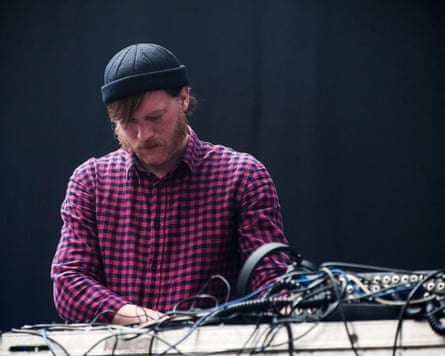
When Willner released From Here We Go Sublime in 2007, he was blindsided by its success: declared an album of the year by many, it was seen as a gamechanging release, bringing the ambience of Kompakt founder Wolfgang Voigt’s Gas project into a poppier framework. At the time, Willner was working in Systembolaget, the Swedish government-controlled alcohol retail chain, where he loved recommending food and drink pairings. “I couldn’t even imagine,” he says. “I just went along with it and thought, I’m gonna ride this wave as long as the wave is going. And that’s why I also didn’t really step back and feel like, maybe this is not the best thing for me.”
Willner is considering touring offers for Now You Exist, but he’s happily protected from being swept back under the wave by his cheffing job. “I can say no to things and I’m not so dependent on having to travel,” he says. “Don’t get me wrong, of course what I did before is a privilege. But it also tore me out a little bit, all the travel. And especially the state of the world right now, I don’t want to go too far away – I like to be close to home base. Not to become picky, but I said a lot of yes before and I’m still trying to learn how to say no. I have a bit more skin on my nose” – a Swedish idiom, skinn på näsan, meaning confidence and resilience built through experience.
Recently, Willner has loved watching his teenage son discover music and go through what he did at that age, “when music becomes really important to you”, even if he’s bemused by his Smiths fandom. Working with a Swedish label is another full-circle moment. “It’s like coming home,” he says. “Maybe it’s something that had been wanting for a while. But also, everything was just so random.” When Boman propositioned him in that burger queue, “I got quite psyched by the idea.” Willner likes to compare chance moments to “slipping on the banana peel”: food once again flinging him into the future.