





He was one of the greatest playwrights of the 20th century and she was one of the greatest actors. In newly unearthed recordings made over a period of nearly three decades, Arthur Miller opened up about his short-lived marriage to Marilyn Monroe, saying she wanted a husband who was a “father, lover, friend and agent,” and the child she longed for would have been an “additional problem”.
In taped conversations with his friend and biographer Prof Christopher Bigsby, Miller said he had felt “death was always on her [Monroe’s] shoulder – always”. He had believed that if he did not “take care of her life” she would come to a “catastrophic end”.
“One time I brought doctors to pump her out because she had swallowed enough stuff [drugs] to kill her,” he said. “So I felt she was in a very delicate psychological position. As it turned out, it took some years, but it happened. It was beyond my powers or anybody else’s to hold her back.”
Monroe’s death from a barbiturate overdose in 1962, at the age of 36, had seemed inevitable to him. “It was impossible for her to live, let alone with anybody. You couldn’t go on with that intensity of life, and those drugs, and manage to survive,” he said.
The couple began a passionate extramarital affair in 1955 and married in 1956. Miller said it took him just months to realise he had made a mistake. “I was not really prepared for what I should have been prepared for, which was that she had literally no inner resources … She wanted a father, a lover, friend, agent, above all someone who would never criticise her for anything, or else she would lose confidence in herself. I don’t know if that human being exists.”
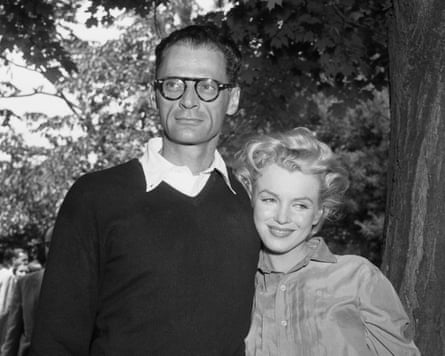
After Monroe had a miscarriage and an ectopic pregnancy, the couple sought medical help without success, the recordings reveal. Reflecting on their loss, Miller said he felt Monroe wanted to be a mother “in an ideal sort of way”, while working under “terrific pressure” in Hollywood: “In a way, I am not sure how good it would have been for her to have a child. It would have been an additional problem … I am not sure how it would have worked out in practice.”
He described Monroe as “delightful to be with” and “a very smart woman” who had “a terrific sense of humour, irony and generosity”, but said “a kind of paranoia” took over. “She began to suspect everybody of exploiting or damaging her.”
The couple became completely estranged while Monroe was starring in The Misfits, the film Miller wrote for her, in 1960. They started quarelling just months after their marriage, when Monroe was filming the Prince and the Showgirl: “We got into an argument about whether [the director, Laurence] Olivier was persecuting her … I found myself defending him, and that was the worst possible thing I could have done. But I don’t think any other course would have mattered either.”
By the time he left the set, their marriage was in effect over, he said. “We weren’t speaking. There was no way to approach her … She was genuinely hostile to me.”
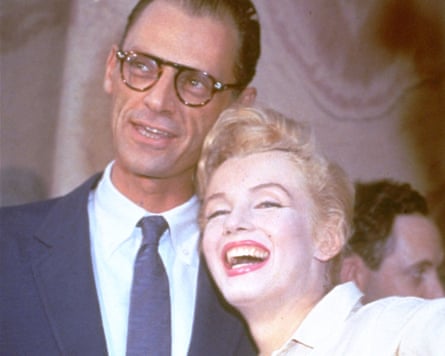
From a career perspective, he felt he had spent the four years of their marriage “doing nothing basically”, apart from The Misfits, and that even if Monroe’s feelings had changed, he would have ended the marriage then. “I couldn’t have gone on. It would have killed me. I couldn’t work anymore.”
The previously unpublished conversations were recorded over nearly 30 years, beginning soon after Miller met Bigsby in the mid-1970s and continuing until a few years before the Pulitzer prize-winning playwright’s death in 2005. They have come to light after Bigsby, now 84, transcribed them for a book, The Arthur Miller Tapes: A Life in His Own Words, published on Thursday by Cambridge University Press.
Miller also revealed how the unprecedented success of Death of a Salesman in 1949 – the first play in American theatre to win a Critics’ Circle award, a Tony and a Pulitzer – simultaneously empowered him and contributed to the breakdown of his first marriage to Mary Slattery. “My horizon suddenly opened up into all kinds of other ways of expressing my dominance. I felt I could do anything, and we kind of broke apart then, I think.”
He told Bigsby that fame “is a form of power which is sexual, or implicitly sexual”. He said he became “totally immersed” in his work, “all day and all night”. “Now that I look back at it, I don’t know how anybody could live with me at all.”
At the same time, throughout his life, he questioned his ability to write, he confessed. “My whole life has been a struggle with self-doubt.” Only a “minor percentage” of what he wrote had “ever seen the light of day,” he revealed.
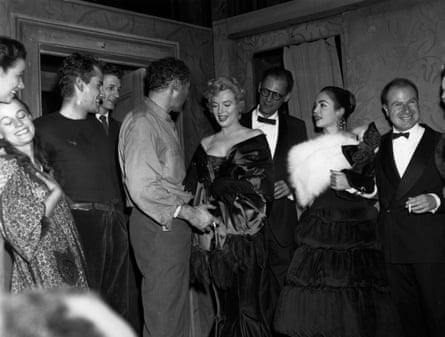
Miller also talked about his flirtation with communism and Hollywood’s suppression of his work after he refused to name communist writers before the House Un-American Activities Committee in 1956.
He said McCarthyism created “a kind of irrational sensation of overhanging fear that some unseen force had infiltrated society, that was busy boring holes in it, to bring it down. There was no rational way to confront all of this, because every time you did so you could be accused of being part of that conspiracy.”
He had feared he and other “dissident people” would end up “either in a lunatic asylum or in some kind of quasi-fascist system”, self-censoring themselves while “the most outrageously patriotic people would be running everything”. “That was one of the reasons I started to write The Crucible. I had to find a means to address [that],” he said.
He set the play during the Salem witch trials because “it was simply impossible to discuss what was happening to us in contemporary terms. There had to be some distance given to the phenomenon. We were all going slightly crazy trying to be honest, trying to see straight and trying to stay safe.”
Miller also talked in the tapes about his upbringing, his first sexual encounter in a brothel at the age of 16, his views on Zionism and antisemitism as an atheist Jew, his inspiration for The Misfits and many of his plays, the impact of the Holocaust on his work, and his 40-year marriage to his third wife, Inge Morath.
Bigsby, who is an emeritus professor of American studies at the University of East Anglia, thinks the ideas and experiences that shaped Miller’s life and career ensured his plays remain highly relevant today. “He talks about his Jewishness [as] a sensibility, a continuing concern with the fragility of society, which he learned from the Depression and learned again from the Holocaust, that we walk on very thin ice in our sense of civilisation,” he said. “All of this is fundamental to Miller. He’s a person who believes in the importance of history, in the connection between the past and the present, because that’s the basis of morality.”