


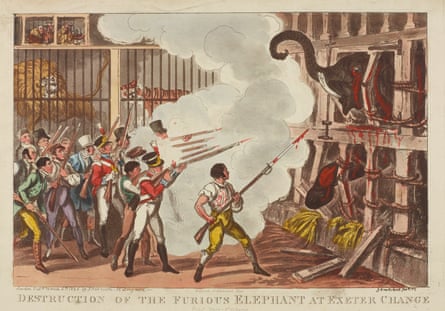
In the spring of 1826, two extraordinary things occurred in central London. The first was the death of Chunee the elephant. On 1 March at Cross’s Menagerie, upstairs in the Exeter ’Change on the Strand, Chunee was killed by a firing squad in the cramped enclosure where he’d been kept for the previous six years.
By this point Chunee was more than three metres (10ft) tall and weighed at least five tonnes. Like all adult male elephants, he periodically went into musth, when his body was flooded with testosterone, making him aggressive and uncontrollable. After Chunee injured one keeper (apparently deliberately) and accidentally killed another, the proprietor, Edward Cross, decided to have him destroyed.
Soldiers summoned from nearby Somerset House fired 152 musket balls into the elephant. Only wounded, he was reportedly finished off with a harpoon. The whole horror show was capped the next day by members of the public being charged a shilling to watch his body being butchered by students from the Royal College of Surgeons.
Then came the second extraordinary thing. On 29 April 1826, galvanised by public outrage at Chunee’s terrible fate, and after years of discussions among scientists and politicians about the need for an organisation to promote the proper scientific study and display of “members of the animal kingdom”, the Zoological Society of London (ZSL) was founded.
To celebrate its 200th birthday on Wednesday, ZSL is building on its founding principles by announcing a new £20m wildlife health centre at London zoo. As well as allowing public access to ZSL’s vets at work (already glimpsed in David Levene’s recent Guardian picture essay), the new centre will augment ZSL’s leading role in wildlife conservation. This is already the prime focus of its Institute of Zoology, its two zoos in London and Whipsnade with their 2.2 million visitors last year, and the 2,764 conservation projects it’s operated in more than 80 countries worldwide.
I know all this because I was a ZSL trustee for 30 years, though my attachment goes back a lot further. I joined the XYZ (Exceptional Young Zoologist) club when I was seven, beguiled and inspired not least by Desmond Morris’s Zoo Time. Aged 18, I became an associate member. Ten years later, I was elected a fellow. Thanks to my small role in a successful insurrection by ZSL’s members against the decision to close London zoo in 1991, I was promoted to the ZSL council. That crisis (one of several during ZSL’s 200-year history) had been precipitated by the huge backlog maintenance bill on the 13 iconic listed buildings at Regent’s Park.
The zoo didn’t close, but we also wanted to reinvigorate ZSL by refocusing its energies on conservation biology, to understand and preserve the fundamental interconnection between animals, people and ecosystems. We wanted it to take its rightful place in the vanguard of the worldwide struggle for wildlife conservation and, in line with the ambitions of its founders, to work to understand and protect the living beings with whom we share this planet, often so uneasily.
Whenever I’ve been asked: “But what does ZSL do?”, I’ve always answered: “Everything.” Primarily, it’s about all life on Earth.
But it’s also all about us; it’s about how and why we stare, gawping, into their faces and pretend it’s not a mirror.
It’s about the history of London, enshrined in ZSL’s name. In 1831, William IV transferred the royal menagerie from the Tower of London to London zoo. When the lion terraces were being redeveloped in the mid-2010s, it was said to be the first time there had been no lions living in London since the reign of King John. By ZSL’s calculations, about 5% of the wild population of Asiatic lions have been born on the site since 1991.
And it’s about how ZSL has permeated the wider culture, far beyond just coining the word “zoo”. My favourite fantasy quiz question is connecting Dracula to Withnail and I in one move. (The answer? The old wolf enclosure in London zoo’s south-east corner featured in both book and movie.)
ZSL has inspired artists from Edwin Landseer to Elisabeth Frink and writers from AA Milne and JK Rowling to Evelyn Waugh and Beatrix Potter. It brings together architectural styles from Decimus Burton’s Georgian neoclassicism to Berthold Lubetkin’s modernism to Hugh Casson’s brutalism. It has also commissioned poets from Louis MacNeice, who wrote a surreal zoo guide in 1938, to the current poet laureate, Simon Armitage, who recently published a 200th birthday poem, The Moon and the Zoo.
But most importantly, ZSL connects humans – more than half of us urban dwellers – back to other animals. Although I’m deeply sympathetic with arguments against the captivity of animals, I’ve also seen all the surviving representatives of an entire species of snail, saved from extinction in a plastic container in ZSL’s care. That species has now been reintroduced into the wild – one of ZSL’s many success stories in pushing back the consequences of human rapacity.
Our world is beset by cheap politicians raucously and cynically seeking to divide people. Whereas we urgently need to connect, in harmony and solidarity, with every other living thing, including each other. In hundreds of thousands of ways, that’s what ZSL has been doing for 200 years.
After London zoo’s new Tiger Territory opened in 2013, an education officer told me she’d overheard a year 3 pupil say to their teacher, looking up from the glass separating them from a Sumatran tiger, so close you could smell it: “But miss! You never told us they were real!”
For the record, a quarter of the global population of Sumatran tigers has been born as part of a global breeding programme managed by ZSL. Keeping it real.
-
Martin Rowson is a cartoonist and author