


惯性聚合 高效追踪和阅读你感兴趣的博客、新闻、科技资讯
阅读原文 在惯性聚合中打开

推荐订阅源

AI
AI
OSCHINA 社区最新新闻
OSCHINA 社区最新新闻
D
Docker
Last Week in AI
Last Week in AI
Apple Machine Learning Research
WordPress大学
WordPress大学
F
Full Disclosure
博客园 - 【当耐特】
博客园 - 司徒正美
V
Visual Studio Blog
F
Fortinet All Blogs
T
Tor Project blog
T
Threatpost
Blog — PlanetScale
Blog — PlanetScale
月光博客
月光博客
C
Cyber Attacks, Cyber Crime and Cyber Security
阮一峰的网络日志
阮一峰的网络日志
GbyAI
GbyAI
cs.CL updates on arXiv.org
T
Tenable Blog
M
MIT News - Artificial intelligence
L
Lohrmann on Cybersecurity
P
Palo Alto Networks Blog
I
Intezer
Stack Overflow Blog
Stack Overflow Blog
The Register - Security
The Last Watchdog
The Last Watchdog
S
Securelist
T
Tailwind CSS Blog
V
Vulnerabilities – Threatpost
U
Unit 42
博客园 - 叶小钗
P
Proofpoint News Feed
C
Cybersecurity and Infrastructure Security Agency CISA
H
Help Net Security
Cyber Security Advisories - MS-ISAC
酷 壳 – CoolShell
酷 壳 – CoolShell
Hacker News - Newest:
Hacker News - Newest: "LLM"
NISL@THU
NISL@THU
J
Java Code Geeks
H
Hackread – Cybersecurity News, Data Breaches, AI and More
SecWiki News
SecWiki News
www.infosecurity-magazine.com
Project Zero
Project Zero
T
The Exploit Database - CXSecurity.com
TaoSecurity Blog
TaoSecurity Blog
A
Arctic Wolf
Martin Fowler
Martin Fowler
T
Threat Research - Cisco Blogs
N
News | PayPal Newsroom

The Guardian

Rory McIlroy surges into six-shot Masters lead with stunning second-round flourish ‘That’ll be the end’: actor Sam Neill joins fight to stop controversial goldmine near his New Zealand vineyard Roberto De Zerbi targets ‘Ange-ball’ revival to save Spurs from relegation Bath hit back to reach semi-final after stunning Northampton in 11-try epic Secret Garden to Outcome: the week in rave reviews Zebras, wealth and power: Hungary’s election tests Orbán’s grip on power ‘TikTok effect’ brings sellout crowds and younger fans to Grand National meeting The war over Omagh’s gold: the £21bn mine plan tearing a community apart Britain’s shadow workforce is paid as little as 65p an hour. Who cares for the carers? From You, Me & Tuscany to Euphoria: your complete entertainment guide to the week ahead Six great reads: the man who let snakes bite him, masked heavy metal and the brutal reality for foreign students in the UK American Classic review – I defy you not to fall in love with Kevin Kline and Laura Linney’s tender comedy Cuba’s doctors were a lifeline for the world. Now the Caribbean is shamefully complicit in the US drive to expel them An environmental disaster in Moldova has Russia’s fingerprints all over it RMIT drops misconduct case against student who accused university of being ‘complicit in Gaza genocide’ Ichiro Suzuki statue unveiling goes awry as bronze bat snaps during ceremony Survivors of Epstein’s abuse accuse Melania Trump of ‘shifting burden’ on to victims European football: Real Madrid held at home by Girona to extend winless run Arne Slot insists he is ‘aligned’ with Liverpool board and fans as squad is rebuilt Kamala Harris ‘thinking about’ running for president again in 2028 JD Vance warns Iran against trying to ‘play’ the US in peace talks West Ham double up twice to thrash Wolves and put Spurs in relegation zone Trump administration releases new renderings of so-called ‘Arc de Trump’ Crispin Odey drops £79m libel claim against FT over sexual misconduct allegations Bafta apologises for events surrounding John Davidson’s Tourette’s outburst Cocktail of the week: Bar Shrimp’s la rosita – recipe New drug may extend survival in aggressive ovarian cancer, trial shows One dead and 27 injured after bus with British passengers crashes in Canary Islands Pope adds to Smith’s mass of Surrey runs with England woes a world away OpenAI CEO Sam Altman’s home targeted with molotov cocktail Reform UK local election candidate was twice disciplined by Tories over ‘racist comments’ Remaining in Nato is in best interests of US, says Keir Starmer Prince Harry sued for defamation by charity he co-founded Anthropic’s new AI tool has implications for us all – whether we can use it or not Concerns raised about motorbike tourist trail after death of British teenager in Vietnam The Guardian view on Trump’s civilisational threats: the words that fuel war must be condemned The Guardian view on dystopias for our times: the American nightmare Doctors’ leader claims new reduced pay offer killed chances of ending strikes in England Netanyahu-ism has achieved nothing for Israelis – and come at a monstrously high price Deborah Levy: ‘CS Lewis’s White Witch terrified me – but I wanted to meet her’ How I Shop with Michelle Ogundehin: ‘We grownups have enough stuff already’ Trump’s war and Melania’s Epstein statement, with US editor Betsy Reed – The Latest We have to stop killer motorists on Britain’s roads UK starts crackdown on EU citizens’ post-Brexit rights Londoners aren’t unfriendly – but don’t compare us to New Yorkers The religious right and the perversion of faith Artemis II images reignite moon mission memories Orbán and Magyar trade accusations in last days of Hungary election campaign Reckonwrong: How Long Has It Been? review | Safi Bugel's experimental album of the month Martin Rowson on Middle East peace talks – cartoon Masters magic, the Grand National and Premier League drama – follow with us Fears of UK and EU flight cancellations as airports warn of jet fuel shortages Reform’s petulance over slavery reparations shows it just doesn’t grasp Britain’s place in the modern world Peers vote to ban pornography depicting sex acts between stepfamily members Starbucks’s retail arm gets £13.7m tax credit even as sales increase Flyby review – interstellar musical is a voyage of epic strangeness Grand National preview: Jagwar can deny Irish cohort in Aintree classic Week in wildlife: an ostrich on the lam, a tortoise crossing a road and surfing seals Anger as swifts’ nesting holes in Derbyshire rail viaduct ‘blocked up’ Peter Mandelson faces fixed-penalty notice for urinating in public ‘There’s no shortage of terrifying technology’: how AI became TV drama’s new go-to villain ‘Fresher than anything in a shop’: the best recipe boxes and meal kits for time-poor foodies, tested Who was Hilma? Af Klint exhibition to highlight exclusion of women from abstract art Critics assemble! Here’s my list of the greatest superhero movies of all time US inflation soars in March as war on Iran drives economy into uncertainty Amazon to finally launch Leo satellite internet in ‘mid-2026’, says CEO Grand National 2026: horse-by-horse guide to all the runners Pete Hegseth’s holy war: the militant Christian theology animating the US attack on Iran Add to playlist: the beautifully dazed, countrified indie-rock of Tracey Nelson and the week’s best new tracks Not just about Gaza: the Muslim voters turning from Labour to the Greens ‘I’m worried there’s too much of me,’ says a birch: inside the interspecies council giving nature a voice Why is anyone surprised by the US and Israel’s latest war? It’s only what the world allowed them to do in Gaza Tori Amos review – fans hang on every note of this dramatic deep dive into her back catalogue Coachella 2026: Justin Bieber launches a major comeback in the desert Super Mario what?! The seven best obscure Mario games ‘An abomination’: the Lancashire town kicking up a stink over reopened landfill Pillion to Roofman: the seven best films to watch on TV this week Holly Humberstone: Cruel World review – Taylor Swift fave trades gothic melancholy for pop glow-up Thrash review – cursed shark thriller sinks like a stone on Netflix Gulf states rethink security in light of US-Israel war on Iran Go Gentle by Maria Semple review – a joyfully clever New York romcom Welcome to Y’all Street: bullish Dallas aims to steal New York’s financial crown Margo’s Got Money Troubles to Beef: the seven best shows to stream this week I baulked at the idea of ‘friction-maxxing’. But there’s more to it than meets the eye Reich: The Sextets album review – Colin Currie celebrates the minimalist master’s joy of six Benjamina Ebuehi’s sweet and salty chocolate chip cookies recipe Experience: my house was taken over by 70,000 bees Malcolm in the Middle: Life’s Still Unfair review – the TV magic they’ve created here is absolutely miraculous Lava bursts forth as Hawaii’s Kilauea volcano erupts Sonos review: Are these the best portable speakers that money can buy? I tested to find out Buy bread in the evening, hit the sales on a Tuesday: retail workers’ top tips to cut your shopping bill The best water flossers in the UK, tested for that dentist-clean feeling Where to start with: Muriel Spark You be the judge: should my girlfriend stop mixing gold and silver jewellery? The best carry-on luggage in the UK, tested on an assault course How games capture the awe and terror of cosmic isolation I never text back – and it’s ruining my relationships The pet I’ll never forget: Beau, the labrador who saved my life Life Is Strange: Reunion review – a decade-long story comes to an impassioned close Why is gaming becoming so expensive? The answer is found in AI
‘Living library’: inside the marine biobanks racing to protect ocean species from extinction
Stephanie Co · 2026-05-04 · via The Guardian

In the mudflats of Swan Bay, Victoria, royal spoonbills sweep their paddle-shaped bills through shallow water. Nearby, under the grass-covered roof of the Queenscliff marine research centre, a team of scientists from Deakin University are trying to bring the ecosystems those birds and many others rely on back from the brink.

Some of that involves associate professor Prue Francis’s beakers – filled with bubbling brown gunk – that are bathed in red light inside a fridge equipped with sensors, alarms and a backup generator.

The beakers contain golden kelp. The red light keeps them perpetually in an early algal life stage. “They won’t produce the next stage. They’ll just keep growing like grass,” Francis says. Another fridge, smaller and colder, contains trays of tiny vials of the same stuff, but dormant.
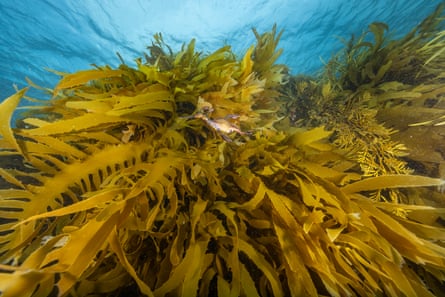
Leafy seadragon and golden kelp.
Leafy seadragon and golden kelp. Photograph: Stefan Andrews

These fridges are part of what the university calls its “living library”: a biobank, or long-term storage for at-risk marine life forms. Biobanks act as insurance policies against species extinction, and as research hubs for scientists studying species genetics, growth and resilience in the age of environmental crisis.

“Restoration has become quite an urgent need for not just our coastline but for coastlines all across Australia and the world,” Francis says.

“A lot of our research teams are looking at ways of being able to do restoration, or future-proofing some of our organisms that are getting lost at such a high rate.”

These facilities are becoming increasingly important.

Ear snips and tail tips

Deakin’s living library is one of an array of biobanks throughout Australia, which can store everything from seeds of native plants to the cells and tissue of threatened animal species.

The Australian National Botanic Gardens in Canberra collects seeds from the ACT region, the Australian Alps, Uluru, Kakadu and Norfolk, Christmas and Cocos islands. The seeds are harvested in the wild and stored in a -20C vault but can be grown into adult plants if needed.

Melbourne Museum has a more unusual collection: cryogenically frozen but still-living cells of Australian wildlife. In this biobank, tissue samples (such as ear snips from mammals or tail tips from reptiles), DNA and living cells are kept in 2ml tubes at -196C, a temperature at which all biological activity stops. There’s even the potential to store embryos from threatened species.
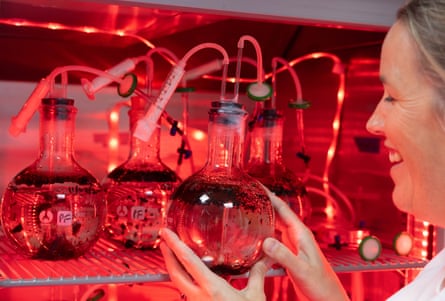
Prue Francis with the golden kelp biobank.
Prue Francis with the golden kelp biobank. Photograph: Ellen Smith/The Guardian

It was a crisis that triggered the establishment of biobanks for golden kelp, a foundation species of the 8,000km stretch of interconnected ecosystems that make up Australia’s Great Southern Reef. The kelp provides critical habitat and food for lobsters, abalone and numerous fish species, many of them found nowhere else on Earth.

But this kelp likes cold water, and it’s the first thing to die off when water warms up.

“There was a really intense marine heatwave off the coast of Western Australia a few years back and it wiped out a lot of the golden kelp,” Francis says. “And that was scientists’ call to action, seeing that huge decline, to start establishing biobanks around the different areas where this golden kelp is found.”

Francis was involved in a recent kelp restoration project in two marine sanctuaries in Port Phillip Bay – Jawbone and Ricketts Point – where golden kelp had been overgrazed by purple sea urchins.

“The first thing we did was to reduce the urchins in those areas to a density that we know that they can coexist with the kelp,” Francis says. “Then part of our work was to grow the kelp.”

Interactive

Golden kelp is an algae, so it doesn’t have a root system like a terrestrial plant. Instead, it has a holdfast: a growth anchoring it to a rock or other substrate. In the lab, that substrate was cotton twine or pieces of green gravel (“Gardening at its best!” Francis says) on which the kelp grew for six weeks before it was sent off with scuba divers to be “planted” in place back in 2022.

Just a couple of weeks ago, a project partner at the Nature Conservancy sent Francis photos of the restoration sites. “They just look absolutely fantastic,” Francis says. “Some of those kelp have gone beyond 30cm in length and are showing reproductive signs as well.”

‘Global challenge’

A distinctive briny smell lingers in the halls of the Queenscliff marine science centre, a product of up to 800,000 litres of seawater that’s pumped through the facility every day and split between the university’s labs and the Victorian Fisheries Authority and Shellfish Hatchery, which is also at the site.

The smell is particularly pronounced in a room full of open-topped bubbling tanks, where Dr Kathy Overton manages a small community of native flat oysters. These oysters used to form vast and complex reefs throughout the temperate areas of Australia, until destructive fishing practices all but wiped them out.
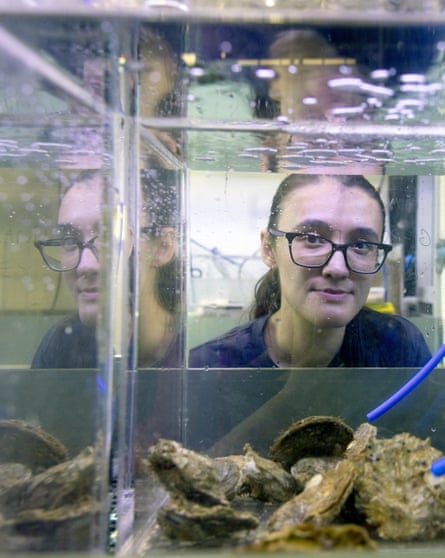
Kathy Overton with the flat oyster living library.
Kathy Overton with the flat oyster living library. Photograph: Ellen Smith/The Guardian

“Less than 1% of historical reefs remain,” Overton says. “They’re definitely one of the most imperilled marine ecosystems that we have here in Australia.”

Last year, Overton collected samples from remnant reefs in different parts of Victoria to fill in some research gaps on these oysters: to understand their genetic diversity and to see if she could get different genetic populations to reproduce. (Three populations out of four in the trial were successful.)

“Having these oysters here means that we can look for different experiments to better understand how we can restore them,” Overton says. “In the long term, it’d be really fantastic to be able to build on this.”

On the other side of the lab, marine ecologist Laney Callahan is running an experiment on seeds harvested from the only flowering marine plant, seagrass.

Seagrass meadows are favoured habitat for fish, crustaceans and other kinds of marine life, while processing carbon and nitrogen, trapping sediment and keeping the water clear. But as seagrass meadows often occur in estuaries and intertidal zones, they are heavily affected by human activity, including coastal development, agriculture runoff, dredging and changes in climate.
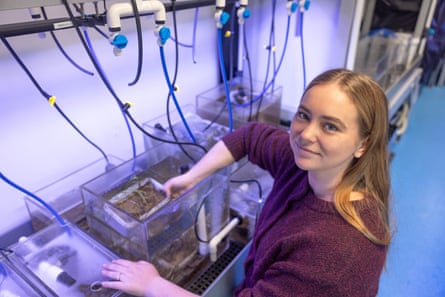
Marine ecologist Laney Callahan with the seagrass restoration project plants.
Marine ecologist Laney Callahan with the seagrass restoration project plants. Photograph: Ellen Smith/The Guardian

“Any time the ocean’s changing because of something that we’re doing, they’re vulnerable to that,” Callahan says.

Seagrass meadows declined substantially in Port Phillip Bay during the millennium drought and in Western Port Bay during large-scale industrialisation in the 70s and 80s. In the most degraded areas of Western Port, the water is full of sediment and the mud is waist-deep.

“That’s one of my dream sites to restore but it’s definitely the most difficult,” Callahan says.

Six months ago, she was out planting 300 sq metres of seagrass in Coronet Bay, a project that’s showing early positive results. But “the goal is to grow bigger. We really want to achieve larger scale restoration this year, hopefully”, Callahan says.

“It’s a global challenge at the moment, seagrass restoration.

“There’s a handful of successful projects that have achieved restoration at a scale that’s ecologically relevant, but very few. And that’s something that we’re all working towards together.”