








There is a disconnect between the proliferation of reports recommending we should be more active and actual levels of activity, that are scarcely budging. Sports councils, health bodies, charities and thinktanks are piling up the evidence that sport and physical activity help us live healthier, happier lives, improve academic attainment at school and productivity at work, connect our communities and help prevent crime and reoffending. Why can’t we turn this into reality?
Reports often call for better coordination, including the recent House of Commons inquiry Game On: Community and School Sport. But sport and physical activity remains poorly linked among schools, sports clubs, community organisations, parks and playgrounds. In an era of superintelligence and rockets flying around the moon, surely we could do better?
Structural change and innovation is needed. Mark Davies, an entrepreneur and former chair of British Rowing and Archery GB, has long advocated linking local schools and sports clubs, an idea flagged when Tracey Crouch was sports minister (2015-2018). Frustrated by inaction, Davies set up The Big Map to enable schools and clubs to connect, directly and link with funders to explore more entrepreneurial ways to make this happen.
Nationally it has been a struggle to integrate the agenda for sport and physical activity into health, education and community-building. Greater Manchester’s Moving Partnership is pioneering a different practical approach, connecting health, transport, urban design services and community groups rather than relying on individual willpower. Working to a 10-year strategy with strong political backing, they are constantly experimenting, learning and adapting to do what has never been done before.
Major change requires political will and a vision for sport that is not about whether the UK hosts the next Olympics or World Cup. That is lacking partly as a long-term consequence of our health, education and political systems. Education has prioritised individual academic subjects over a holistic view of how we learn, develop and thrive during our lifetimes.
PE has now become almost optional. The Youth Sport Trust advocates for better PE through its spotlight on the growing urgent needs of the Class of 2035. The recent Centre for Social Justice (CSJ) report, Inactive Nation, highlights the growing health crisis among primary school children and the need to place physical activity at the core of school life. The CSJ urges the national scaling of Bradford’s Creating Active Schools framework, that offers a glimpse of what is possible if schools think, lead and organise school life around movement.
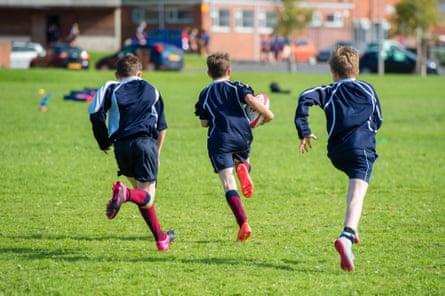
Over the long term, the health system has oriented our lives around medical treatment rather than holistic, preventative approaches that include movement and activity. Social prescribing is nibbling away at the problem, but is piecemeal. A national shift to prevention, rather than cure, requires a strong proactive approach in which sport and physical activity is made much more accessible.
One recent survey called out an important, uncomfortable truth: too many people had awful experiences of sport and PE lessons growing up. Age UK started a campaign to support older people to be more active, Act Now, Age Better, with a survey revealing more than 4m mid-lifers remain traumatised by memories of PE lessons. A similar number were put off physical activity for life by PE at school.
It is a devastating reminder that when it comes to the health of the nation, the impact of our schooling lasts far beyond exam results. If ever there was a powerful argument to radically reshape school PE, Age UK has made it.
That resonated with me. As a tall, uncoordinated teenager who could not run very fast, I was labelled unsporty at school and spent most PE lessons trying to hide en route to the school field. My father experienced similar in the 1950s.
It is only through serendipity that my fate changed at university when I unexpectedly tried rowing and with it a chance to experience sport differently. It gave me camaraderie, joy, a way to discover and learn with others and compete for fun. Decades later, I still feel supported in life by belonging to this community. Although it led to at elite level, that’s secondary.
Age UK’s campaign is an important reminder to everyone in sport that experience matters most. Too often there has been a focus on increasing participation, that people will feel better simply by taking part. Age UK’s survey reminds us that our experiences are what keep us involved – or put us off for life. Too many people have felt unwelcome, excluded and too quickly labelled unsporty because sport was not shaped around people, people had to shape themselves around sport.
We have lost sight of sport’s potential to be a core ingredient in living a good life. That it can be adapted to suit an individual’s needs, whether that is supporting a child to attend school regularly, thrive through their teens or older years, or choose a path away from crime. Fortunately, there is a distinct body of evidence for this.
Although it hardly figures in most sports coverage, let alone government policy, the unheralded sport for development sector understands how to use sport and physical activity to tackle wide-ranging social issues and holds the answer to thinking differently, measuring real life effects and transforming lives. Whether it’s the Alliance for Sport in Criminal Justice or Street Games, these experts know how to adapt sport and physical activity to meet complex social challenges, rather than win local leagues.
Shaping positive, meaningful experiences over the long-term that better meet some of the most serious social issues in society must form the central vision for the future of sport and physical activity.
-
Do you have an opinion on the issues raised in this article? If you would like to submit a response of up to 300 words by email to be considered for publication in our letters section, please click here.