


During Donald Trump’s first term, as his lies distorted reality and gaslighted Americans, Stephen Colbert said his goal was to remind his audience: “Hey, you’re not crazy.”
But watching political comedy during Trump’s second term – be it a deranged Saturday Night Live impression of a cabinet member, or a rapid-fire late-night monologue full of ICE jokes – it’s hard not to wonder: are we placating ourselves from the enormity of Trump-induced horror?
It’s not a new concern, of course. Weak mockery of Nazi leaders may have allowed Germans to “let off steam” while the regime solidified its power. Decades later, as The Daily Show was taking off, some pundits feared it encouraged apathy by rolling its eyes at the political sphere. As the US inches closer to autocracy, how can comedy work against repression, rather than sanitizing its targets – call it “clownwashing”?
“We are in a hyper-individualistic, transactional, consumerist kind of culture. So for us, entertainment is something to be consumed,” says the Los Angeles comedian and writer Jenny Yang, who is a former political organizer. “Sometimes it might spur you into action, but a lot of times it feels like a good laugh is a safety valve” – a way to release the discomfort. “There is a normalization when you take the buffoonery of something that’s actually really insidious and evil and package it into something funny.” But it doesn’t have to be that way. “The comedian’s and jester’s job is to say that the emperor has no clothes,” says Yang. “The power of humor and the biting joke is the ability to say, ‘No, this person is not as important or powerful as you think they are.’” If a joke can cut a ruler down to size, that can ease the path toward fighting back.
Perhaps that’s why Franklin Roosevelt reportedly encouraged Charlie Chaplin to make his Hitler parody The Great Dictator, released in 1940. Comedy “deflates the strongman’s image as invincible”, says Anat Shenker-Osorio, a political strategist and messaging consultant. And an authoritarian regime, she argues, depends on that image: it leaves the other pillars of society – big companies, law firms, universities – too scared to oppose it.
Comedy also draws power from its ability to reach people in ways that polemical speeches cannot. “Comedy is a way to get people to let their defenses down,” says the comedian and actor Sasheer Zamata, who recently hosted Brave of Us: How to Ridicule a Ruler, a comedy fundraiser in Los Angeles benefiting immigration organizations. The comedian Zainab Johnson agrees: “Comedians have the ability to penetrate people’s psyches, people’s hearts, their mind, their souls, because humor is disarming.”
Shenker-Osorio, who organized the Brave of Us event, says comedy creates a “persuasion window” – a rare opportunity to change someone’s mind. One of the most difficult elements of persuasion is getting people “to realize that an opinion that they’ve held could possibly be wrong” – whether it’s about washing the dishes or ICE. If you rail against Trump’s evils to your Maga uncle, he’s more likely to get defensive than to change his mind, she says. But comedy creates a permission structure that allows people to “feel safe being willing to reconsider their opinion, including being able to save face”, she says. “It’s very hard to both laugh and be inside of more calcified beliefs.”
Take, for instance, the costumes worn at anti-ICE protests. “When you see that picture of the inflatable frogs and the masked, armed, camouflaged ICE agents,” says Shenker-Osorio, “it’s a little hard to maintain the story that these are essential law-enforcing people who are dealing with a crime-laden hellscape.” Instead, it looks like “a place where people drink too much kombucha”.
Another way to reach those who may not agree with you, Zamata says, is by going personal. “The comedy I do usually comes from a personal place, and talking about my experience as a woman or a Black woman, and that inherently has become political,” she says. “Just kind of existing in this country and talking about my experience can be foreign to some people.” She recalls a Trump voter approaching her after a show and telling her he’d been blown away; he hadn’t known her work beforehand. “I didn’t feel like I was being talked down to,” she recalls him saying. “I got to learn in a safe space and not feel like I’m the enemy.”
Had she just “ripped Trump to shreds”, he might have had a different reaction. “I feel like that just shuts people off, like because no one wants to be told they’re wrong. I don’t think that’s the best method of getting people to change their mind.” Instead, her comedy often focuses on her own life and interests, which segue into the sociopolitical: a discussion of car eyelashes and truck nuts raises questions about gender in America; witnessing a creepy situation in Central Park leads to a reflection on criminal justice.
Context also matters; the Brave of Us event was a case in point. Interspersed between comedy sets were appeals for action: representatives from the non-profit Haitian Bridge Alliance, Comunidades Indígenas en Liderazgo and the National Day Laborer Organizing Network gave compelling accounts of their work, and Jane Fonda took the stage to warn of the growing threat to democracy. (“Comedians are the most important people when you have a dictator, because authoritarianism and humor can’t exist in the same room,” Fonda said, citing the historian Timothy Snyder’s phrase “tactical hilarity”.) This summer, Yang is planning a comedy tour at immigrant grocery stores. And while doomscrolling may not offer much hope, social media comedy can be potent.
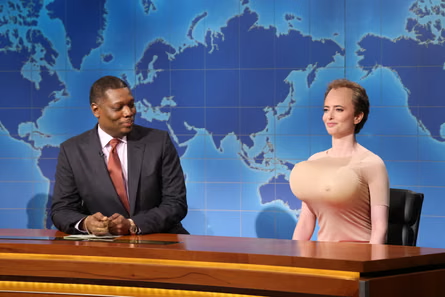
Cassie Willson’s videos use familiar social comedy formats – often two characters, both played by Willson, in earnest conversation or person-on-the-street interviews – to ridicule the billionaire class and systems that support it. In one clip, a billionaire offers advice: “You can’t afford groceries? Have you tried renting out your vacation home?” In another, she reflects on what she wishes she could tell her younger self: always wear sunscreen, and stop NBC’s The Apprentice before it rehabilitates the image of a failing businessman, with catastrophic consequences.
“I think that if I can point out some of the ridiculous things that are happening in our government, in our economy, in our culture, and make my audience laugh, then it can make them feel like, OK, there’s space for me in this,” Willson says.
Another model comes from Iran, where another oppressive regime appears to be beating Trump at his own social media game. Using AI-generated Lego figures and faked images of Trump himself, Iranian accounts are posting clips that portray the US president as inept and self-obsessed – and have far more bite than the president’s own posts of himself pouring feces on a crowd or dressed as the pope.
Of course, comedy works in both political directions; just look at the comics who helped lift Trump to victory in 2024, from Joe Rogan to Tony Hinchcliffe, who performed at Trump’s Madison Square Garden rally that October. At Trump’s victory celebration, his ally Dana White, CEO of UFC, thanked the comedian Theo Von and hailed the “mighty and powerful” Rogan, both of whom endorsed the now president. Trump “also might be one of those people who, on the low, wishes he was a comedian himself”, Johnson says. His rallies can feel like standup routines, whether he’s dressed as a garbage collector or mocking Joe Biden. “I would argue that Trump has been very effective at using his star power for evil ends,” says Yang.
Even humor that’s well intentioned can do more harm than good, as the British comedian Stewart Lee pointed out in a recent appearance on Pod Save the UK. “Personality-driven satire” – mocking the prime minister’s voice, for instance – “is a sideshow to what’s happening. It’s a useful distraction, if anything,” he said. It gives the impression of flexing the right to free speech – without having an impact. “Instead of having a funny voice for Keir Starmer, it needs to be about Palantir and it needs to be about Amazon,” he said. “It needs to be about Jeff Bezos. It needs to be about Elon Musk” – tackling the systems in place and the people who uphold them.
Rudolph Herzog, author of Dead Funny: Telling Jokes in Hitler’s Germany, has come to a similar conclusion. Jokes can distract us, be “mistaken for real resistance” or serve to simply reassure people things are OK. Still, he wrote in Foreign Policy: “Satire and comedy can help stop the slippage toward totalitarianism – but only as long as they ruthlessly target policies, not just the vanity or quirks of the mighty.”
In 2024, rightwing comedians’ elevation of Trump was arguably much more influential than late-night hosts’ jibes. And yet Trump’s own actions suggest he’s deeply threatened by liberal humor. His administration approved the Paramount-Skydance merger shortly after Paramount canceled Colbert’s Late Show; his FCC chair, Brendan Carr, put pressure on media companies to suspend Jimmy Kimmel. As Yang says: “He is threatened by anyone who can garner attention and love, and that’s entertainers and comedians.”