






By mid-morning on Thursday, word had spread on WhatsApp groups and social media accounts that Keir Starmer would be visiting the headquarters of the Jewish-led Hatzola ambulance service in Golders Green, north London. The organisation’s members had only been informed that a senior cabinet minister was on their way after the stabbings of two Jewish men in the area on Wednesday, so the gathering crowd was a puzzle to those inside. “I didn’t even tell my children,” said one.
The protesters knew. By the time the prime minister arrived at midday there were about 200 people gathered to make their feelings heard, many holding up freshly printed posters bearing the words: “Keir Starmer Jew harmer”. They had been distributed by a direct action group opposed to the continuation of the pro-Palestinian marches, called Stop the Hate.
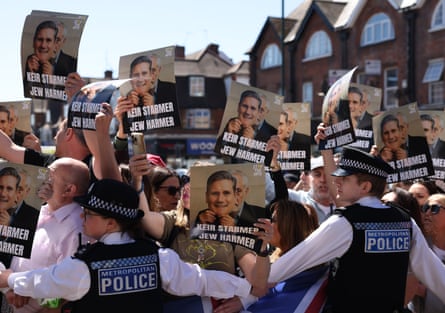
The prime ministerial convoy was greeted by a cascade of boos, jeers and chants as it swept past the security gates at the front of the building. “Keir Starmer is a joker,” screamed some. “Starmer, Jew harmer,” bellowed a man with a loud hailer. “You are a disgrace,” screeched a woman as the prime minister stepped out of his car to meet his hosts. “I feel betrayed by Starmer,” said Moshe, 20, a shop worker, of his motivation for being among the protesters.
He was further irritated by Starmer’s decision not to visit the scene of the attack but instead to attend a closed meeting at the Hatzola building a 15-minute walk away. “If he wanted to show support, that is what he should have done,” he said. Downing Street would not comment on the reasons for the prime minister’s limited visit.
It is understood the clamour from the street could be heard inside Hatzola’s headquarters as Starmer offered words of thanks to volunteers at the ambulance service and Shomrim, a community security group, one of whose members had helped police tackle the assailant on Wednesday.
The stabbing of two Jewish men in Golders Green, declared a terrorist incident by the Met police, has been met by loud demands for action; reassuring words are said to be insufficient in light of the concerted terror campaign against the UK’s Jewish community.
For the last 48 hours, politicians have been straining to convince the country that they get it. The Conservative leader, Kemi Badenoch, visited the scene on the day of the attack, describing antisemitism as a “national emergency”. In Golders Green, it was asked: why had Starmer not come?
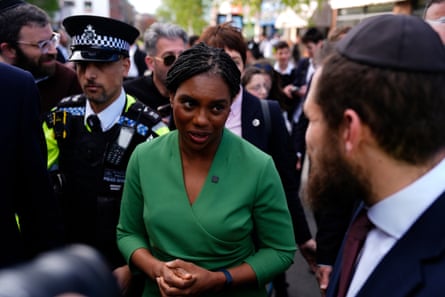
Indeed, the first person to arrive in north London on Thursday, in time to lead the lunchtime news, was not the prime minister but the man who the polls suggest is favourite to replace him should the Labour party not remove him first.
Nigel Farage was talking to everyone. He was interviewed in front of a memorial wall dedicated to protesters killed in a crackdown in Iran in January. The wall had been the target of an attempted arson attack earlier in the week. He was chatting to broadcasters as he walked down Golders Green Road to where the stabbings took place.
Further interviews took place in a kosher cafe, and others followed on the street, including one with GB News during which he offered an “exclusive line”.
He had heard just the previous night that Iranian operatives – “terrorists” – had been among those arriving on the small boats across the Channel in recent weeks. “I do have a source within the Iranian-Persian diaspora who is one of the best-connected human beings in the world that I know,” Farage said with evident satisfaction.
It was not a large crowd that gathered around the Reform leader, who was wearing his customary double breasted suit, but it was certainly a supportive one. His message when speaking in front of the memorial wall was that he would proscribe the Islamic Revolutionary Guard Corps, something the prime minister had said he would do but that he doubted would happen.
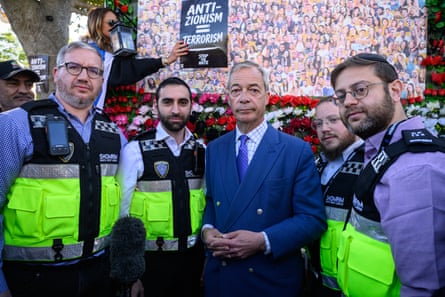
Farage said he would ban the Muslim Brotherhood and, to loud approval, he told the crowd that he would throw some cash towards Shomrim. “I just met the boys from Shomrim who were first on the ground and clearly they are going to need a lot more help and support, and a little bit of central funding wouldn’t go amiss,” he said. Farage brushed off questions about allegations of his own schoolboy antisemitism and racism. “Well, when I was a child, so come on … It’s nonsense,” he said.
The government, he said, had been “weak, weak” on the pro-Palestinian marches in London. “The time has come for firm resolve for government action, to publicly say what the difference [is] between what is right and what is wrong, regardless of the electoral consequence in one or two big inner cities in this country,” Farage said.
Peter Ettedgui, a Bafta-winning director who claims to have been targeted by Farage with antisemitic abuse when they were at school, said: ‘The idea that the guy who used to hiss ‘gas them’ at me and tell me that ‘Hitler was right’ is now putting himself forward as the protector of the Jewish community is grotesque and frightening.”
With the polls opening for the local elections in seven days’ time, Farage said: “Without being party political, I am delighted to be here with some of our local candidates standing in the election.”
Gedale Weinberg, one of those Reform candidates, said Farage would have stayed longer in Golders Green but had become nervous of the large crowds and the lack of security. “I did not see one police officer around at all, and we were with him with his entourage,” Weinberg said. “We were his security … he was an open target.”
It was, though, a largely supportive audience facing him. “I think Farage has some good ideas,” said Jake Dayan, 29, a real estate developer. “He’s always been tougher on immigration. And I think immigration is a good starting point for dealing with a lot of problems we have in this country.
“So I appreciate him showing up … I don’t see him as an antisemitic politician in the slightest. In fact, I think anyone who wants to take a tough stance on immigration is doing the most for the Jewish community.”
Ben Grossnass, 40, who works in furniture sales and is a volunteer member of Shomrim, met Farage and Starmer on Thursday. He had been informed of the Reform leader’s visit that morning, and had joined him at the memorial wall to speak to the media and local people. Had he agreed with Farage’s analysis? “Very much so and we expressed that with the prime minister this afternoon,” he said.
It had been a civil meeting with Starmer, Grossnass said, but the prime minister had been left in little doubt of the seriousness of the situation. Holocaust survivors were leaving the country out of fear of attack, the prime minister was told, and there had to be action about the “hate marches” in central London.
The anger outside the building was understandable, added Grossnass. “There was a mad man looking to kill anyone visibly Jewish,” he said. “How could people stay quiet?”
What was the prime minister’s message? “He promised change,” said Grossnass.