







Many Labour MPs believe Keir Starmer will not survive as Labour leader for long enough to fight the next election. What they cannot agree on, however – even after a disastrous set of results in this week’s elections – is how his departure might come about.
The Labour rulebook makes it notoriously difficult to unseat a party leader: none has been formally ejected in the postwar period, though some, including Tony Blair, have resigned under pressure from their own MPs.
A curveball was thrown into the mix on Saturday when the backbencher Catherine West launched a leadership challenge.
West, the MP for Hornsey and Friern Barnet and a junior Foreign Office minister until she was sacked in the reshuffle last year, announced that unless a cabinet minister came forward to challenge Starmer for the leadership by Monday morning, she would do it herself.
If the Labour party does want to oust Starmer, here are some of the ways it can do so.
1. The 81 MPs rule
According to the Labour party rulebook, someone seeking to replace a sitting leader must secure the written support of 20% of the parliamentary party, which is currently 81 MPs. Anyone who garners that many nominations can be put forward for a leadership contest, with the sitting leader qualifying automatically should they wish to remain in post.
There is no evidence that West has those numbers and she is being described as a stalking horse, a figure used to test the waters or mount a challenge on behalf of a third party.
Starmer has promised to stand again if a contest is forced, meaning the challenger or challengers would have to take on the prime minister directly. Labour MPs would then vote on who should lead the party and be prime minister.
This is the main reason why replacing a Labour leader is much more difficult than replacing a Conservative one. Tory party rules mean MPs can express their lack of confidence in a prime minister anonymously, and do not have to rally around an alternative to force a contest.
Allies of the Greater Manchester mayor, Andy Burnham, the health secretary, Wes Streeting, and the former deputy prime minister Angela Rayner all claim their candidate has the necessary support to force a vote.
But it may be that MPs who pledge their support in whispered conversations in Westminster corridors are more reluctant to put their names to a public challenge.
2. Public pressure
There are various ways in which Labour figures can exert enough public pressure to persuade a leader to stand down. The most obvious is for ministers to quit en masse, as happened to Boris Johnson in 2022, when the resignation of 30 ministers made running a government all but impossible.
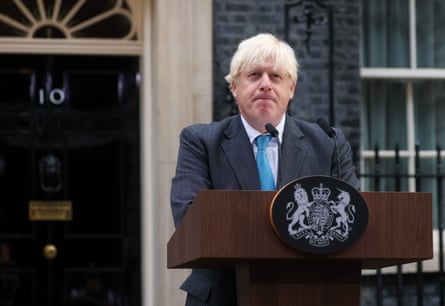
Boris Johnson delivers a speech outside 10 Downing Street before officially resigning on 6 September 2022. Photograph: Bloomberg/Getty When Anas Sarwar, the leader of the Scottish Labour party, called for Starmer to be replaced earlier this year, the prime minister’s allies thought cabinet ministers might follow. Only once they had secured public messages of support from every one of them did they feel the prime minister’s position was completely safe.
If regional Labour leaders all decided to call on the prime minister to resign, that would have a less direct impact but would also make it difficult to stay in post. So far, Sarwar is the only one to have done so.
3. The men and women in grey suits
Rather than stage a public display of disloyalty, senior Labour MPs may choose private persuasion to try to get Starmer to go.
Politicians such as the former Tory leader Iain Duncan Smith and the Liberal Democrat Charles Kennedy have been quietly ousted in such a manner. It would allow Starmer to keep his dignity and resign on his own terms.
However, given that the prime minister has said he intends to stay in post come what may, it may require someone very close to him to apply the necessary pressure, backed up with the threat of multiple resignations.
4. A vote of confidence
Labour ministers trying to oust Jeremy Corbyn in 2016 found him a stubborn opponent. After half his shadow cabinet resigned in protest against his leadership following the Brexit referendum, Corbyn replaced them and carried on.
As a result, two Labour MPs then called a parliamentary vote of no confidence in Corbyn. The rebels won the vote 172-40 but still he fought on, refusing to resign.
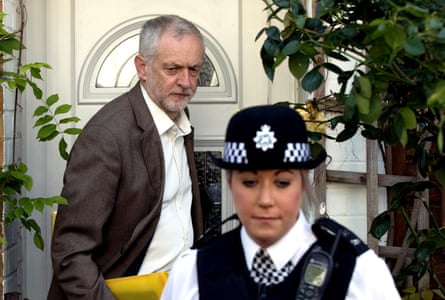
Jeremy Corbyn faced a vote of no confidence in June 2016 but fought on, refusing to resign. Photograph: Carl Court/Getty In the end, a leadership contest was held after Corbyn’s challenger, Owen Smith, gained the requisite number of signatures. But the sitting leader was allowed to fight the contest automatically and ended up winning.
For Starmer’s rivals, there is a lesson here. A parliamentary vote of no confidence is easier to call than a formal leadership election, and if the sitting leader loses they come under huge pressure to resign.
But given the fact that such a vote has no binding power, Starmer could choose to do what his predecessor did and cling on.