




It’s an odd, ungainly, unforgettable portrait. Anna McNeill Whistler’s face is rigid, lightless and cold as she poses for her son. She’s like a carving from a medieval tomb sutured to an aesthete’s dream. Starbursts of silver dance on the curtain in front of her while she sits as grim as death. Yet by painting her in silhouette, absorbing her black dress into his personal vision, Whistler turns her into a symbol of art for art’s sake.
At least that’s one way of seeing the masterpiece lent by the Musée d’Orsay that stars in Tate Britain’s luscious, seductive blockbuster dedicated to the American painter who delighted and scandalised late Victorian Britain. He competed with Walter Pater and Oscar Wilde for leadership of the Aesthetic Movement which dared to say that art has no responsibility to depict real life or serve a moral purpose. The cosmic curtain and carefully composed pattern of Whistler’s Mother add up to the movement’s earliest manifesto: to ram the point home, he called it Arrangement in Grey and Black No 1. Even when I’m painting my mum, says Whistler, I “arrange” her.
Yet in this insightful show you see that, like Hitchcock’s Norman Bates, he himself is partly Mother. The abstract vision of the life beautiful and Anna McNeill Whistler’s bony reality are two sides of Whistler himself. Part of him wants to paint beauty for beauty’s sake while the other is a hard-bitten observer, suspicious of the very glitz he creates.
At the far end of the gallery from his mother hangs his raw 1860s masterpiece Wapping. The surface of the Thames glistens yellow and brown between a crowd of steamers and sailing boats in what was then the world’s most cosmopolitan port: the lurid colours of the water look lovely until you realise they’re probably caused by a scum of faeces, piss and god knows what else. In the foreground a woman and two men chat freely on the terrace of a dockside bar: Whistler’s model and lover Joanna Hiffernan leans back sensually.
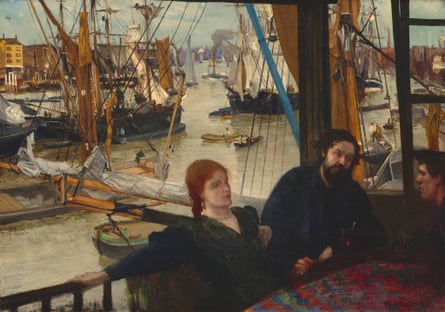
It’s a louche, staggeringly honest evocation of modern city life. The only other artists who painted like this in 1860 were French. Whistler had recently spent time in Paris among the avant garde and imitated the rugged style of Courbet. But reality was becoming more complex. As industrial capitalism melted the past, Manet led the way in painting the flowing, alienated coolness of modern bars, cafes, boudoirs. In Wapping, Whistler brings a Manet-like eye to London. He also records the realities of the East End docks in black-lined etchings. Seafarers share stories at a Rotherhithe pub in front of a row of tall masts; longshoremen brood in silence over their drinks.
Then, in 1865, Whistler suddenly paints the sea as if it was a piece of silk decorated with white lace and a ribbon. Green and Grey, Channel is a stunning declaration of artistic independence. He takes the sea, the element humans can’t control, the roaring theme of Turner’s visions, and makes it a painterly plaything. It is all totally, explicitly artificial and brilliantly arrogant: where other artists might look at the sea with awe, Whistler regards it as much less real than himself, arranging it just as he arranges his mother.
This big show follows Whistler in this insistently subjective quest to arrange the world. It includes a reconstruction of The Peacock Room, the notoriously extravagant installation he made out of his patron Frederick Leyland’s dining room, ignoring Leyland’s wishes. At the heart of the simulation hangs the original cartoon for his depiction of himself and Leyland as fighting peacocks, jousting in mutual vainglory.
Was Whistler the first absolute modernist? His completely free celebrations of colour and pattern anticipate Klimt and Pollock. You can see here why he drew the very first public attack on abstract art when the veteran critic John Ruskin accused him of merely “flinging a pot of paint in the public’s face”.
Ruskin was enraged by his paintings of fireworks over the Thames by night, even though they are accurate depictions: fireworks in the dark are so spaceless and mysterious that they do look abstract. In Nocturne: Black and Gold – The Fire Wheel, Whistler captures a spinning galaxy of blazing yellow in a black void flecked with red sparks.
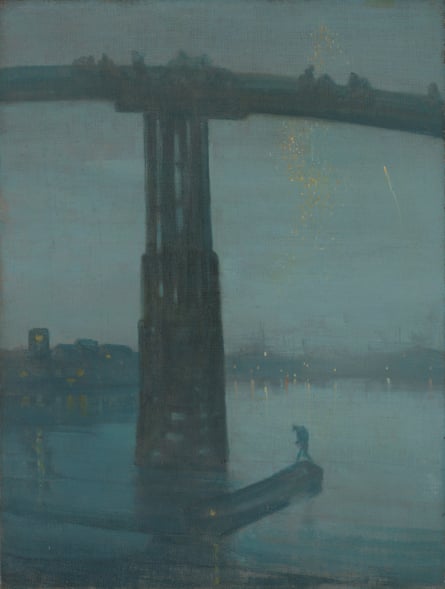
That same hovering between fact and fantasia makes his c 1872-5 work Nocturne: Blue and Gold – Old Battersea Bridge one of the most haunting pictures of London. Tiny flashes of gold fireworks hang in the twilight behind the support and gentle curve of the wooden structure, which could be a bridge in old Edo in a Hiroshige print. The Japanese prints and porcelain he collected reveal where Whistler got his ideal of an art that’s both abstract and accurate.
Yet you can’t just put on a kimono and escape your own skin. Whistler was his mother’s son. In Symphony in White, No 2: The Little White Girl, Hiffernan poses beside a mantlepiece, holding a Japanese fan, gazing at a lustrous blue and white vase. Whistler captures the plays of light, glistening surfaces and luxuriance, yet the coup de grace is brutal: her face in the mirror is tired, lost, melancholic. All this beauty is a bore. She knows it and so does Whistler.