







When Assimi Goïta, the leader of Mali’s military junta, sat down with the Russian president, Vladimir Putin, in the Kremlin last summer, it symbolised Moscow’s commanding sway over Mali at the expense of the west.
As the two men spoke, roughly 3,500 miles to the south, about 2,000 Russian troops were propping up the regime in the landlocked desert country, as part of Moscow’s broader push for influence across the Sahel region.
But in the last few days, a wave of coordinated, surprise attacks by jihadist militants and a separatist group has exposed the limits of Moscow’s reach and military might in the impoverished west African state.
Over the weekend, rebel fighters launched one of their most effective assaults in years against the Russian-backed authorities. Fighting continued into Monday, with the full picture still unclear.
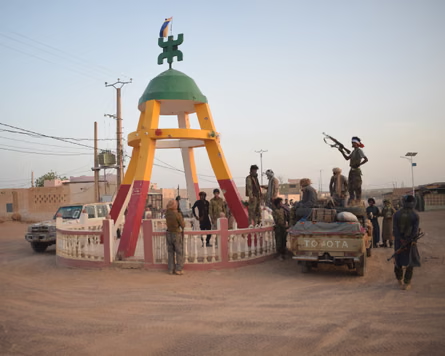
The rebels have so far achieved at least one major victory. Russia’s Africa Corps, the successor to the Wagner group, said on Monday it had pulled out of Kidal, a strategically important northern town.
“This crisis is definitely affecting the credibility of Russia’s interventions in the region,” said Ibrahim Yahaya Ibrahim of the International Crisis Group thinktank.
Mali’s eastern neighbours, Burkina Faso and Niger, expelled French and American forces following coups in 2022 and 2023 respectively.
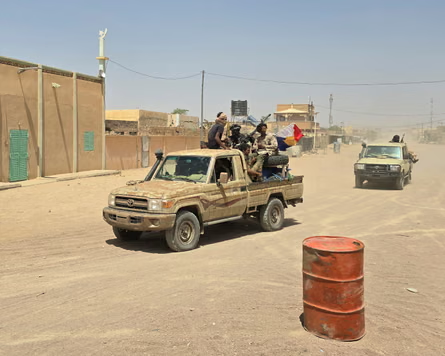
They, too, turned to Moscow, with the three countries forming a Russian-backed bloc across the heart of the Sahel.
But it is in Mali that Russia’s presence runs deepest.
“Questions will be raised now over whether the Russians can provide the kind of solution that African nations facing insurgencies are looking for,” Ibrahim said.
The Africa Corps has acknowledged some casualties in the fighting, saying it had evacuated its wounded and heavy equipment.
Military bloggers close to the defence ministry, meanwhile, said a Russian helicopter had been shot down near the city of Gao, killing those on board.
The losses also extend to the highest levels of the Malian government.
The junta confirmed late on Sunday that Sadio Camara, Mali’s defence minister and a key architect of the partnership with Russia, died of wounds sustained in a suicide attack on his residence.
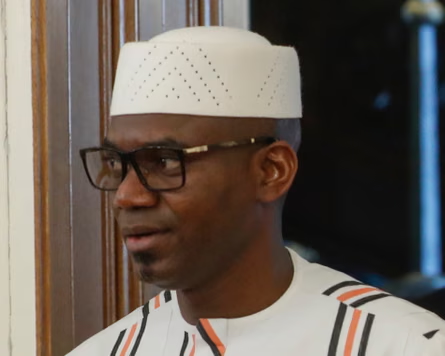
When Mali’s military seized power in 2021, Camara was the driving force behind the country’s quick shift in alliances, Ibrahim said.
The junta expelled France – which had maintained troops in the country since its 2013 intervention against Tuareg and Islamist militants – and turned to Russia as its primary political and military backer.
Since then, Moscow has sought to replicate in Mali a model it has used elsewhere in Africa, offering security support and political backing in return for access to plentiful resources.
The junta initially turned to the Wagner group, the notorious paramilitary network backed by Russia and led by the late Yevgeny Prigozhin. Around 1,000 mercenaries arrived in late 2021 and helped secure a series of battlefield gains.
In November 2023, Wagner-backed Malian forces retook Kidal, a Tuareg stronghold that had been in rebel hands for more than a decade.
But Wagner’s fortunes shifted after Prigozhin’s failed march on Moscow and his murky death in a plane crash two months later, as the Kremlin moved to bring his mercenary empire to heel.
Wagner was wound down, and its fighters in Mali were absorbed into the Africa Corps, a new structure under the direct command of Russia’s defence ministry.
The restructured Russian force has struggled to match Wagner’s military effectiveness and political reach, analysts and former members say, with its most capable forces either fighting in Ukraine or killed there.
The Africa Corps first ran into serious trouble in the summer of 2024, when up to 50 Russian soldiers were ambushed and killed by rebels in Mali – thought to be the deadliest single incident for Russia on the continent.
“Africa Corps is nowhere near as good at its work as its predecessor,” said Marat Gabidullin, a former Wagner commander who remains in contact with members of the new formation.
“Morale is low, commanders are often not qualified, and the soldiers are poorly trained.”
The loss of Kidal now marks a sharp reversal of Russia’s fortunes in Mali.
Ibrahim said: “Losing Kidal after first recapturing it is a major symbolic setback for the Russians.”
But, he added, without Russian backing, the junta’s losses would likely have been far heavier.
“It would have been much more catastrophic for the military regime if the Russians were not stationed in the big cities,” he said.
Moscow has so far struck a cautious tone.
The foreign ministry issued a brief statement condemning the attacks but offered little detail on Russia’s role in the fighting.
But state media and pro-Kremlin Telegram channels were quick to emphasise Moscow’s involvement, crediting Russian forces with helping to hold the rebels at bay.
Kommersant, a well-connected Russian newspaper, wrote: “Largely thanks to the fighters of the Russian armed forces’ Africa Corps stationed in Mali, most of the attacks were repelled.”