

惯性聚合 高效追踪和阅读你感兴趣的博客、新闻、科技资讯
阅读原文 在惯性聚合中打开

推荐订阅源

博客园 - 三生石上(FineUI控件)
Blog — PlanetScale
Blog — PlanetScale
B
Blog
GbyAI
GbyAI
爱范儿
爱范儿
月光博客
月光博客
N
Netflix TechBlog - Medium
T
Tailwind CSS Blog
G
Google Developers Blog
大猫的无限游戏
大猫的无限游戏
Vercel News
Vercel News
H
Hackread – Cybersecurity News, Data Breaches, AI and More
WordPress大学
WordPress大学
The GitHub Blog
The GitHub Blog
Recent Announcements
腾讯CDC
MyScale Blog
MyScale Blog
V
Visual Studio Blog
The Cloudflare Blog
Microsoft Security Blog
A
About on SuperTechFans
Google DeepMind News
Last Week in AI
Last Week in AI
OSCHINA 社区最新新闻
OSCHINA 社区最新新闻

The Guardian

Rory McIlroy surges into six-shot Masters lead with stunning second-round flourish ‘That’ll be the end’: actor Sam Neill joins fight to stop controversial goldmine near his New Zealand vineyard Roberto De Zerbi targets ‘Ange-ball’ revival to save Spurs from relegation Bath hit back to reach semi-final after stunning Northampton in 11-try epic Secret Garden to Outcome: the week in rave reviews Zebras, wealth and power: Hungary’s election tests Orbán’s grip on power ‘TikTok effect’ brings sellout crowds and younger fans to Grand National meeting The war over Omagh’s gold: the £21bn mine plan tearing a community apart Britain’s shadow workforce is paid as little as 65p an hour. Who cares for the carers? From You, Me & Tuscany to Euphoria: your complete entertainment guide to the week ahead Six great reads: the man who let snakes bite him, masked heavy metal and the brutal reality for foreign students in the UK American Classic review – I defy you not to fall in love with Kevin Kline and Laura Linney’s tender comedy Cuba’s doctors were a lifeline for the world. Now the Caribbean is shamefully complicit in the US drive to expel them An environmental disaster in Moldova has Russia’s fingerprints all over it RMIT drops misconduct case against student who accused university of being ‘complicit in Gaza genocide’ Ichiro Suzuki statue unveiling goes awry as bronze bat snaps during ceremony Survivors of Epstein’s abuse accuse Melania Trump of ‘shifting burden’ on to victims European football: Real Madrid held at home by Girona to extend winless run Arne Slot insists he is ‘aligned’ with Liverpool board and fans as squad is rebuilt Kamala Harris ‘thinking about’ running for president again in 2028 JD Vance warns Iran against trying to ‘play’ the US in peace talks West Ham double up twice to thrash Wolves and put Spurs in relegation zone Trump administration releases new renderings of so-called ‘Arc de Trump’ Crispin Odey drops £79m libel claim against FT over sexual misconduct allegations Bafta apologises for events surrounding John Davidson’s Tourette’s outburst Cocktail of the week: Bar Shrimp’s la rosita – recipe New drug may extend survival in aggressive ovarian cancer, trial shows One dead and 27 injured after bus with British passengers crashes in Canary Islands Pope adds to Smith’s mass of Surrey runs with England woes a world away OpenAI CEO Sam Altman’s home targeted with molotov cocktail
Robbins’ account raises questions over whether he was mis...
Paul Lewis, · 2026-04-21 · via The Guardian

An account of Peter Mandelson’s vetting process given by the former top civil servant Sir Olly Robbins has raised new questions about whether Robbins was misled about the findings of the agency responsible for vetting.

Robbins, who was sacked from his role of permanent secretary at the Foreign Office last week after revelations in the Guardian, gave testimony about the process to a select committee.

Robbins told MPs that he did not see the vetting file produced by United Kingdom Security Vetting (UKSV), which he described as existing in a “hermetically sealed box”.

However, he said he was briefed on the risks it highlighted at a meeting on 29 January 2025 with a top Foreign Office security official. That was the day after UKSV had submitted its recommendation.

According to Robbins, he was briefed that UKSV considered Mandelson “a borderline case”, and vetting officials were “leaning towards recommending that clearance be denied”. Robbins said he was told the case was not clearcut, and UKSV had indicated the Foreign Office “may wish to grant” Mandelson clearance with mitigations put in place.

But he was repeatedly questioned by MPs on the committee about the UKSV vetting file – a template of which was released on Friday.
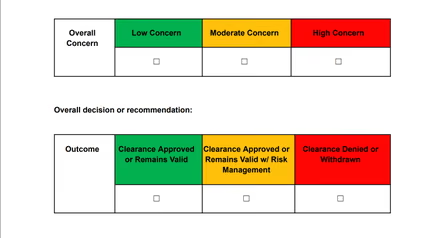
Document lists three rankings for possible ‘overall concern’: low, medium and high. In the next box, there is a space for a vetting office to list the outcome of the assessment with their ‘overall decision or recommendation’. Again, there are three options: clearance approved, clearance approved ‘with risk management’, or clearance denied
A template page from the summary document produced by UKSV after Mandelson’s vetting. Illustration: No Credit

They said they understood the vetting file document clearly showed that UKSV’s advice was that Mandelson should be denied clearance as there was high concern, with ticks beside two key red boxes on the form.

The document in question lists three rankings for possible “overall concern”: low, medium and high, colour-coded in green, yellow and red, respectively. In the next box, there is a space for a vetting officer to list the outcome of the assessment with their “overall decision or recommendation”.

Again, there are three colour-coded options: clearance approved, clearance approved “with risk management”, and – in a red box – clearance denied. MPs on the committee said they understood that Mandelson had received two ticks beside red boxes.

Responding to questions from the Tory MP John Whittingdale, Robbins said he did not recall the briefing he received being “that definitive”.

In a letter he submitted to the committee before giving evidence, Robbins said he was told in an “oral briefing” that “UKSV considered Mandelson a ‘borderline’ case, leaning towards recommending that clearance be denied”.

Mandelson vetting row: Starmer v Robbins blame game deepens - The Latest

In the hearing, he reiterated his position that UKSV was “leaning against” granting Mandelson clearance. But he said that “the way in which it was described to me” was that UKSV and Foreign Office officials had “debated some of the assessments UKSV had made” which had “shifted up and down” before he was briefed. And he in effect conceded that he nonetheless took the decision to grant Mandelson clearance without even seeing the UKSV file.

Robbins suggested that the file was a highly confidential document. He said that the usual process was not to reveal its contents to officials, except in “wholly exceptional circumstances”.

He said his team consulted the Cabinet Office and was told that Robbins “required a national security justification” to see the UKSV file and he did not pursue the matter further.