





When we hear the beautiful call of a bird from a high bough, we’re told it’s likely to be a male – singing for territory, or belting out tunes to woo a female. But as the annual dawn chorus reaches a crescendo this spring, a new guidebook is urging us to think again – and turn our ears to the hidden world of female birdsong.
The songs, sounds and sights of female birds have historically been overlooked in field guides and sound archives. In 2016, just 0.01% of the bird sounds in the global Xeno-Canto sound library were labelled female. Another sound archive was just 0.03% female, according to a 2018 study.
But the new book – The Sound Approach to Birding 2 – aims to correct this under-representation and properly explain female birdsong. Female birds sing for territorial displays, to ward off other females and to attract extra males, according to Lucy McRobert, a writer and researcher who studied the issue for the guidebook.
The book comes with its own library of 300 sounds from 200 species, accessed via web or app. The clips are drawn from the larger online archive of Sound Approach, a birdsong project founded in 2000 with confirmed recordings of females for 41% of species found in the Western Palearctic, a biogeographical region encompassing Europe, north Africa and most of the Middle East.
“We’ve got a completely false narrative around female bird sounds and female birdsong,” McRobert said. “The common narrative is that males sing to compete for territory and female attention. Actually, the situation is far more complicated than that. Female birds do sing. Many species have female song repertoires and you can separate some males and females by song.”
Male European ornithologists were not simply sexist, they exported their assumptions about male birdsong around the world based on the fact that male song predominates among the songbirds of the Western Palearctic. In fact, globally, up to 70% of female bird species sing. Among many tropical birds, females sing just as vividly as males – in duets for pair bonding, to ward off other females or to support territorial defence. Just like males, females may also sing to advertise their availability.

Mark Constantine, the author of the new book and a co-founder of Lush cosmetics, said: “Everything we believe about our birdsong isn’t true. I love the fact that Donald Duck is actually a female – he quacks like a female. Most people don’t realise that the female mallards quack and the males don’t.”
Constantine was inspired to take a closer look at female bird sounds by Jasmine Donahaye, the author of Birdsplaining, which highlights the sexism of field guides from the 1950s to the 1980s. In the illustrations of the guides she grew up with, Donahaye noticed how the male birds were drawn in an “upright, bold, declarative” position while the females were often depicted in the background, half-obscured by the male, and “bent over, submissive and demure”.
“Female birds are always described in these field guides in relation to the description of male birds. She’s always ‘paler’ or ‘duller’ – some kind of negation of him,” she said. “Sometimes it doesn’t even specify that the female is bigger.”
Constantine asked McRobert to “Donahaye” the new book to ensure female bird sound was fully considered. They had some surprising revelations.
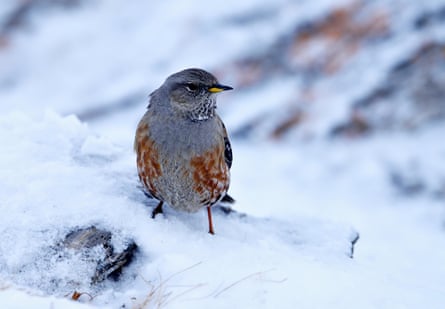
Alpine accentor females sing an irresistible song when alone, and swiftly attract male company – and copulation. Older females who lay the biggest clutches of eggs are the ones with the more elaborate songs. Female song in this species can be identified by prominent rattling sounds strung out in a row.
The tawny owl’s “tu-whit” call is often considered to be female, answered by the male’s returning “to-who”. In fact, according to the Sound Approach team, male and female tawny owls can make either call.
Constantine and his sound recordists believe the “tu-whit, to-who” popularised by Shakespeare was actually the playwright’s putting into words the call of a long-eared owl, which much more closely matches Shakespeare in their sound recordings. In reality, tawny owls sound much more like “ker-wick” followed by a quavering “woooo”.
Although there are few documented cases of female garden songbirds such as thrushes singing, female robins sing for certain periods during winter. Constantine’s sound recordists proved this by ringing female birds and then watching and recording them sing, although Constantine admits they haven’t yet been able to identify distinguishing features of female robin song.
As well as singing, Constantine argues that female birds set the ever-changing trends in songbird songs, with research showing that males who sing in the latest style are rewarded with the best territories and mates.
“The female bird conducts the orchestra. She chooses in all regards what the male birds are going to sing – that’s mind-boggling,” he said. “It’s so refreshing to have another think about it all. When people get deeper into bird sound, they are not allowed to ignore the difference between male and female sounds. It’s happening now, especially among the more nerdy, computer-based birders like us.”
Donahaye said she hoped the new recognition for female birdsong would lead to insights into the complexities of bird behaviour. She said: “How much have we missed because we weren’t asking a question because the assumption was that males sing for all these reasons and females don’t sing? It will be very interesting to see what more research shows up.”
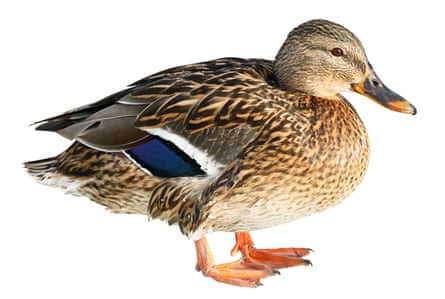
Mallard (Anas platyrhynchos)
Appearance: Like most ducks, the males are showy with iridescent green heads; camouflage is more important for the dappled brown females who incubate the eggs and rear the chicks.
Sounds: The females quack. The males – apart from Donald – don’t. Instead, they give a quieter, slightly rasping call of one or two notes.
Nightjar (Caprimulgus europaeus)
Appearance: Both male and female are fantastically camouflaged with mottled plumage that resembles tree bark. The males have white markings on their wingtips and tail, which are flashed when displaying to other males or females.
Sounds: The males are known for their distinctive nocturnal “churring”, which sounds more like a machine or wind-up toy than a bird. According to The Sound Approach to Birding 2, the females will give the same kind of “churr”, but only occasionally, such as when they are moving nest sites.
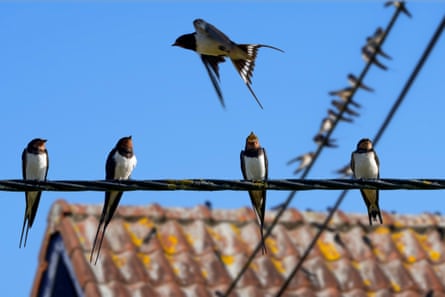
Barn swallow (Hirundo rustica)
Appearance: Females have shorter tail streamers than the males and paler buff-white or light-brown underparts. Males have deeper red-brown colouring underneath.
Sounds: Females sing alongside males during courtship, with both sexes employing rather tuneless continuous twitter-warbles and rapid-fire whirrs for up to 20 seconds. Males may seek to thwart a mate’s attempted copulation with another bird by giving a fake alarm call, described as an irritable “ee-tee” or “keet”. Females retaliate by singing over their male’s song – jamming his signal and shutting him down – preventing him from advertising his prowess to other females.
此内容由惯性聚合(RSS阅读器)自动聚合整理,仅供阅读参考。 原文来自 — 版权归原作者所有。