




After three months in immigration detention, 1,500 miles (2,400km) away from her 13-month-old daughter, LT was running out of options.
Her baby, who was allergic to formula and had other food sensitivities, had been vomiting constantly and needed breastmilk. But the government refused to release LT – an asylum seeker from Haiti – on bond. So, the family’s pediatrician petitioned the government to allow her to pump and mail her breastmilk from the Dilley detention center in Texas to her baby in Florida. That request was denied.
Desperate, LT asked whether her child could be brought into the detention center to be with her. The government denied that, too, she said, on the grounds that the child, who is a US citizen, couldn’t be kept at an immigration detention center.
“I’m terrified of losing my baby,” she said.
The US government has targeted thousands of parents like LT for deportation since Donald Trump took office in January 2025. A Guardian analysis of government records has found that, during the first seven months of his presidency, the administration arrested the parents of at least 27,000 children. During this period in 2025, the US Department of Homeland Security (DHS) was deporting about twice as many parents each month compared with 2024.
The records do not detail how many of these children were detained or deported with their parents, and how many families were split up. But the data provides one of the starkest views yet of how Trump’s mass deportation scheme has affected parents and children. In thousands of cases, DHS sought to deport parents who had a different citizenship or nationality than their children, creating major legal and logistical barriers to keeping families together.
The Guardian’s analysis also revealed:
-
During the first seven months of 2025, the administration arrested 18,400 parents – including 15,000 fathers and 3,000 mothers. They are the parents of 27,000 to 32,000 children.
-
The administration arrested the parents of at least 12,000 US citizen children.
-
Nearly 7,500 fathers and 1,000 mothers who were arrested had a different nationality than at least one of their children. In about half of these families, siblings had different citizenships from each other.
-
On average, the Trump administration has been arresting about 2,300 parents each month and deporting 1,400 parents every month. The Biden administration, in comparison, deported about 700 per month in 2024.
Taken together, these figures capture the vast scope of a new family separation crisis created by the US government, human rights advocates said, a crisis that has far surpassed in scale the “zero tolerance” policy of the first Trump administration, when the US systematically separated immigrant children from their parents at the US-Mexico border.
The data underlying these findings comes from I-213 forms, which immigration agents fill out each time they make an arrest alleging a person is in the US without authorization. The forms document people’s ages, nationalities, criminal histories – and, crucially, the number and nationalities of their minor children.
A spokesperson for the DHS said the agency “cannot verify the veracity of this data” – even though the Guardian acquired the data via a freedom of information lawsuit. The Guardian cross-checked the records against other government sources.
The government data, said immigration lawyers and researchers, is likely an underestimate of the number of family separations – because in many cases, immigration officials don’t ask the people they arrest whether they have children, and in other cases parents don’t disclose that they have children in order to protect their families from being detained or deported.
Quick GuideHow the Guardian reported on family separation
Show
The Guardian's findings are based on data extracted from I-213 forms, which immigration officials fill out each time they arrest an individual. The forms cover the period of fiscal year 2023 through August 2025. The Guardian obtained the data after filing a public records lawsuit along with the Reporters Committee for Freedom of the Press.
The anonymized data extracted from these forms includes biographical details, ages, nationalities and criminal histories of about 200,000 individuals arrested from October 2023 to August 2025. The records also list the number and nationality of each individual's children.
To calculate how many children were affected, we counted the children of fathers and mothers separately, to avoid double-counting any children who had both parents arrested. We reported a range to be transparent about the limitations of the data.
In order to report on the impact of family separation, we matched 86% of the I-213 records with a unique record in the data released by the Deportation Data Project, led by a team of academics and lawyers at the University of California, Berkeley tracking immigration enforcement using government data. By cross-referencing these two data sources, we were also able to calculate the number of parents that the Trump administration has been deporting.
Read more about how the Guardian reported this story, and access the I-213 records, here.
The separations will have generational, transnational reverberations, said Faisal Al-Juburi, of the legal aid non-profit Raíces. “We have now reached the metastasis of family separation under this administration,” he said. “I don’t think we’ve even begun as a nation to grapple with the impact of this type of immigration enforcement and the domino effect it will have.”
LT, 30, fled political violence in Haiti, where, she said, supporters of an opposing political party burned down her house, kidnapped her and raped her. She escaped first to the Bahamas and then arrived by boat in Miami, Florida, in 2019. She fears she would die if she returned now; she said her sister was murdered last year. And her daughter, she worries, wouldn’t be able to get the medical care she needs in Haiti – so she wouldn’t risk bringing her baby there even if she could.
She has also grown increasingly worried that her baby will end up in foster care. LT’s mother is watching the child, but it is impossible for her to work full time and care for an infant – especially not one with complicated medical needs. And, LT has filed a domestic violence complaint against the baby’s father, whom she said has threatened to kill both her and the infant.
“I wish I could be there for my daughter,” LT said in a written statement her lawyers shared with the Guardian. “She is my first child, and I cannot be there for her.”
The Guardian has reviewed more than a dozen cases, and interviewed multiple parents and children who had been separated by detention or deportation. In each case, a sudden arrest or deportation of a parent had radically disrupted the trajectory of a child’s life.
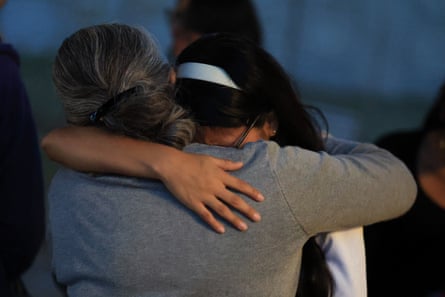
When KO, a 41-year-old Guatemalan mother of three was arrested at an ICE check-in appointment, she told an officer she had a 19-month-old who would be expecting her back home. “The officer said my child and I could die for all he cared,” she said.
While Herminia was held away from her nine-year-old and 16-year-old for eight months, the children’s mental health started to deteriorate, she said. Her young daughter had trouble sleeping through the night, and her teen son considered dropping out of school in order to work and support his sister.
After Marco, 61, was arrested at a Home Depot in Maryland and deported to El Salvador, his 17-year-old, Mark – a US citizen – spent his last months of high school working so that he and his mother could make enough money for rent.
Families described scrambling for funds after a primary breadwinner was detained or deported. Teens and young adults had to drop out of school to take care of younger siblings after both parents were deported. Children were left wondering when or whether they would ever be able to see parents who had been deported back to countries where they faced death threats.
“They are uprooting lives,” said Al-Juburi.
To meet Trump ’s demand for “mass deportations”, the administration has been arresting a record number of immigrants, including people who have been living in the country for many years and have built lives and families in the US. The vast majority of people detained have either no criminal histories, or minor convictions such as traffic offenses.
The push for mass deportation has had a pernicious impact on families, and on mothers in particular. Using the same records as those obtained by the Guardian, ProPublica found that the Trump administration was deporting four times as many mothers of US citizens each day compared with the Biden administration.
Meanwhile, the administration has also weakened protections for non-citizen parents, and stepped back commitments to keep parents united. In several cases, immigration officials had also threatened to separate families, seemingly in order to coerce parents into voluntarily leaving the US.
Lauren Bis, a spokesperson for the DHS, declined to answer a series of questions from the Guardian, including questions about government policies on family separation. The agency denied separating families, and said that “parents are asked if they want to be removed with their children”. Bis also said “being in detention is a choice”, encouraging immigrant parents to use a government app to “self-deport”.
Many parents who have fled dangerous conditions in their home countries feel they cannot risk bringing their children with them. And if they are deported from the US without their children, their separation could be indefinite.
That is the case for EFA, an asylum seeker from Venezuela who was arrested – unexpectedly – at a routine ICE check-in appointment in October. Her husband struggled both to care for their two-year-old son and to make enough money to support him. Before her arrest, EFA had worked night shifts and her husband had worked days so that one of them was always home with their child.
The family’s church congregation jumped into action, organizing a childcare rotation while her husband worked. But the situation is tenuous. EFA’s husband is also an asylum-seeker, and the family is fearful that he, too, will be detained, leaving their son without a guardian.“I cannot help but feel an immense amount of sadness and helplessness due to this separation,” EFA said in a written statement her lawyers at Raíces provided to the Guardian.
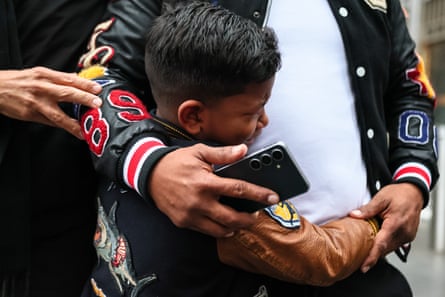
If she were deported to Venezuela, things could get even more complicated. Both she and her husband still face the threat of violence due to their political activism, she said, and are reluctant to take their son back there. But if she leaves the US without her child, it could become exponentially more difficult for the family to reunite. If she is deported, she would be barred from trying to re-enter the US for a decade. And even if EFA and her husband decided to bring their son to Venezuela, they would likely encounter logistical and legal barriers. There are no Venezuelan consulates in the US, and EFA’s husband wouldn’t be able to get a new passport to travel. Many Venezuelans in the US have been struggling to acquire travel documents to return home, even as the US government continues to encourage immigrants to “self-deport” to their home countries.
Her health and sanity, she said, are unravelling at the Dilley detention center where she’s being held. She cries herself to sleep every night, she said, but “I have not sought psychological help because I do not believe anyone can ease the sorrow in my heart. I just need to be with my son.”
Seven years ago, Trump’s “zero tolerance” separation policy sparked national outrage after the media began sharing images of agents wresting crying children from their parents’ arms and placing them in cages. Trump officially ended the policy after about six weeks, but more than 5,500 children had been separated from their parents by then. Hundreds of parents remain separated from their children years later, because the administration lost track of many of the families it forced apart.
Kelly Kribs, an attorney at the Young Center, said the separation crisis unfolding now is even more insidious.
“It’s leading to all the same forms of trauma that we saw unfold back in 2018,” said Kribs, who worked for years to reunite families separated by the zero-tolerance policy. “But the speed and the scale of the separations now is at a level we’ve never seen before.”
In recent months, she has been working with parents who have been both detained or deported away from their children in the US. A report earlier this year also found that the government was deporting a significant number of parents without first asking whether they had children, or allowing them an opportunity to arrange for the care of their children, in apparent violation of its own policies.
Once families are separated across international borders, it can be extraordinarily difficult to reunite them, Kribs said.
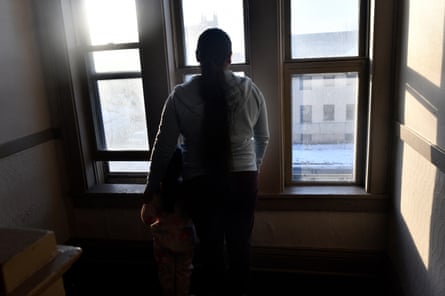
For Oscar, 32, a Honduran environmental activist who was deported back to the country from which he had fled death threats, it could take months or years before he is able to rejoin his wife, Ana, and his seven- and nine-year-old children in Maryland.
The family had applied for asylum together, but then Oscar was arrested at a check-in appointment, moved to a Texas detention facility and deported. Ana and the children, in the meantime, were granted asylum. So Oscar’s lawyer filed a petition to allow him to rejoin his family in the US. But the International Refugee Assistance Project, an advocacy group, found “dramatic delays” in the processing of these petitions.
Oscar, meanwhile, plans to remain in hiding in Honduras – staying alone in an apartment and avoiding going outside – for as long as he can. When he calls the children, he tells them: “Dad is going to come back soon.” He tells them to behave well for their mother, to remember that he didn’t leave them by choice and to consider that, maybe, this is all part of God’s plan. “We are going to get through this, that I know,” he tells them. “I believe in God’s will and I know that I can return to you.”
Things can get doubly complicated when parents and children don’t share the same citizenship. Recently, Kribs said, she was trying to help a Venezuelan man who was deported by the US to Mexico – one of many immigrants that the government has sent to “third countries” that are willing to accept deportees. His son, who was born in Colombia, remained in the US. So at first, Kribs tried to get the US to deport the child to Mexico – but Mexico declined to receive him. Instead, the father had to figure out a way to travel to Colombia, where he was finally able to reunite with his son after two months of separation.
Among the many considerations Kribs had in that case and others was the question of how to help a young child cross international borders alone. Often, the relatives who step in as guardians after children’s parents are deported are also undocumented, and unable to travel with a child. Getting someone who isn’t a relative to accompany them can be challenging to arrange, and it requires notarized paperwork so there’s no risk the adult will be stopped under suspicion of child trafficking.
Complex, and ever-evolving international politics can also affect how easy – or difficult – it is for a child to get the correct travel documents. Airline policies vary on when and how children can fly unaccompanied. Even if the airline allows for it, Kribs said, it can be a scary journey for a young child. “How can a six-year-old be expected to navigate customs and immigration on his own?” she said.
Hundreds of families are facing similarly mundane yet mountainous barriers to reunification, Kribs said. Hundreds of parents do not know when they will be able to hold their children again.
“I think that’s part of what makes this problem harder for the public to wrap their brains around, is now the family separation is all around us every day across the country, which makes it hard to call out as a unique crisis,” she said. “It has become our everyday reality.”
-
The Guardian has used initials or first names only in some cases, to protect the identities of individuals who fear retaliation within the US immigration system, or who face threats in their home countries