



惯性聚合 高效追踪和阅读你感兴趣的博客、新闻、科技资讯
阅读原文 在惯性聚合中打开

推荐订阅源

N
News | PayPal Newsroom
IT之家
IT之家
Jina AI
Jina AI
博客园 - 司徒正美
GbyAI
GbyAI
WordPress大学
WordPress大学
B
Blog
大猫的无限游戏
大猫的无限游戏
Y
Y Combinator Blog
阮一峰的网络日志
阮一峰的网络日志
Blog — PlanetScale
Blog — PlanetScale
cs.CL updates on arXiv.org
Threat Intelligence Blog | Flashpoint
Recorded Future
Recorded Future
T
Threat Research - Cisco Blogs
AWS News Blog
AWS News Blog
Latest news
Latest news
宝玉的分享
宝玉的分享
小众软件
小众软件
NISL@THU
NISL@THU
C
CERT Recently Published Vulnerability Notes
The GitHub Blog
The GitHub Blog
P
Privacy & Cybersecurity Law Blog
P
Palo Alto Networks Blog
Spread Privacy
Spread Privacy
Last Week in AI
Last Week in AI
K
KPMG report finds enterprise disconnect between AI and its ROI | CIO
P
Proofpoint News Feed
cs.AI updates on arXiv.org
量子位
博客园_首页
T
The Exploit Database - CXSecurity.com
The Cloudflare Blog
M
MIT News - Artificial intelligence
H
Help Net Security
Security Archives - TechRepublic
V2EX - 技术
V2EX - 技术
I
InfoQ
D
Darknet – Hacking Tools, Hacker News & Cyber Security
freeCodeCamp Programming Tutorials: Python, JavaScript, Git & More
O
OpenAI News
MongoDB | Blog
MongoDB | Blog
奇客Solidot–传递最新科技情报
奇客Solidot–传递最新科技情报
P
Privacy International News Feed
Microsoft Security Blog
C
Cybersecurity and Infrastructure Security Agency CISA
Google DeepMind News
H
Hacker News: Front Page
W
WeLiveSecurity
N
News and Events Feed by Topic

The Guardian

Rory McIlroy surges into six-shot Masters lead with stunning second-round flourish ‘That’ll be the end’: actor Sam Neill joins fight to stop controversial goldmine near his New Zealand vineyard Roberto De Zerbi targets ‘Ange-ball’ revival to save Spurs from relegation Bath hit back to reach semi-final after stunning Northampton in 11-try epic Secret Garden to Outcome: the week in rave reviews Zebras, wealth and power: Hungary’s election tests Orbán’s grip on power ‘TikTok effect’ brings sellout crowds and younger fans to Grand National meeting The war over Omagh’s gold: the £21bn mine plan tearing a community apart Britain’s shadow workforce is paid as little as 65p an hour. Who cares for the carers? From You, Me & Tuscany to Euphoria: your complete entertainment guide to the week ahead Six great reads: the man who let snakes bite him, masked heavy metal and the brutal reality for foreign students in the UK American Classic review – I defy you not to fall in love with Kevin Kline and Laura Linney’s tender comedy Cuba’s doctors were a lifeline for the world. Now the Caribbean is shamefully complicit in the US drive to expel them An environmental disaster in Moldova has Russia’s fingerprints all over it RMIT drops misconduct case against student who accused university of being ‘complicit in Gaza genocide’ Ichiro Suzuki statue unveiling goes awry as bronze bat snaps during ceremony Survivors of Epstein’s abuse accuse Melania Trump of ‘shifting burden’ on to victims European football: Real Madrid held at home by Girona to extend winless run Arne Slot insists he is ‘aligned’ with Liverpool board and fans as squad is rebuilt Kamala Harris ‘thinking about’ running for president again in 2028 JD Vance warns Iran against trying to ‘play’ the US in peace talks West Ham double up twice to thrash Wolves and put Spurs in relegation zone Trump administration releases new renderings of so-called ‘Arc de Trump’ Crispin Odey drops £79m libel claim against FT over sexual misconduct allegations Bafta apologises for events surrounding John Davidson’s Tourette’s outburst Cocktail of the week: Bar Shrimp’s la rosita – recipe New drug may extend survival in aggressive ovarian cancer, trial shows One dead and 27 injured after bus with British passengers crashes in Canary Islands Pope adds to Smith’s mass of Surrey runs with England woes a world away OpenAI CEO Sam Altman’s home targeted with molotov cocktail Reform UK local election candidate was twice disciplined by Tories over ‘racist comments’ Remaining in Nato is in best interests of US, says Keir Starmer Prince Harry sued for defamation by charity he co-founded Anthropic’s new AI tool has implications for us all – whether we can use it or not Concerns raised about motorbike tourist trail after death of British teenager in Vietnam The Guardian view on Trump’s civilisational threats: the words that fuel war must be condemned The Guardian view on dystopias for our times: the American nightmare Doctors’ leader claims new reduced pay offer killed chances of ending strikes in England Netanyahu-ism has achieved nothing for Israelis – and come at a monstrously high price Deborah Levy: ‘CS Lewis’s White Witch terrified me – but I wanted to meet her’ How I Shop with Michelle Ogundehin: ‘We grownups have enough stuff already’ Trump’s war and Melania’s Epstein statement, with US editor Betsy Reed – The Latest We have to stop killer motorists on Britain’s roads UK starts crackdown on EU citizens’ post-Brexit rights Londoners aren’t unfriendly – but don’t compare us to New Yorkers The religious right and the perversion of faith Artemis II images reignite moon mission memories Orbán and Magyar trade accusations in last days of Hungary election campaign Reckonwrong: How Long Has It Been? review | Safi Bugel's experimental album of the month Martin Rowson on Middle East peace talks – cartoon Masters magic, the Grand National and Premier League drama – follow with us Fears of UK and EU flight cancellations as airports warn of jet fuel shortages Reform’s petulance over slavery reparations shows it just doesn’t grasp Britain’s place in the modern world Peers vote to ban pornography depicting sex acts between stepfamily members Starbucks’s retail arm gets £13.7m tax credit even as sales increase Flyby review – interstellar musical is a voyage of epic strangeness Grand National preview: Jagwar can deny Irish cohort in Aintree classic Week in wildlife: an ostrich on the lam, a tortoise crossing a road and surfing seals Anger as swifts’ nesting holes in Derbyshire rail viaduct ‘blocked up’ Peter Mandelson faces fixed-penalty notice for urinating in public ‘There’s no shortage of terrifying technology’: how AI became TV drama’s new go-to villain ‘Fresher than anything in a shop’: the best recipe boxes and meal kits for time-poor foodies, tested Who was Hilma? Af Klint exhibition to highlight exclusion of women from abstract art Critics assemble! Here’s my list of the greatest superhero movies of all time US inflation soars in March as war on Iran drives economy into uncertainty Amazon to finally launch Leo satellite internet in ‘mid-2026’, says CEO Grand National 2026: horse-by-horse guide to all the runners Pete Hegseth’s holy war: the militant Christian theology animating the US attack on Iran Add to playlist: the beautifully dazed, countrified indie-rock of Tracey Nelson and the week’s best new tracks Not just about Gaza: the Muslim voters turning from Labour to the Greens ‘I’m worried there’s too much of me,’ says a birch: inside the interspecies council giving nature a voice Why is anyone surprised by the US and Israel’s latest war? It’s only what the world allowed them to do in Gaza Tori Amos review – fans hang on every note of this dramatic deep dive into her back catalogue Coachella 2026: Justin Bieber launches a major comeback in the desert Super Mario what?! The seven best obscure Mario games ‘An abomination’: the Lancashire town kicking up a stink over reopened landfill Pillion to Roofman: the seven best films to watch on TV this week Holly Humberstone: Cruel World review – Taylor Swift fave trades gothic melancholy for pop glow-up Thrash review – cursed shark thriller sinks like a stone on Netflix Gulf states rethink security in light of US-Israel war on Iran Go Gentle by Maria Semple review – a joyfully clever New York romcom Welcome to Y’all Street: bullish Dallas aims to steal New York’s financial crown Margo’s Got Money Troubles to Beef: the seven best shows to stream this week I baulked at the idea of ‘friction-maxxing’. But there’s more to it than meets the eye Reich: The Sextets album review – Colin Currie celebrates the minimalist master’s joy of six Benjamina Ebuehi’s sweet and salty chocolate chip cookies recipe Experience: my house was taken over by 70,000 bees Malcolm in the Middle: Life’s Still Unfair review – the TV magic they’ve created here is absolutely miraculous Lava bursts forth as Hawaii’s Kilauea volcano erupts Sonos review: Are these the best portable speakers that money can buy? I tested to find out Buy bread in the evening, hit the sales on a Tuesday: retail workers’ top tips to cut your shopping bill The best water flossers in the UK, tested for that dentist-clean feeling Where to start with: Muriel Spark You be the judge: should my girlfriend stop mixing gold and silver jewellery? The best carry-on luggage in the UK, tested on an assault course How games capture the awe and terror of cosmic isolation I never text back – and it’s ruining my relationships The pet I’ll never forget: Beau, the labrador who saved my life Life Is Strange: Reunion review – a decade-long story comes to an impassioned close Why is gaming becoming so expensive? The answer is found in AI
Shark or sea monster? The Canadian marine mystery that still intrigues experts 90 years on
Leyland Cecc · 2026-05-07 · via The Guardian

Its head resembled a dog’s, its downturned nose a camel’s, and at the end of its reptilian body was the tail of horse. Witnesses say it was covered in a thin white film. When the remains of a strange creature were pulled from the stomach of a sperm whale, most of those present agreed: it was a sea monster – or at least something unknown living in the depths off Canada’s west coast.

Crews at the whaling station in the archipelago of Haida Gwaii assembled a platform of wooden boxes and laid out the 3-metre (10ft) carcass, using a white sheet to display the curiosity that had baffled veteran whalers.

A photo of the creature, called the “Cadborosaurus”, by locals, appeared on the front page of a local newspaper on 31 October 1937, adding to the growing lore that a marine cryptid – a creature unknown to science – and at times supposedly measuring three times as long, stalked the waters.

Samples of the mysterious discovery have long disappeared and all that remains are a handful of black and white images.

John Kirk, president of the British Columbia Scientific Cryptozoology Club, is adamant the carcass was of an unknown species hiding at the edge of human understanding in the emerald depths of the Salish Sea. He cites first-hand accounts of the discovery, including an interview with a flenser who helped remove the carcass.

“The scientific world, of which we are a part, is always looking for excuses not to allow new animals into the catalogue. And quite frankly, I find that notion absolutely cockamamie,” he says.

The ‘Cadborosaurus’ laid out on a white sheet by whalers and photographed for the local newspaper.
The ‘Cadborosaurus’ was laid out on a white sheet by whalers and photographed for the local newspaper. Photograph: John Kirk/BCSCC/Alamy

One of the few pieces of the carcass sent for identification was shipped to a museum in Victoria, 400 nautical miles (740km) south-east of Haida Gwaii. It was disposed of after the museum’s director – not a trained zoologist – suggested it was from a foetal baleen whale.

“We lost a massive discovery here because of misidentification,” Kirk says. “And I think it’s a horror story of how flippant scientists can sometimes be in regard to these kinds of things.”

But almost 90 years later, many scientists say the images simply show a decomposing basking shark – a giant and ancient fish that once thrived off Vancouver Island before being slaughtered to virtual local extinction. Today, the basking shark shares the cryptid’s fate: often misidentified and rarely, if ever, seen by veterans of the ocean.

Because sharks have no bones, the change from living creature to carcass is a profound transformation. When basking sharks decay, their massive gill-basket – the structure that most defines the lumbering fish – collapses. What remains is a long neck-like structure and a small head. The breaking down of muscle fibres and cartilage can give fins a furry, feather-like appearance.

“With a long spinal cord and a small head at the end, it looks like a mythological sea serpent,” says Ben Speers-Roesch, a professor of marine biology at the University of New Brunswick. “Unless you know what you are looking at or have familiarity with it, it’s not intuitive what this creature might have been.”

In 1977, the Japanese fishing trawler Zuiyō Maru pulled a creature from the depths off the coast of New Zealand that resembled a long-lost dinosaur. The discovery prompted a flurry of excitement from scientists who claimed it was an unknown species, until an analysis of amino acids in the muscle tissue suggested it was a basking shark.
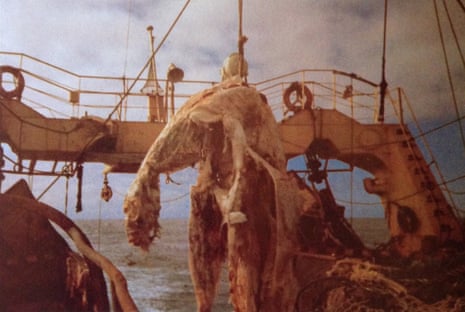
Zuiyō Maru carcass
The Zuiyō Maru carcass, pulled from the sea off New Zealand in 1977, was thought to be an unknown species but tissue analysis revealed it to be a basking shark. Photograph: Zuiyo-maru

Speers-Roesch says this is called the “pseudo-plesiosaur carcass” phenomenon, when decomposed basking sharks appear to have a long neck, small head, and large paddles – all hallmarks of a prehistoric plesiosaur.

He concedes that the 1937 photo from Canada diverges from typical carcasses because of how it was displayed.

“The mystery has persisted because it has elements that are not as easily identifiable as a basking shark. It does look a little bit different in a couple of ways,” he says, adding that on rare occasions, young basking sharks have been found in the stomach of sperm whales. “But so much of the carcass captures what we know about basking sharks and how they decompose. Even if you’re well educated, you can really make poor interpretations of what you are observing.”

With no surviving samples and only a handful of photographs, the question of what the mysterious creature was can never be resolved definitively. But the real story, say scientists, is not so much the mystery of a species that might exist, but the tragic end of one that did. Now, amid a push to protect the waters of the Pacific and the vulnerable species that remain, a rare sighting of a basking shark in 2024 has renewed interest in the species and in the long-forgotten campaign that wiped them from the coastal waters.
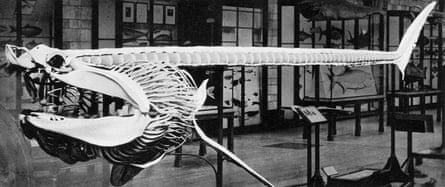
Cast of a basking shark
Cast of a basking shark: a rare sighting of one of the creatures in British Columbia waters in 2024 has renewed interest in the species. Photograph: Chronicle/Alamy

In 1955, the federal government devised a plan to kill off the sharks. Its strategy relied on a large blade fixed to the bow of a patrol ship, called a “razor-billed shark slasher” by local media.

“Because basking sharks fed at the surface, crews could lower the blade and run them over,” says Scott Wallace, a former fisheries scientist who wrote the 2007 federal government report that determined the basking shark was endangered and largely extinct in British Columbia waters. “They simply cut them in half.”

The sharks’ only crime was to have inadvertently wandered into nets laid by anglers to catch salmon.

“Anything that interacted with salmon or the salmon fishery was killed off as a way of thinking that they could again manage the ocean,” says Wallace, who co-authored the book Basking Sharks: The Slaughter of BC’s Gentle Giants. “And it wasn’t long before basking sharks were added to the official ‘nuisance list’ and they became a target.”
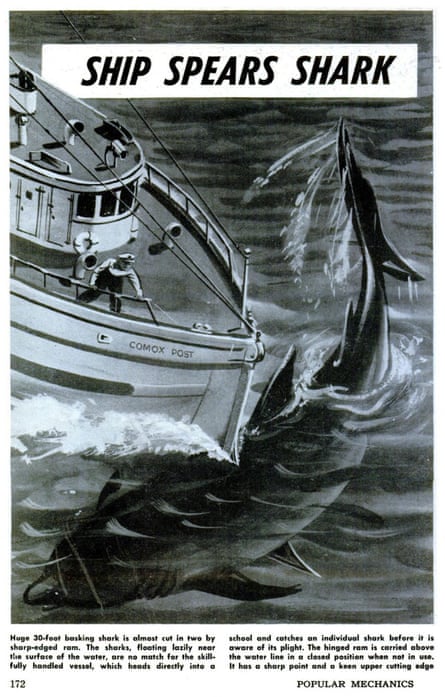
A ship developed to kill basking sharks as featured in Popular Mechanics magazine.
A ship developed to kill basking sharks, called a ‘razor-billed shark slasher’ by local media, was featured in Popular Mechanics magazine. Photograph: Popular Mechanics

At the same time, officials were shooting seals and sea lions around fishing grounds and river mouths. In the early 1960s, Canada’s fisheries ministry installed a .50-calibre machine gun on an island, a weapon typically used against armoured vehicles and low-flying aircraft. Its sole purpose was to kill orcas. The high-powered gun was never used, but the message was clear: the ocean’s giants were something to be destroyed, not respected.

The government estimates it killed at least 413 basking sharks with the boats over the next 14 years. At the same time, as many as 1,500 sharks may have been killed by entanglement. There was also a brief attempt to create a commercial fishery for their liver oil, but experts say it is unclear how many sharks were slaughtered from that effort. All told, as many as 2,600 – more than 90% of the population – was eradicated.

Now, federal law makes it illegal to kill, harm or capture a basking shark if it is found off the coast of British Columbia. The government has an official recovery strategy and action plan, and the sharks are protected by the strongest wildlife protections in Canadian law. But Canada’s fisheries department also concedes it could take 200 years for the sharks to recover to a healthy population.
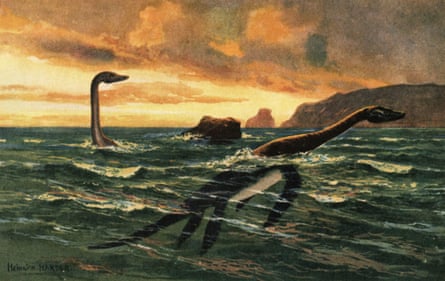
An illustration of the Plesiosaurus dolichodeirus in the ocean.
An illustration of the plesiosaurus, a large marine reptile that lived during the early Jurassic period, from 1908. Photograph: Florilegius/Universal Images Group/Getty Images

“There are periods of time – often decades – that they [basking sharks] just disappear,” says Wallace. “And then all of a sudden, they return. Maybe it’s the ocean conditions – we really don’t know. But there is a chance, and it’s slim, that they’re still in the area, out of human view.”

While the tragic story of the demise of the basking shark is indisputable, the “pseudo-plesiosaur carcass” phenomenon is not enough to sway some that the mysterious creature in the 1930s photograph is something that is identifiable.

“The carcass is most certainly not a basking shark,” says Kirk. “And it’s not a reptile. Whatever it is, it must be a mammal because it possesses hair and it doesn’t resemble any of the orders of marine mammals today in those waters.”
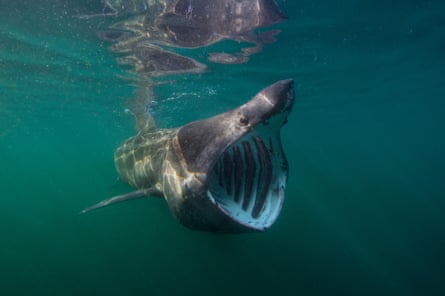
A basking shark feeding at the surface on plankton off the Isle of Coll, Inner Hebrides, Scotland.
A basking shark feeding at the surface on plankton off the Isle of Coll, Inner Hebrides, Scotland. Photograph: Nature Picture Library/Alamy

For Kirk and cryptozoologists, the prospect of something eluding scientific acceptance is a powerful draw and underscores their relentless hunt.

In 2010, while walking his dog, Kirk says he encountered an unknown creature in the waters where British Columbia’s Fraser River empties into the Salish Sea. Its head was “pointed” and the neck extended from the water “like a stovepipe” with a hump curled behind. The encounter was a “breathtaking experience” and left him stunned.

“But I will tell you: in my nearly four decades living in the region, one thing I’ve never seen is a basking shark,” he says. “Not sure if I ever will.”

Speers-Roesch understands the urge to look at a century-old photograph and believe something unexplored still lurks in the ocean. But the nexus of human senses and the natural world is a space rife with error. Under the right conditions, a carcass can look nothing like the living animal. When a dead racoon washed up on a shore on Long Island, in New York state, word spread quickly that the bloated, hairless carcass was an unknown creature, called the “Montauk monster”.

“Humans will always be curious about the unknown,” says Speers-Roesch. “There are still profound mysteries and species in the ocean that we know very, very little about, and probably even species of relatively large animals that are yet to be discovered or described. But when you actually look at the creatures that are known to exist in the ocean, it’s even more spectacular and powerful.”