




惯性聚合 高效追踪和阅读你感兴趣的博客、新闻、科技资讯
阅读原文 在惯性聚合中打开

推荐订阅源

freeCodeCamp Programming Tutorials: Python, JavaScript, Git & More
T
Tailwind CSS Blog
J
Java Code Geeks
Microsoft Azure Blog
GbyAI
GbyAI
爱范儿
爱范儿
量子位
Martin Fowler
Martin Fowler
V
V2EX
博客园 - 三生石上(FineUI控件)
I
InfoQ
MongoDB | Blog
MongoDB | Blog
奇客Solidot–传递最新科技情报
奇客Solidot–传递最新科技情报
N
Netflix TechBlog - Medium
D
DataBreaches.Net
钛媒体:引领未来商业与生活新知
钛媒体:引领未来商业与生活新知
Last Week in AI
Last Week in AI
U
Unit 42
Apple Machine Learning Research
H
Help Net Security
T
The Blog of Author Tim Ferriss
Hugging Face - Blog
Hugging Face - Blog
美团技术团队
Engineering at Meta
Engineering at Meta

The Guardian

Rory McIlroy surges into six-shot Masters lead with stunning second-round flourish ‘That’ll be the end’: actor Sam Neill joins fight to stop controversial goldmine near his New Zealand vineyard Roberto De Zerbi targets ‘Ange-ball’ revival to save Spurs from relegation Bath hit back to reach semi-final after stunning Northampton in 11-try epic Secret Garden to Outcome: the week in rave reviews Zebras, wealth and power: Hungary’s election tests Orbán’s grip on power ‘TikTok effect’ brings sellout crowds and younger fans to Grand National meeting The war over Omagh’s gold: the £21bn mine plan tearing a community apart Britain’s shadow workforce is paid as little as 65p an hour. Who cares for the carers? From You, Me & Tuscany to Euphoria: your complete entertainment guide to the week ahead Six great reads: the man who let snakes bite him, masked heavy metal and the brutal reality for foreign students in the UK American Classic review – I defy you not to fall in love with Kevin Kline and Laura Linney’s tender comedy Cuba’s doctors were a lifeline for the world. Now the Caribbean is shamefully complicit in the US drive to expel them An environmental disaster in Moldova has Russia’s fingerprints all over it RMIT drops misconduct case against student who accused university of being ‘complicit in Gaza genocide’ Ichiro Suzuki statue unveiling goes awry as bronze bat snaps during ceremony Survivors of Epstein’s abuse accuse Melania Trump of ‘shifting burden’ on to victims European football: Real Madrid held at home by Girona to extend winless run Arne Slot insists he is ‘aligned’ with Liverpool board and fans as squad is rebuilt Kamala Harris ‘thinking about’ running for president again in 2028 JD Vance warns Iran against trying to ‘play’ the US in peace talks West Ham double up twice to thrash Wolves and put Spurs in relegation zone Trump administration releases new renderings of so-called ‘Arc de Trump’ Crispin Odey drops £79m libel claim against FT over sexual misconduct allegations Bafta apologises for events surrounding John Davidson’s Tourette’s outburst Cocktail of the week: Bar Shrimp’s la rosita – recipe New drug may extend survival in aggressive ovarian cancer, trial shows One dead and 27 injured after bus with British passengers crashes in Canary Islands Pope adds to Smith’s mass of Surrey runs with England woes a world away OpenAI CEO Sam Altman’s home targeted with molotov cocktail
Fears of resurgence in Somali piracy after three vessels ...
Mohamed Gabo · 2026-04-29 · via The Guardian

Three vessels have been hijacked off the coast of Somalia in the past week, raising fears of a resurgence in piracy around the Horn of Africa, and adding to the woes of the global shipping industry.

The merchant vessel Sward was taken over on 26 April, a day after a dhow was seized. These followed the 21 April hijacking of Honour 25, a motor tanker carrying 18,000 barrels of oil, according to the Maritime Security Centre Indian Ocean (MSCIO), the tracking service of the EU’s naval force.

“All incidents remain ongoing …,” the MSCIO said in a statement on Monday. “Vessels operating in the area are strongly advised to maintain heightened vigilance … particularly within 150NM [nautical miles] of the Somali coast between Mogadishu and Hafun where feasible.”

Piracy around Somalia jumped in the late 2000s, peaking in 2011 with 212 attacks, according to EU naval force data. Pirates became more audacious, raiding ships as far as 2,270 miles off the Somali coast in the Indian Ocean.

An international naval coalition then stemmed the tide of attacks, cutting them to just a handful each year from 2014. However, incidents began to rise again in 2023.

Global shipping is already reeling from the near-total closure of the strait of Hormuz by Iran and attacks by the Iranian-backed Yemeni Houthi rebels around the narrow Bab el Mandeb strait. Ships have to sail through the straits to exit the Red Sea, one of the world’s busiest shipping routes, with many then heading around the Horn of Africa.

Sward is a cement carrier that left the port of Suez in Egypt on 13 April. It was en route to Mombasa, Kenya, when it was captured by pirates about 11km (6 nautical miles) from the Somali port town of Garacad. The ship had 17 crew members, 15 from Syria and two from India, according to three security officials from the autonomous Somali region of Puntland.
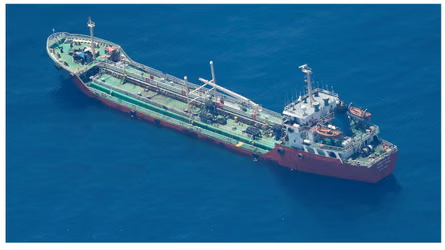
The motor tanker Honour 25.
The motor tanker Honour 25 was hijacked on 21 April. Photograph: EU Naval Force Operation ATALANTA

After the hijacking shortly after 8pm on Sunday, the pirates steered the ship towards the coast and anchored it in a remote area near Garacad. Six armed men and an unarmed interpreter fluent in English and Arabic then boarded the ship.

“He’s not only speaking with the crew but also dealing with the owner of the ship,” one of the security officials said. A second official simply put it: “The interpreter is in charge.”

As of Tuesday morning, four more armed men had boarded Sward, bringing the total number of pirates on board to 20, according to the officials.

Jethro Norman, a senior researcher with the Danish Institute for International Studies, said pirates had taken advantage of international navies diverting resources towards the Red Sea to combat the Houthi attacks, and Puntland’s Emirati-backed security forces being stretched.

Norman said: “Pirate networks are testing the waters again and they are better equipped than the last generation. GPS, satellite communications and hijacked dhow motherships let them operate hundreds of miles offshore.”

A third Puntland security official said that a shipment of khat, a narcotic stimulant widely used in the Horn of Africa, was taken out in a small boat to the pirates on the cement carrier on Tuesday morning. It had been driven about 150 miles from the inland city of Galkayo on Monday, suggesting that the pirates have a network on land and are potentially preparing for a long siege out at sea.