







In a studio down a residential road in west Warsaw, a group of former political prisoners are cutting golden stems of wheat to 90cm lengths and stacking them, ready to be shipped to the Venice Biennale. A giant ball made of books banned in the neighbouring country of Belarus – Harry Potter, Nobel prize winner Svetlana Alexievich, an illustrated history of kink – rests on the claw of a bulldozer. There is the sound of laughter, organ music and an angle-grinder, as surveillance cameras are attached to a towering iron crucifix.
This is Official. Unofficial. Belarus., the first major art project by Belarus Free Theatre (BFT). Unusually, this work by the exiled troupe has no performance element but has instead been created by painters, sculptors, composers and even the man recently voted world’s best chef. Rasmus Munk has been concocting a dish at his two-Michelin-starred restaurant in Copenhagen that will taste of detention under an authoritarian regime, the subject of the entire installation. A scent has been commissioned, too: it will smell like a freshly dug grave in the Belarus countryside in late August, laid with rotting flowers.
If all this sounds insanely ambitious, BFT’s co-founders would be the first to agree. Natalia Kaliada and husband Nicolai Khalezin, based in London since 2011, have produced some of the most challenging political theatre of recent years, from 2007’s Being Harold Pinter to Olivier-nominated opera Dogs of Europe – but they never dreamed of staging an exhibition. Actually, that’s not quite true, says Khalezin. A former curator, he wanted to represent Belarus at Venice decades ago, but “I was told by the government, ‘Here are the artists you can pick.’” Since 1994, his homeland has been controlled by the dictator and Putin ally Alexander Lukashenko, who stole the last two elections and has imprisoned thousands of opponents.
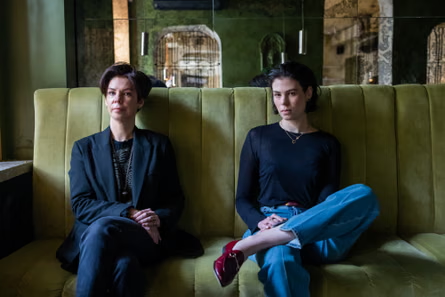
Instead, their daughter Daniella Kaliada has masterminded this project. Today she walks around the iron crucifix in a baseball cap and loafers, making adjustments. The surveillance cameras were bought new but are being sanded to look weathered. Painter Sergey Grinevich shows her a new addition – a smear of green and white paint meant to look like seagull poo. Daniella thinks it’s too much and wipes it off. At 26, she is getting used to wrangling artists older and more stubborn than her.
That includes her mother. My day starts at one of the Kaliadas’ favourite Belarusian cafes in Warsaw, where yellow mimosa hangs from the ceiling and the room is noisy with exiles. Natalia wants me to try syrniki, sweet cottage cheese pancakes, but Daniella makes a face: “I absolutely despise them.” She feels the same way about theatre. “There is always a danger,” she explains, “that a narrative is being broadcast. With visual art, the individual constructs their own.”
Mother and daughter are strikingly similar – emphatic, warm, laser smart – and disagree on everything: how best to motivate a team, the correct amount of rust on metal, where to stand for the Guardian’s photos. “But we agree on quality,” smiles Natalia. “The way we fight behind the scenes, how many nights we cry? Nobody cares.”
Daniella was first interrogated by the Belarusian KGB when she was eight, and has a clear memory of the day her mother was arrested at a protest in 2010. “Nikolai was at home and the doorbell went at 5am. I looked through the peephole and saw six men wearing masks. We sat in the house for six hours, with the doorbell continuously going, our dog barking and the phone ringing. When it stopped, the silence was deafening.”
Natalia was detained for 20 hours and threatened with rape. “You go numb,” she says, “because the worst thing is not to have any control.” Friends were jailed for months and years; the husband of Daniella’s godmother was kidnapped and killed. “In jail, you don’t understand what will happen. And in that moment, your brain freezes.”
Official. Unofficial. Belarus. will attempt to capture both experiences: the numbness of the detained, the fear of those left behind. They also want to make a wider point about digital curbs to personal freedoms. “Belarus is a unique authoritarian combination,” says Daniella, “but we can all relate to the idea of surveillance.” Her mother adds: “In Belarus, I could go with friends to talk in the woods and leave the phone. Now it doesn’t matter whether you leave your phone – there will be drones. There is no place for a human to be safe.”
As the title suggests, their Venice installation is not an official pavilion but a “collateral event” at the Chiesa di San Giovanni Evangelista, because pavilions have to be requested by a ministry of culture. This year, for the first time since its full-scale invasion of Ukraine, Russia has an official pavilion. “It’s a failure of international law and institutions,” says Natalia. “It’s inseparable from the world failure on Ukraine. Who is being legitimised? When the state says, ‘The pavilion is coming’, it means the machinery is coming, the money is coming.”
Russia’s pavilion is curated by Anastasia Karneeva, who runs an art consultancy with the daughter of foreign minister Sergey Lavrov. Her father is an executive at Rostec, Russia’s biggest defence contractor. “It is state-connected at the highest levels,” says Daniella. The Kaliadas hope the pavilion will become a focus for protest – Pussy Riot are promising a takeover – and prompt a review of the biennale’s constitution. “To allow any country to participate, regardless of politics, is outdated,” says Daniella. “If the Olympics can change, why not the biennale?”
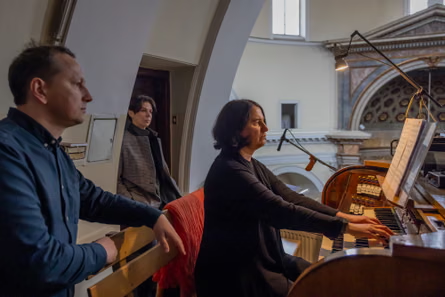
We drive to St Alexander’s, a Catholic church popular with Belarusians that stands on an island in the traffic. Composer Olga Podgaiskaya likens it to Noah’s ark: “In the summer,” she says, “people sit on the floor and it feels like we’re this circle of people who have survived something.” From the upper gallery, she plays the organ piece she has composed for Venice: a 20-minute sequence of alarms, crescendos and silences.
Last November, Podgaiskaya’s husband was kidnapped on a visit to Belarus, detained for 15 days and tortured. “I wanted to scream,” she says. “But when somebody goes to jail, you can’t be loud because they get beaten up.” She hopes people can hear that trauma in her piece, which is “a reminder that evil lives very close by. I also hope the government people who are watching us constantly – I hope I might heal them slightly.” Are the KGB among her audience? “Of course,” says Daniella, who has been translating. “We’re very close to the border. If you think we’re not being followed – well, we are.”
As we drive to the studio, I talk to Khalezin, who has flown in for the day, wearing a natty white overcoat and bearing flowers for his wife. The ball of books is his. “It’s a rereading of the Sisyphus story,” he explains. “The ball has fallen from the mountain and crushed the arm of a bulldozer. Because when books are banned in Belarus, they are shredded and buried in the ground.”
Khalezin also hosts a YouTube cookery show, every week urging Belarusian viewers – joining via VPNs – to watch, then delete and unsubscribe. One recent guest was Stephen Fry. Another was Rasmus Munk, who later tells me his Venice contribution will take the form of a communion wafer, to be served at the church venue. Twenty versions were rejected for being too sweet or crunchy. “The one Natalia and Daniella associated with a lack of hope dissolved instantly,” Munk says. “It’s flavoured with a bud from the ‘toothache plant’ that leaves a numbing sensation, like Sichuan pepper.” He coloured it the grey of the Belarusian army uniform.
At the studio, Grinevich is working on two large canvases – one a row of naked figures crouching or praying, the other a crowd of young men in masks, very like the view Daniella had through her peephole. Between them leans a painting of a wheat field that will hang near a 3D version constructed from the stacked stems. “It will be very ordered, very lifeless,” says Daniella. Above it, they will suspend “straw spiders”, a Belarusian form of dream-catcher fashioned from prison bars by artist Vladimir Tsesler.
Grinevich left Belarus to be here and may never go back. “I stand to lose a lot,” he says. “My workshop, 500 art works, the very beautiful house I built.” He studied for 12 years in Minsk, the capital of Belarus, specialising in monumental art, and points to the country’s strong lineage of exiled painters: Marc Chagall, Chaïm Soutine, Nadia Léger, wife of Fernand. Before Lukashenko’s rule, Grinevich painted Soviet propaganda: portraits of Lenin and murals for army buildings. He says today’s state art is “over-sexualised and amateurish”, marked by its devotion to power rather than skill.
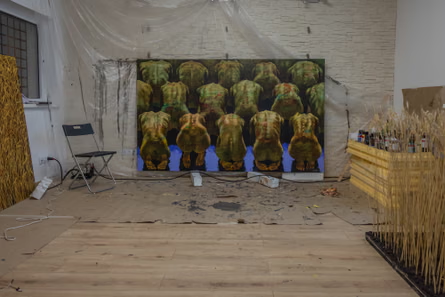
Still, he is not above taking direction: Daniella wants him to tweak the masked men so that there are echoes of other security forces, like America’s ICE agents, and to make them less Belarusian. “Our ICE are not scary-looking,” she says. “They’re young, pretty men from the provinces.”
Earlier, Natalia told her daughter off (very mildly) for being impatient with the older artists, herself included – but the installation might not exist without the arrogance of youth. “When a person of 26 decides to curate a major pavilion,” says her mother, “I ask her, ‘Why do you want to deal with art and politics? Stay away!’ And she says, ‘No, I must, because [younger] generations have to stand up.’ It’s about what we do now in order to have a future.”
Belarus is no longer home, Natalia says, but a collection of memories – her mother’s pancakes, walks in the woods. Their apartment was seized after they left and friends had to delete any trace of contact with them. Natalia doesn’t think about the personal risks – “I cannot spend my energy running” – preferring to focus on art. Next up is an opera based on The Elephant, a satire about repression by Belarusian novelist Sasha Filipenko in which an actual elephant appears in every home in the country.
Natalia wishes the status of Russia and Belarus at the biennale were reversed, that the Russians had had to jump through hoops to be there. But the effort of staging this project has proved to her what a powerful force her people are in exile: more than half of it has been funded, anonymously, by Belarusian businesses.
It feels especially important at a time when borders everywhere are tightening, she says, adding that the fear instilled by an authoritarian regime takes a long time to ebb, if ever. “That if somebody knocks on the door, it means I or Nicolai will be arrested. Daniella told me a couple of years ago, on a walk in Hyde Park, ‘It’s only now that I am slowly getting rid of that.’”