


Sylvia Sleigh wouldn’t paint people if she didn’t find them interesting – and by interesting, I mean attractive. She didn’t idealise nudes like the old masters. Instead, the naked bodies she depicted were really, truly beautiful. Many were friends, among them artists and critics. Others were paid models. Scrolling through images of her radical, realist artworks online, I find myself humming along to the REM song: “Shiny happy people …”
It was surely part of the appeal of Johanna Lawrenson, the elegant brunette with enviably long legs who posed for the 1963 painting The Bridge. Few exhibitions are worth visiting for a single artwork alone, but this monumental canvas is special. Sleigh kept it until her death in 2010, at which point it was donated to a not-for-profit theatre company in New York. Now it’s for sale, and before it’s snapped up there’s a rare chance to see it on show at Malarkey, a small space overlooking Russell Square in London.
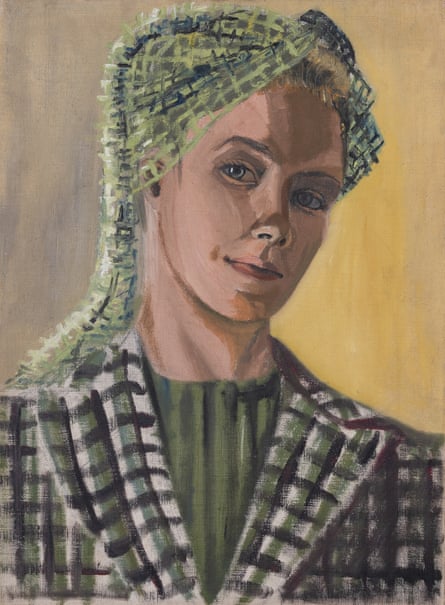
The Bridge is on display alongside seven other paintings by Sleigh, brought together by curator and adviser Daniel Malarkey. There’s her first ever commission, a dappled view of Hampstead Heath painted in 1946, and her earliest-known self-portrait, inquisitive in a green net turban, from 1941. It’s a homecoming of sorts for the artist, who was born in Wales in 1916 and studied at Brighton School of Art before moving to London with her first husband, the painter and gallerist Michael Greenwood. There she attended evening art history classes and met her second husband, the art critic and curator Lawrence Alloway, with whom she moved to the US in 1961, settling in New York.
The Bridge shows Lawrenson reclining on a cream-coloured sofa, her upper-half propped up on one of two bluish-green cushions, in front of a window overlooking the 59th Street Bridge. It was painted in an apartment that Sleigh and Alloway shared on the Upper East Side, facing the East River. Lawrenson’s left arm is bent at the elbow, her rosy cheek resting on top. Her right arm extends along her body, palm to thigh. Her legs are pressed together, and gently overlapping. The eyes are closed.
Sleigh took the subject from Giorgione, whose 1510 painting Sleeping Venus has inspired big hitters from Titian’s Venus of Urbino to Manet’s Olympia. Here, the direction of the nude has been reversed, and the drowsy woman inserted into a modern setting (and afforded a daring flash of pubic hair – unusual to viewers even in the 1960s). Just as the peaks and valleys in Giorgione’s Italianate landscape echo the curves of his pale-skinned goddess, so the bridge parallels Lawrenson’s slender figure, the skeletal steel framework rising and falling in tandem with the nape of her neck, her shoulder, her hip.
There’s no question that Sleigh, whose interest in art history began when her mother showed her books as a child, was intimately acquainted with the objectification of women on museum walls. She once said that the reason she painted nude men as well as nude women was because she wanted to give her perspective, “portraying both sexes with dignity and humanism. It was very necessary to do this because women had often been painted as objects of desire in humiliating poses. I don’t mind the ‘desire’ part, it’s the ‘object’ that’s not very nice.” I like to picture her, paintbrush in hand, lining up body and bridge with a wry smile.
According to Andrew Hottle, who’s writing a monograph on Sleigh and preparing the catalogue raisonné of her paintings, she wasn’t an overt feminist so much as an artist experimenting with the nude. Even later, when she helped to found the all-female SoHo20 Gallery, she was never out on the street, marching with picket signs. Her version of feminism was more intellectual, he says. “She was around 47 when she painted this, and she’d been exploring the nude model for years. It was her largest painting up to that point, and a culmination of her experiments.”
Lawrenson, who later became the partner of the notorious activist Abbie Hoffman, was working at the time as an artist’s model. She posed for high-fashion photographers and participated in at least one performance piece by Claes Oldenburg. This was the only time Sleigh painted her, and since Lawrenson wasn’t a friend, she was probably paid. Whether painting a friend or a professional model, Sleigh’s standard was to talk as she worked. She was interested in people, and she was chatty.
She painted slowly and methodically, with thin layers of oil paint. Apparently, she built up bodies with seven layers of subtly different flesh tones because there are seven layers of skin. Which is why Lawrenson’s face is so dewy, her legs luminous; against the cushions, which verge on flat, her body pops. Usually, Sleigh worked on two or three paintings at once, moving between them as the layers dried, turning her attention to the background when a sitter wasn’t around. For The Bridge, she jotted down in her diary eight sessions with Lawrenson, totalling about 30 hours.
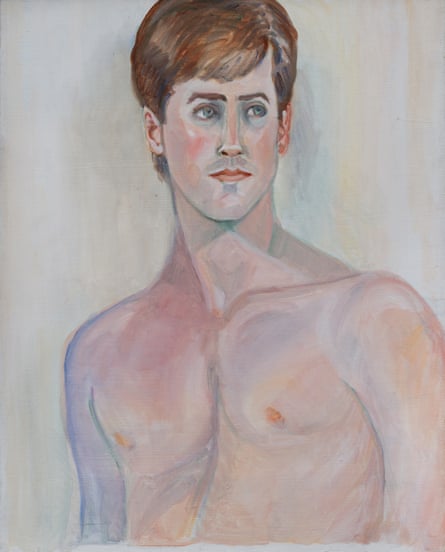
When I think of Sleigh, I think primarily of her male nudes: The Turkish Bath, a fabulously modern 1973 interpretation of Ingres’s painting of the same name using male bathers; the very many nude portraits of Paul Rosano, a musician and artists’ model with soft, curly body hair; Alloway as an audaciously effeminate bride. Hanging opposite The Bridge at Malarkey is a small painting of a topless young man called Robert, with peachy lips and grey-blue eyes.
I asked Hottle how the female nudes sit alongside their male counterparts. “Nude, clothed – to her, it was all just the human condition. In Sleigh’s mind, it wasn’t odd to see a nude male or a nude female, just as it wasn’t odd to see a clothed male or a clothed female.”
Above all, she thought of herself as a portraitist, who showed people at their best. The result, with The Bridge, is a painting that’s sensuous but not sexual, an ideal in reality. A real woman who’s really beautiful.