


As one of Britain’s leading TV sports presenters for the best part of three decades, Sue Barker has always been more comfortable asking questions than answering them. Many who watched her relaxed, confident style as she presented coverage of Wimbledon from 1993 to 2022 probably did not know she was once a tennis player herself. Fewer still would have known that Barker is a grand slam champion.
Her finest hour came at Roland Garros in 1976, when she won her first and only slam title, beating the Czech Renata Tomanova in three sets. This year’s event, which begins on Sunday, marks the 50th anniversary of Barker’s win. Following in the footsteps of Christine Truman, who won in 1959, and Ann Jones, who did it twice, in 1961 and 1966, Barker is the last British player, man or woman, to triumph in Paris.
It remains one of the finest achievements in British tennis, and has a claim to be one of the most underrated in British sport. It does not help that the 1976 final was not shown live on television due, reportedly, to a strike by French camera technicians. It is also, no doubt, because of what happened at Wimbledon the following year, when Virginia Wade won the title most coveted by British players. Barker was upset by the Dutchwoman, Betty Stöve, in the semi-finals, a loss that hurt so much she could not bring herself to watch the final. Instead she went out and spent a good chunk of her £3,500 prize money on jewellery.
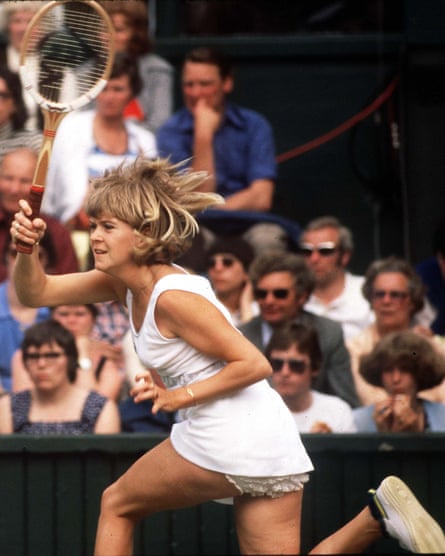
Barker politely declined an interview request to mark the anniversary of her win in Paris, not wanting to look back too much. “It’s funny how some people look at their losses,” the former British No 1 Jo Durie says. “I know she was really disappointed in 1977 when she knew she could beat Virginia [but lost to Stöve].” Durie, who is four years younger than Barker, feels she should be enormously proud of what she achieved. “Virginia’s win was a bigger inspiration because it was Wimbledon and that’s the one everyone wants to win. But when Sue won in Paris, it made me think, if she can do it then maybe I can do it.”
At only 20 years old, it seemed as if Barker would go on to bigger things, but after missing out at Wimbledon the following year, her career was cut short by injury and she retired in 1984. “Winning the French Open was magical,” she told the Isle of Wight literary festival last year, when touring with her book: Wimbledon: A Personal History. “Of course, I thought it was the first of many, so I didn’t really celebrate that well. If I’d known it was my only one I really would have gone to town.”
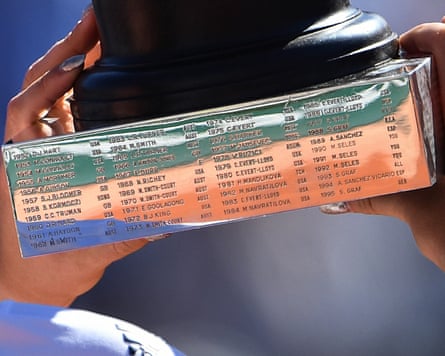
In fact, after a couple of quick glasses of champagne, Barker flew home, losing her trophy and medal in the process. When Ash Barty won the French Open in 2019, she became the first Australian woman to do so since Margaret Court in 1973, but as she scanned the list of names on the trophy, she was surprised to see that Barker was also listed as an Australian. In a 2022 interview with BBC Sport, Barker said she did not care too much. “I think it’s because I used to play so much in Australia that people used to think I was Australian,” she said. “There weren’t that many British players on the clay. But it doesn’t really bother me, I knew I’d won it.” At the time, embarrassed tournament organisers vowed to make the necessary correction, but the French Tennis Federation did not respond to the Guardian when asked if the alteration has been made.
Ranked No 3 at her peak in 1977, Barker was a good athlete and possessed a forehand that was the envy of her rivals, good enough to pick up victories over Chris Evert, Martina Navratilova and Billie Jean King, only for her career to be cut short by injury. “Sue could beat anyone on her day, she knew that,” Durie says. With Evert, Navratilova and King all absent in 1976, she was also the No 1 seed in Paris so had to deal with high expectations. “I looked back at her draw,” Durie said. “She had a close one in the quarter-finals [against Regina Marsikova], then [Virginia] Ruzici was a great player on clay and Tomanova in the final, they were good wins. She was expected to win too, so she had that pressure.”
Ruzici won Roland Garros in 1978 and after her playing career, was the longtime manager of her fellow Romanian Simona Halep. Ruzici found Barker too good on the day. “We had similar styles,” Ruzici says. “She had the big forehand and more of a slice backhand, although with time, she started to drive it more.”
Like Barker, Ruzici’s win at Roland Garros came when Evert was again missing. “I was lucky in 1978 when I won, because Chris Evert didn’t play,” she says. “Chris was my bête noire, she beat me about 20 times. But what counts is having the title, because you have it for ever, and it’s there in the books. In the long run, that’s what counts.”
For all the disappointment of Wimbledon in 1977, Barker would surely agree.