


Over a decade ago, in a more affordable though no less cutthroat era of New York City, the film-maker Debra Granik met Coss Marte at a diner in Manhattan’s Lower East Side. Granik, a chronicler of rugged self-reliance in the features Leave No Trace and Winter’s Bone, was interested in making a drama on recalibrating to life after prison. Marte, a former drug dealer incarcerated for seven years by the time he was 27, was an expert. After developing his own workout while serving five years in prison, he had come up with a business plan for a gym run entirely by fellow returning citizens. “I lost over 70lbs in six months in a prison cell, and now I’m hiring people coming out of the prison system to teach fitness classes,” he would say, joking that his six by nine cell for solitary confinement was a similar size to some New York apartments.
Granik was fascinated. “He was defying all the odds,” the film-maker told me on a Zoom call this April. That Marte was set on becoming a successful entrepreneur by employing people almost entirely out of the carceral system was near unprecedented. “Coss was like, ‘I don’t know where my destiny will lead me, but I am using all my energy to not get re-ensnared in the criminal justice system.’” Granik recalled. So she started filming a documentary. “From there, we just never stopped recording,” Marte told me.
The result, some 12 years later, is Conbody vs Everybody, a singular, sprawling portrait of redemption and hard-earned resilience in one of New York’s most rapidly gentrified neighborhoods, told through the hub of one unlikely gym. The five-hour series, culled from hundreds of hours filmed over eight years and playing on the Criterion Channel in the US, begins with Marte’s pitch and expands outward, tracing a web of people who found a job, a purpose and a community through a gym often on a razor’s edge. From denied investments to evictions, byzantine parole rules to the looming maw of the carceral state, “it’s been a journey to go through so many nos and continuously bang on that wall and make sure we get a yes somewhere, somehow”, said Marte.
The diffuse series – Granik likens it, accurately, to an “urban novel” – also offers a time-lapse view of a neighborhood in flux, as largely white, so-called knowledge workers moved into a traditionally working-class, immigrant neighborhood over the course of the 2010s.
A born hustler and child of Dominican immigrants – his mother worked at a clothing factory, his father ran a bodega – Marte grew up in the Lower East Side, and recognized a business opportunity when he returned to his transformed childhood block post-incarceration. Boutique fitness classes were booming and the population was amenable to both cause-oriented businesses and cheeky Instagram marketing. Marte proved to be a master code-switcher, selling customers on Conbody’s arduous bodyweight classes and #dothetime sloganeering as well as a handful of investors on a business staffed by people many dismissed out of hand. “We’re bringing the bougie people to the hood” he jokes early in the series. But don’t worry, he assured potential investors: “We’re not scaring away the white people.”
Still, the business faced more and more arbitrary hurdles and prejudice from people skeptical about trusting former felons. (“They’re going to eat you alive,” one particularly Shark Tank-y early advisor tells him.) Early scenes show the entrepreneur struggling with nerves before pitch sessions to investors, many of whom consider the employment of convicted felons to be too much of a liability – evincing, as Granik put it, “the disjuncture between the ‘everything’s possible, capitalism 2.0, it’s so egalitarian that all you need is a good idea’,” ethos of the mid-2010s, and “actually getting social and financial capital”.
An early iteration of the gym is forced to move, because they share a building with a preschool. Because some parole agreements – or, as Granik put it, “methods to cause madness” – barred “fraternizing” with other convicted felons, some early employees faced the impossible choice of keeping a good job or breaking the law. An early episode sees Marte and founding trainer Sultan Malik attempt to free a coworker, Shane, after he is jailed for violations of parole at Rikers Island; traveling from Long Island to the LES to teach fitness classes was deemed a punishable, risky offense.
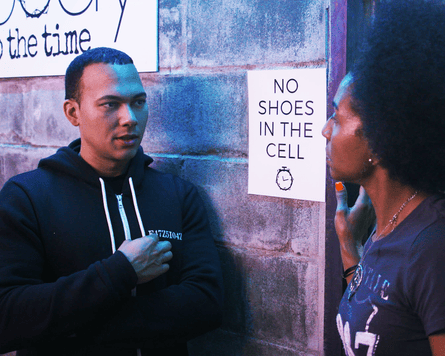
Later episodes find Conbody in less precarious financial positions (the pandemic notwithstanding) though always still hustling – looking to expand, looking to hire ever more newly released people. In time, Marte acts as both an employer and a mentor through the turbulence that is re-entry to a society that fundamentally does not believe in rehabilitation. He’s there when Tommy, freed after 27 years, sleeps at the gym as he struggles to find adequate housing. When another, Jamal, loses his son to gun violence. When Syretta, a rare female instructor among the group building a fitness career after nearly 23 years in prison, gets her first instructor feedback, crucial positive reinforcement and stares down the end of years-long parole. When many of them apply to other gyms with assurances of getting hired, only to be barred due to their criminal records.
Marte “was so aware of the weirdly uncomfortable and dangerous timeline of re-entry for the men and women that were joining him”, said Granik. For many new Conbody employees, the first year features many ups – first day on your own time, first apartment, first legit paycheck. Also, the first time you’re told you can’t be hired because of your criminal record, first time you’re told you’ll never make enough money to live in the neighborhood – all the collateral consequences of a criminal background. “Coss was savvy,” said Granik, “knowing that while it was novel to see a camera record him on the street in flashy, public moments, there were private moments where this was a much deeper commitment to exploring what re-entry feels like.”
All the while, the neighborhood continued to change. Luxury builds replaced old tenements; construction sites loomed over the old bodegas. Video tours of LES apartments invited prospective tenants to live “at the intersection of grit and glamor”, while Conbody was forced to relocate due to a lease that was not renewed; in one episode, Marte and his friends search for a new home by peering into vacant storefronts under renovation, many of them soon going for $20,000-30,000 a month. In one of the more striking, very 2010s images of the series, Conbody operates a gym pop-up – complete with chain-link fence iconography and their standard client “mug shots” – inside a Saks Fifth Avenue store. (Apparently, the retailer hoped endorphins would lead to more in-store purchases.)
“Gentrification is a big sprawling term that becomes empty, becomes ugly. It becomes misunderstood,” said Granik. “And I had never seen it moment by moment. Notification by notification. That was a part of the story that was unfolding right in front of us.”

Years into her filming, Marte’s younger brother, Christopher Marte, ran for city council to fight local displacement and privatization after years within the Black Lives Matter movement. Elected in 2022, the younger Marte continues to work in the halls of power; the elder Marte, at first, wary of protest and politics on the streets. By series end, he is entering prisons around the country as an advocate for the incarcerated, offering both practical fitness classes and a vision of life beyond bars. “The hardest thing that we’re going to face as a society is to embrace the willingness to change, in prison reform and rehabilitation,” Marte said. “That’s the hardest thing we’re going to tackle. What’s real justice, right?”
“I feel like what we’re doing is real justice,” he added. The Conbody team visits Rikers, trains youth inside juvenile facilities, and is now hiring more formerly incarcerated people for Conbud, Marte’s cannabis company operating in New York’s nascent legal market. “It’s a different justice when you get out and you have a check in week one, instead of $40 and a bus ticket, and don’t know when you’re going to get a job and you’re saving your coupons from your EBT [electronic benefits transfer] card,” he said. “How do you live like that in New York City in 2026? You can’t.”
The series is “testimony that what we built has worked”, he added. “It’s at a very minute scale.” In New York, 188,000 people are released from prison every year, a statistic that bookends the five chapters. Conbody and Conbud employ dozens, each one a distinct defiance of the odds and daunting obstacles. Looking at each individual is “what I want people to really get from this”, Marte said of the prospect that this extended record will now reach viewers. “If they’re seeing somebody come out of the system, look at them different and change perceptions. Come and see what we’re doing. Support us.”
-
Conbody vs Everybody is showing on Criterion Channel in the US from 1 May with UK and Australia release dates to be announced