





The coroner’s court in England has been criticised by families of domestic violence victims for an unwillingness to consider how abuse can drive people to suicide.
Grieving loved ones of those who have taken their own lives after abuse said it was not a “joined-up process” whether inquests into suicide deaths consider the treatment victims were subjected to while they were alive.
It is up to individual coroners to decide what evidence will be considered in the scope of the inquest, and up to them whether they will look at just the days and weeks prior to a person’s death, or hear evidence from a much wider timeframe – which can include the months and years of an abusive relationship.
Most cases where someone has taken their own life after domestic abuse do not end in a criminal trial, which means that an inquest is often the first, or only, opportunity for allegations of abuse to be heard in any formal setting.
There is also no appeals process for families and lawyers to turn to if a coroner decides not to hear the evidence they had asked to be included.
“It’s incredibly frustrating and feels like a postcode lottery based on where someone died – which cannot be correct,” Helen Boniface, counsel at Hogan Lovells, said.
“The challenge for a bereaved family is that there is then no easy route to challenge a coroner’s inquest. Judicial review, which would be the legal route in these circumstances, is expensive, involves a risk of adverse costs if the challenge is unsuccessful, and perhaps most importantly extends the process even further, which is an emotional toll that many families simply cannot face.”
The Guardian has been investigating the issue of domestic abuse suicides in a series of reports that tell the story of women whose deaths came after sustained mistreatment.
In September last year, in a landmark verdict, a coroner found that Georgia Barter had been unlawfully killed by her former partner Thomas Bignell, when she took a fatal overdose after years of domestic abuse.

Inquests have a different burden of proof to criminal courts, finding on the balance of probabilities rather than the criminal threshold of beyond reasonable doubt. There is no criminal due process and nobody is convicted or acquitted.
Bignell has not been charged with or convicted of any offences in criminal court in relation to his alleged violence towards Georgia, or her death.
During the inquest, however, the coroner heard evidence from family members, police reports and medical professionals, detailing how he abused Georgia over several years.
In other cases, families have been left battling with coroners who have said they will only consider the period of time immediately before someone taking their own life.
“Half of the problems in terms of lack of access to justice for these bereaved families is to do with the fact that they have such inconsistent responses from coroners,” said Pragna Patel from Project Resist, a campaign group for affected families.
“There seems to be no coordinated attempt to ensure a much more consistent response to these kinds of cases and to wider backgrounds of domestic abuse and coercive control.”
Project Resist is campaigning for police to treat all suicides where domestic abuse is involved as a potential homicide, but Patel said its campaign is also aimed at coroner’s courts.
“It’s not just about how the police investigate,” she said, “but how we can bring about greater consistency in the inquest system itself, and how the coroners take it upon themselves to ensure that their remit is broad enough to look at coercive controlling and domestic abuse dynamics.”
Frank Mullane, from Advocacy After Fatal Domestic Abuse, said that while “some coroners do get it right”, that AAFDA “regularly witness coroners limiting the examination of domestic abuse in the scope of inquests”.
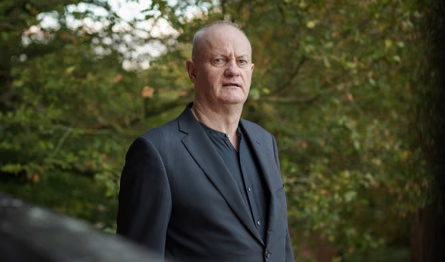
“For example,” he said, “restricting the scope to the day of death, and considering that to be a satisfactory examination of the domestic abuse reveals an ignorance of the cumulative, sustained and patterned nature of domestic abuse.
“It also denies the inquest the chance to understand multiple opportunities to prevent death,” he added. “The government’s VAWG [violence against women and girls] strategy requires a whole systems approach and that includes the actions of coroners. The terrible losses and broken bereaved families caused by domestic abuse have long been superficially treated by some inquests.
“It’s as if domestic abuse is a lower status death. Coroners have a critical role to play in public protection and to do that successfully, they need to fully and properly understand and investigate domestic abuse.”
The family of a woman who died after suffering abuse have also criticised the coronial system for failing to consider how domestic abuse may have contributed to her death.
They commissioned an independent safeguarding review, which identified a “problematic” and “potentially controlling and coercive” relationship between the woman and her partner.
An inquest into her death recorded a narrative conclusion, finding that she had died after being struck by a train, but that it had not been possible to determine why she was on the track, or whether she intended to end her life.
However, her brother said: “Our concern has always been that, although important safeguarding issues were identified, they were never fully explored within a single, joined-up process.
“The inquest focused on the immediate circumstances of her death, but wider contextual issues – including those raised in the independent safeguarding review – were left outside its scope,” he added.
“That means key questions about the full picture remain unanswered, with no clear mechanism for families to have those wider concerns independently reviewed where they fall outside the scope of an inquest.”
“It remains surprising that there is no guidance from the chief coroner focused on investigating cases involving domestic abuse,” Boniface said.
“This is not about removing the discretion of a coroner. Instead, it is recognising that domestic abuse is a challenging area, and guidance would assist bereaved families, those facing allegations of abuse, and the coroners tasked by law with investigating these deaths.”
-
In the UK, Samaritans can be contacted on 116 123 and the domestic abuse helpline is 0808 2000 247. In Australia, the crisis support service Lifeline is on 13 11 14 and the national family violence counselling service is on 1800 737 732. In the US, the suicide prevention lifeline is 1-800-273-8255 and the domestic violence hotline is 1-800-799-SAFE (7233). Other international helplines can be found via www.befrienders.org