




It is a book that records the 19th-century descendants of some of the most notorious troublemakers in naval history: the sailors responsible for the mutiny on the Bounty.
Now, the Pitcairn Register – a handwritten volume that registered the births, marriages and deaths of the children, grandchildren and great-grandchildren of the mutineers and the Tahitian women they enslaved – is finally returning home to the South Pacific.
After seizing control of HMS Bounty in 1789 and kidnapping some Polynesian women from Tahiti, nine of the mutineers arrived on the uninhabited Pitcairn Island in 1790 and decided to hide there from the Royal Navy. They brought along 12 Polynesian women, a 10-month-old Polynesian girl and six Polynesian men, who they forced into slavery.
When the sailor George Hunn Nobbs visited the island nearly 40 years later, he found the offspring of the mutineers had formed a devout Christian community. n English shipwright, John Buffett, had joined them and was recording all their births, marriages and deaths in the register. Nobbs later took on the task himself.
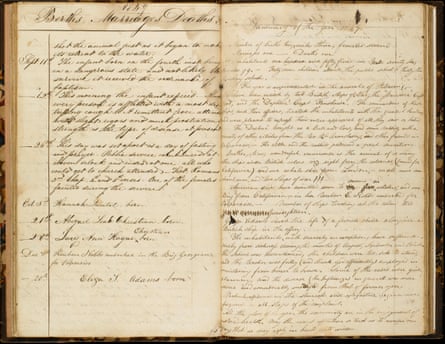
The register got wet in 1854, so Nobbs gave it away to an acquaintance in England, noting that the “dilapidated” handwritten manuscript might “amuse” his friend “over his after-dinner toast and water”. It was later donated to the National Maritime Museum, in London.
Now, the museum is lending the register to the Norfolk Island Museum Trust (NIMT) so it can go on display on Norfolk Island, a remote island governed by Australia in the South Pacific Ocean, for the first time.
More than 25% of the 2,188 people who live on Norfolk Island can trace their ancestry to the mutineers, and some descendants made a formal request and crowdfunded about A$26,000 (£13,700) to bring the register “home” for the island’s annual Bounty Day celebrations on 8 June.
“It’s a foundational document of the Pitcairn and Norfolk Island people,” said the NIMT chair, Dr Pauline Reynolds. She is descended from six of the mutineers and their Polynesian spouses, including the mutiny instigator, Fletcher Christian, and his wife, Mauatua, and has researched the histories of the women on Pitcairn and Norfolk Islands.
Historically, she said, “there’s been quite a male narrative about the Bounty. But the Pitcairn Register tells the story of us, the women, as well”. Without the skills of the Indigenous women, who knew how to make cloth, cultivate local crops and administer herbal medicines, the community would have struggled to survive.
The mutineers treated the highly educated, landowning Tahitian men they had brought with them “like slaves”, she said, leading to conflict and murder: by 1794, the register shows all six of the Polynesian men and five of the mutineers were dead. “In amongst that, you’ve got mothers trying to protect their children. At one stage, according to the register, the women built a raft to escape, but of course it failed and fell apart.”
By 1808, when a passing whaling ship made contact with the community after 18 years of isolation, only one mutineer was still alive, along with 10 Tahitian women and the first generation of children on the island.
The register revealed how “extraordinarily resilient” and resourceful they were to survive, said Helen Mears, the head of curatorship at the National Maritime Museum, and it added to the complexity of stories about the mutiny on the Bounty.
The experiences of Polynesian men and women had been erased from a narrative about an “iconic historical moment in British maritime history” that had previously been told “very much from a male, anglocentric lens” as a psychodrama between a European captain and his men, she said.
“As institutions, we’re interested in history, but we’re also interested in the legacy of history,” she said. “I think the connection with Pauline and other members of the Norfolk Island and Pitcairn Island communities has really enriched our understanding of the register and its significance for descendants, as well as our understanding of this moment in [maritime] history and its legacy.”
Mears said she had found working with Reynolds and other descendants inspiring and was lending the registry to NIMT for at least three years: “This loan, I hope, is the starting point for an ongoing collaboration.”
Reynolds said: “There’s a lot of places in the world that will not work on these things, so to get the full support of the National Maritime Museum has been phenomenal.”
She said she expected the arrival of the register would be a “very emotional” moment for her community. “It’s sacred to us,” she said. “It tells the beginning of our people. It contains who we are.”
此内容由惯性聚合(RSS阅读器)自动聚合整理,仅供阅读参考。 原文来自 — 版权归原作者所有。