








T rex is often depicted as more brawn than brains, but now scientists are hoping to probe just what was going on inside its head, drawing on findings from another kind of dinosaur: birds.
Scientists have previously found some species of bird not only make and use tools, but are able to plan ahead and show basic forms of empathy – with laboratory tests suggesting emus can recognise other birds might have different experiences to themselves.
Now researchers say they are hoping to explore whether there might be telltale hints of these capabilities in the skull, opening up the potential to probe the lived experience of dinosaurs like T rex.
“We can’t put T rex through those tests,” said Prof Steve Brusatte, a palaeontologist at the University of Edinburgh. “But if there are some distinctive features of the brain that maybe tell you with 95% confidence that the animal with that kind of brain is capable of that kind of behaviour today, then we can at least make predictions about these fossils.”
Writing in his new book, The Story of Birds, Brusatte describes how he is working with an international team of researchers to explore such possibilities, adding that scientists are also looking for evidence from shared behaviour seen in modern animals.
The approach might be something of a long shot. But it wouldn’t be the first where birds and their ancestors are concerned: because while many dinosaurs were wiped out when a colossal asteroid struck Earth 66m years ago, one group survived.
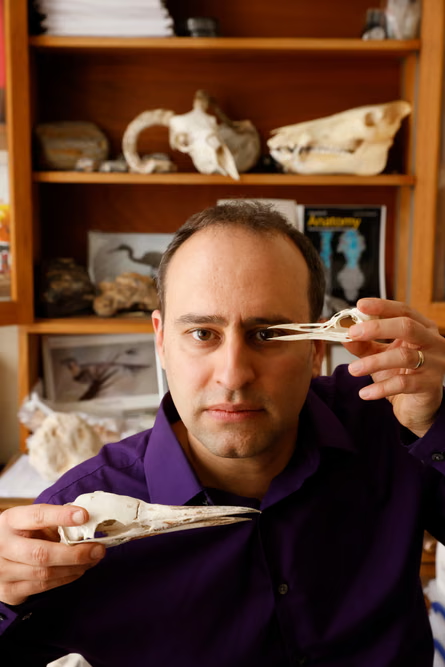
“I don’t think it’s totally percolated into the popular consciousness that birds are dinosaurs,” said Brusatte. “They are real, true dinosaurs. This is not a turn of phrase.”
The Story of Birds swoops through the incredible journey of avian-kind, revealing how small cousins of Velociraptors eventually gave rise to the panoply of birdlife around us today.
“It’s not like a T rex mutated into a chicken one day, and that’s how you got a bird from a dinosaur,” says Brusatte. “It was a long, gradual process of evolution through natural selection.”
As Brusatte notes, features including feathers and wings initially had nothing to do with flight.
“It just so happened that you had feathers that had probably originally evolved for insulation to keep these dinosaurs warm. They’ve been modified into these display structures, these advertising billboards sticking off of the arms of some of these dinosaurs [as wings],” he said, noting that without planning some dinosaurs became small enough, and had wings big enough, to gain a little lift and thrust.
As Brusatte explains, some early birds had teeth, claws or long tails and there were likely many different approaches to getting lift-off. “There was a whole fantastic aviary of birds flapping and fluttering overhead of T rex and Triceratops until the asteroid hit,” he said. “All of those birds then died. Except for the modern-style birds.”
These lucky survivors of the fifth mass extinction had, it seems, a good hand of cards. Not only were they strong flyers, but they grew rapidly from chick to adult, lived on the ground and waded in shallow water – a bonus given forests collapsed in the “impact winter” that followed the disaster. What’s more, they had toothless beaks that meant they could eat seeds – a food that remains in the soil even after trees, leaves and fruits are gone.
But evolution soon gave rise to creatures every bit as fearsome as the dinosaurs that had perished. Among them were the terror birds – creatures that stalked South America for tens of millions of years, reaching up to 10 foot in height, with a head larger than a horse’s skull, fearsome claws on each foot and a beak that was both hooked and razor sharp.
“This was basically T rex reincarnated, a top predator, really big, tiny little arms, ferocious head,” said Brusatte.
That birds today are every bit as much of a dinosaur as the land-shaking sauropods or stocky triceratops that once roamed the planet is not just borne out by fossils. It is also revealed in their DNA. As Brusatte notes, a six-day-old quail embryo has pelvis that looks just like the hips of a theropod like T rex. What’s more, by tinkering with the genes of a chicken in an egg it is possible to trigger, albeit fatally for the chick, the development of teeth.
“When I look at these things and I see the photos of these genetic experiments, and I read the research papers, my mind is blown,” says Brusatte.
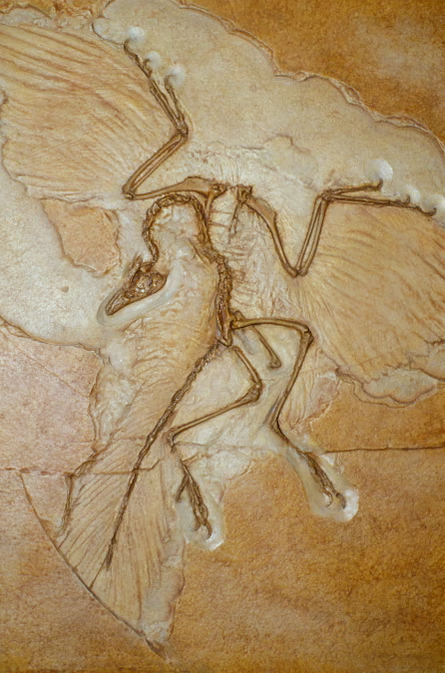
The Story of Birds is not short on charismatic creatures, from the 150m-year-old Archaeopteryx – the oldest fossil bird that became crucial in the fight to establish the theory of evolution – to the enormous “Demon Ducks”, whose eggs were eaten by the first Australian settlers, flightless birds like the doomed Dodo, and the hoatzin, a punky leaf-eating bird that lives in South America today and is constantly belching.
But while Brusatte voices concern over the threats facing birds today – from avian flu to habitat loss, poisons, killer cats and glass buildings – he is upbeat.
“Birds are survivors. They are adaptable, they evolve quickly, they change quickly,” he said.
“When they are confronted with a crisis, maybe not all of them make it through, but some of them do, and they can repopulate really quickly. That is the story of the asteroid. They were the only dinosaurs to survive.”