








Aryna Sabalenka insisted the player push for a greater financial contribution from the grand slams is primarily focused on improving the welfare of lower-ranked players as the world’s elite advanced with their eve-of-tournament protest at Roland Garros.
“I feel like the whole point here, it’s not about me,” Sabalenka said. “It’s about the players who are lower in the ranking, who are suffering. It’s not easy to live in this tennis world with that percentage that we are earning.
“As the world No 1, I feel like I have to stand up and to fight for those players, for lower-level players, for players who are coming back after injuries, the upcoming generation. I feel like our point is pretty clear and pretty fair to everyone. That’s what we are all about.”
The top players opted to escalate their frustrations with the grand slams during media day at Roland Garros by refusing to participate in all but the mandatory media interviews.
Players usually allocate 60-90 minutes of their time for various interviews with broadcasters and written press, photoshoots and social media games, but the players planned to cap their media duties at 15 minutes, a symbolic figure chosen to represent the roughly 15% of average revenue allocated to player prize money by the grand slams. They agreed to split their time between a 10-minute press conference and a five-minute interview with the host broadcaster, their two mandatory duties.
A number of top players have been in dispute with the grand slam tournaments for over a year after sending a signed letter requesting the grand slams to allocate more of their tournament revenues to prize money, contribute to player welfare initiatives, such as a pension, and to create a grand slam player council so that the players have a greater say in the event.
The participants included the No 1s Sabalenka and Jannik Sinner, plus the top-10 players Iga Swiatek, Coco Gauff, Jessica Pegula, Mirra Andreeva, Félix Auger-Aliassime, Ben Shelton, Daniil Medvedev and Taylor Fritz.
Andrey Rublev, the men’s world No 13 and a member of the association of tennis players’ (ATP) advisory council, said: “It’s not only about the money and stuff like that. There are many aspects. They don’t hear you. They don’t answer.
“Just to give you an example: when you send the mail, no one responds to official mail for months. It’s like, ‘Come on, guys.’ We are together, or you completely don’t care that much that you cannot even communicate.” There were no dramatic walkouts or players abruptly ending their press conferences mid-sentence. Many certainly spent more than 10 minutes in their press conferences and 15 minutes overall.
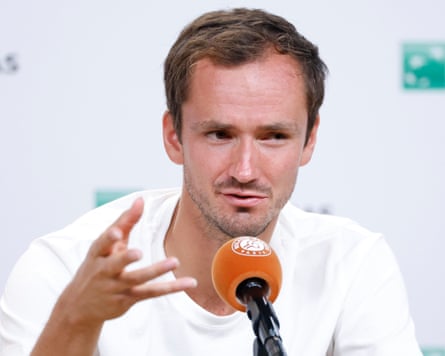
However, throughout the day, the players navigated these unique circumstances in different ways. Despite the moderator calling an end to Medvedev’s press conference, a dogged Russian-language journalist managed to squeeze in two more questions. Medvedev graciously answered, stretching his press conference past the 15-minute mark.
Gauff, meanwhile, took a more direct approach. She discreetly put her phone down on the table in front of her, which was not visible to her audience, and she started a timer before fielding her first question. Nine minutes in, after the moderator asked for any further questions, Gauff looked down at the table: “I have about, like, one minute left,” she said, laughing. Asked whether she had been timing the press conference, Gauff responded with further laughter: “Yes, I’ve got to be strict,” she said. At the 10-minute mark, she personally excused herself from the press conference.
Towards the end of her press conference, Sabalenka glanced over to her agent on the side of the room, who held up one finger while mouthing “one more question”.
The Belarusian then assumed the role of moderator, marking an end to the interview herself. “And now it’s time for national language, and thank you so much for being here, for asking questions,” she said. “As I said a thousand times today, I have huge respect [for you], but we know what’s happening here, so thank you so much.”
The most high-profile omission from the protests was Novak Djokovic, who chose not to participate. The winner of 24 grand slams has been part of various player-power initiatives over the years, both in his time as the ATP council president and founder of the PTPA (Professional Tennis Players Association), but he has recused himself from these initiatives late in his career.
Still, Djokovic, who turned 39 on Friday, said he remains on the side of the players and that tennis should learn from the fractured nature of golf, with the emergence of the LIV tour: “Let’s try to be a bit more united and have a unifying voice into finding better structure and a better future for our sport, because now is the right time.”
Medvedev described this as the most unified he had seen the top players. “It’s good, because it’s probably the first time, at least in my span on the tour, where players are kind of really united,” he said.