


Six decades after David Hockney painted A Bigger Splash, his most famous painting, reproductions have become a visual motif in gay domestic life. I’ve seen framed posters, prints and postcards of the work – which captures the moment after a person jumps off a diving board into an otherwise still cyan blue swimming pool – in countless gay households. In my flat, it appears on a cushion cover that I bought after seeing the real thing at Hockney’s 2017 Tate Britain retrospective.
It’s fitting that A Bigger Splash is now emblematic of this pioneer. As an out gay artist who depicted same-sex desire in his work long before male homosexuality was partly decriminalised in England and Wales, Hockney and his paintings challenged the homophobia within the artistic establishment and beyond. And he did so not through the use of highly sexualised imagery, like the photographer Robert Mapplethorpe, or with the activist themes of painter Keith Haring, but by reshaping our ideas of beauty, intimacy and desire. That’s how he made the biggest splash.
In 1961, when a student at London’s Royal College of Art, Hockney painted one of the earliest expressions of queer identity in British art. We Two Boys Together Clinging is a childlike painting that shows two figures embracing – and perhaps kissing. The title, which is unavoidably written across the painting, stems from a poem by Walt Whitman that had long been embraced by gay readers for its characterisation of physical closeness and companionship between men. It’s a reference that only some viewers would understand, which was obscure enough to avoid censorship laws at the time.

Hockney’s winking way continued on Cleaning Teeth, Early Evening (10pm) W11, painted in 1962. As the title suggests, it features two figures – presumably but not explicitly men – brushing their teeth before bed. That sounds innocent enough, until you see the suggestive positioning of two red Colgate toothpaste tubes shooting toothpaste into each other’s mouths. Again, there’s a campiness to how Hockney leaves very little to the imagination of those who are “in the know” – while still maintaining a claim of innocence in the minds of the masses. It’s an early form of the type of coding that would soon become deeply embedded within queer culture, where visual signifiers such as hankies and earrings were used to identify each other safely.
When Hockney moved to Los Angeles in 1964 – five years before New York’s Stonewall uprising launched the western Pride movement – he found greater freedom to live openly as a gay man. His work portrayed California as a fantasy land of swimming pools, immaculate green lawns, palm trees and the rolling Hollywood hills. His depictions of men – and intimate relationships – became less abstract. In Peter Getting Out of Nick’s Pool, we see a nude young man getting out of a swimming pool, with his bare cheeks the focal point of the painting. An image like this – centring the archetypal twink as a figure of male desire – was highly controversial at the time. Other images, such as 1965’s California depicts two men on lilos, floating nude on the surface of the water, while Portrait of an Artist (Pool With Two Figures) shows a clothed man peering down as another man in white trunks swims.
What’s so revolutionary about Hockney’s paintings is not just that they portray male nudity and desire, but scenes of domesticity: men swimming, showering and brushing their teeth together. This was a time when being gay was not thought of as an “identity” but defined by physical acts. In the UK, it was criminalised by a mixture of privacy and decency laws, which prevented kissing or holding hands in public, and of course the act of “buggery”. There is an obvious arousal to how Hockney’s portraits hint at sex while never portraying it explicitly, but there’s also a tenderness to them. They underlined that gay intimacy and friendship could be seen as beautiful – that same-sex desire didn’t have to be tied to loneliness or tragedy, but could be full of pleasure.
Hockney provided a meeting point between queer identity, fine art and the decorative arts. In the 1960s, Andy Warhol initially struggled to be taken seriously by the New York art establishment, which favoured more “high art” (and straight) artists such as Jackson Pollock and Willem de Kooning. Hockney’s paintings were not only overtly gay, but unashamedly decorative, too, featuring patterned armchairs and floral shower curtains.
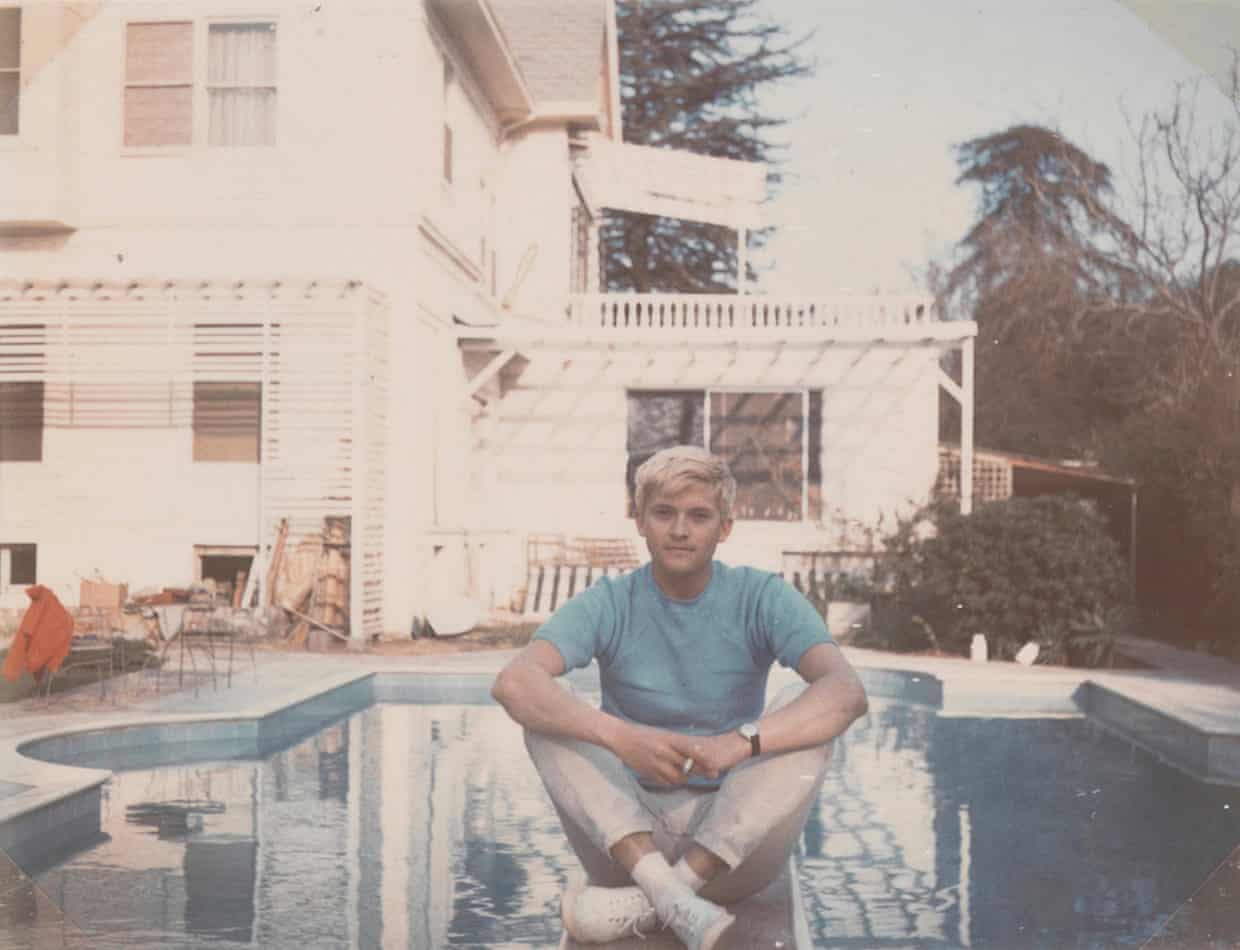
He was influenced by his surroundings, but also his intense friendship with Ossie Clark – one of the most famous fashion designers of 60s and 70s Britain. After meeting as students at the Royal College of Art, the pair had a platonic relationship that fed into their work. When Hockney received critical acclaim for paintings that reimagined the surface of a swimming pool as a patterned textile, where flowing lines imitated the ripples of the water, he proved that “decorative” should no longer be a dirty word, or the preserve of frivolous “low art”.
Unlike gay artists such as Haring and David Wojnarowicz, whose work combined art and political activism, Hockney has always positioned himself first and foremost as an artist. (Though in 1988, he did threaten to cancel a major exhibition at the Tate in protest against Section 28.) Instead, his story is more grounded in achieving gay visibility in establishment spaces, both in the UK and internationally. From staging major exhibitions to breaking auction records, he achieved a level of success that no other gay artist enjoyed during their lifetime.
Visually, Hockney’s legacy is grounded in a hard-to-describe aesthetic – when something just looks and feels, for lack of a better phrase, “a bit gay”. Whether it’s two men floating in a pool, a wall full of portraits of his pet dachshunds or bright, saturated paintings of the Yorkshire landscape, there’s a gay sensibility – and a thrilling sense of freedom – that radiates from his work. He carried that into later decades of his career, where he explored so many different styles and mediums, from collage to video, print-making, public art and iPad drawings.
This type of reinvention, which Hockney has modelled throughout his life, is a motif – and a fantasy – that is deeply embedded in queer culture. That’s why his work is so enduring: Hockney didn’t just see the beauty in gay life, he shared it with the world.