








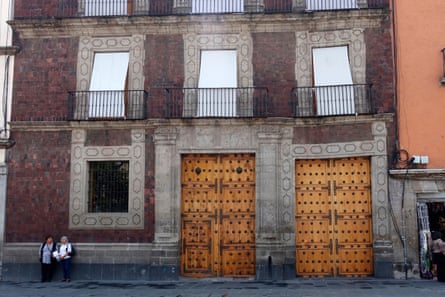
Walking into Mexico City’s sprawling central Zócalo is a dizzying experience. At one end of the plaza, the capital’s cathedral, with its soaring spires, slumps in one direction. An attached church, known as the Metropolitan Sanctuary, tilts in the other. The nearby National Palace also seems off-kilter.
The teetering of many of the capital’s historic buildings is the most visible sign of a phenomenon that has been ongoing for more than a century: Mexico City is sinking at an alarming rate.
Now, the metropolis’s descent is being tracked in real time thanks to one of the most powerful radar systems ever launched into space. Known as Nisar, the satellite can detect minute changes in Earth’s surface, even through thick vegetation or cloud cover.
“Nisar takes radar imaging observations of Earth to the next level,” said Marin Govorčin, a scientist at Nasa’s jet propulsion laboratory. “Nisar will see any change big or small that happens on Earth from week to week. No other imaging mission can claim this.”
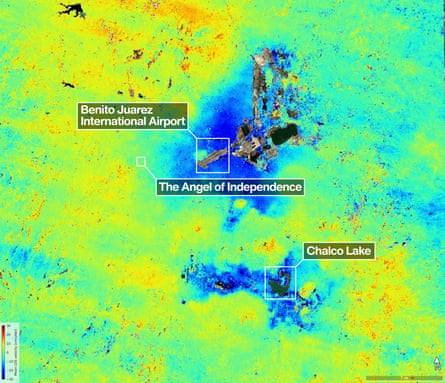
Though not the first time that Mexico City’s sinking has been observed from space, the Nisar mission has provided a greater sense of how far the sinking spreads and how it changes across different types of land than any other space-based sensor. It has also been able to penetrate areas on the outskirts of the city that were previously challenging to study because of the complex terrain.
The implications of the imagery extend far beyond the Mexican capital. “This study of Mexico City speaks to the realm of possibilities that will open up thanks to the Nisar system,” said Darío Solano-Rojas, an engineer at the National Autonomous University of Mexico (Unam). “And not just for sinking cities but also for studying volcanoes, for studying the deformation associated with earthquakes, for studying landslides.”
According to Nasa, the technology is also capable of monitoring the climate crisis, glacier sliding, agricultural productivity, soil moisture, forestry, coastal flooding and more.
“Images like this are just the beginning,” said David Bekaert, a project manager at the Flemish Institute for Technological Research and a member of the Nisar science team. “We’re going to see an influx of new discoveries from all over the world.”
The Nisar system, a joint initiative between Nasa and the Indian Space Research Organisation, found that some areas of Mexico City, including at the city’s main airport, were sinking by more than 2cm a month, one of the fastest subsidence rates in the world.
Among the clearest examples of this rapid descent is the Angel of Independence statue on the city’s main Paseo de la Reforma avenue. Completed in 1910 to commemorate 100 years of Mexican independence, the 36-metre monument has had 14 steps added to its base as the land around it has gradually sunk.
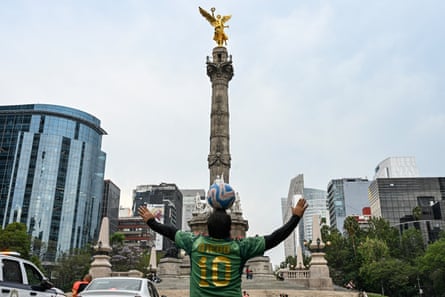
But the impact of Mexico City’s subsidence can be seen across the metropolis of about 22 million people, from tilting buildings to warping roads and damages to the underground metro system.
Efraín Ovando Shelley, another engineer at Unam, said: “It affects the entire urban infrastructure of the city: the streets, the pipes for water distribution, the water supply, the drainage pipes.”
First documented in 1925, the city’s sinking is a result of centuries of exploitation of the groundwater. Because Mexico City and its surrounds were built on an ancient lake bed, the soil beneath the city is extremely soft. When water is pumped out of the aquifer below, this clay-like earth compacts, resulting in a city that is quietly sinking.
Govorčin said: “Mexico City is subsiding primarily due to pumping of groundwater from the aquifer below the city at a rate that far exceeds natural recharge from precipitation. As water is withdrawn, the aquifer compacts under the weight of the city above it.”
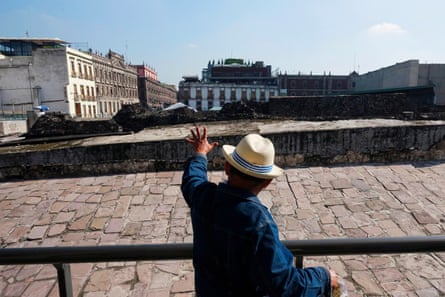
The underground aquifer still contributes about half of the capital’s water supply. As pumping of the groundwater has increased, the aquifer’s shrinking has intensified, with the water table now contracting by about 40cm a year.
This creates a vicious cycle: as the city sinks in on itself, the ageing pipes that pump water across the urban centre end up cracked and broken, with the capital losing an estimated 40% of its water due to leakage. Add to that the climate crisis, which has resulted in years of low rainfall, and the metropolis may be hurtling towards a disaster scenario in which taps in swaths of the city run dry.
As for the city’s gradual descent, there have been limited efforts to tackle the problem beyond fortifying the foundations of ancient buildings. Experts say the Nisar imagery will help draw greater attention to the issue, although actually halting the descent will be a challenging task.
“To stop the sinking, we would have to stop water extraction,” Shelley said. “And if we stop water extraction, what water are we going to drink? The standard joke is that if we can’t drink water, well, let’s drink tequila.”