


惯性聚合 高效追踪和阅读你感兴趣的博客、新闻、科技资讯
阅读原文 在惯性聚合中打开

推荐订阅源

B
Blog RSS Feed
量子位
Recent Announcements
T
The Blog of Author Tim Ferriss
美团技术团队
Cyber Security Advisories - MS-ISAC
Blog — PlanetScale
Blog — PlanetScale
H
Help Net Security
freeCodeCamp Programming Tutorials: Python, JavaScript, Git & More
博客园 - Franky
让小产品的独立变现更简单 - ezindie.com
宝玉的分享
宝玉的分享
大猫的无限游戏
大猫的无限游戏
V
Visual Studio Blog
博客园 - 聂微东
aimingoo的专栏
aimingoo的专栏
Microsoft Security Blog
U
Unit 42
J
Java Code Geeks
钛媒体:引领未来商业与生活新知
钛媒体:引领未来商业与生活新知
IT之家
IT之家
Hugging Face - Blog
Hugging Face - Blog
腾讯CDC
L
LangChain Blog

The Guardian

Rory McIlroy surges into six-shot Masters lead with stunning second-round flourish ‘That’ll be the end’: actor Sam Neill joins fight to stop controversial goldmine near his New Zealand vineyard Roberto De Zerbi targets ‘Ange-ball’ revival to save Spurs from relegation Bath hit back to reach semi-final after stunning Northampton in 11-try epic Secret Garden to Outcome: the week in rave reviews Zebras, wealth and power: Hungary’s election tests Orbán’s grip on power ‘TikTok effect’ brings sellout crowds and younger fans to Grand National meeting The war over Omagh’s gold: the £21bn mine plan tearing a community apart Britain’s shadow workforce is paid as little as 65p an hour. Who cares for the carers? From You, Me & Tuscany to Euphoria: your complete entertainment guide to the week ahead Six great reads: the man who let snakes bite him, masked heavy metal and the brutal reality for foreign students in the UK American Classic review – I defy you not to fall in love with Kevin Kline and Laura Linney’s tender comedy Cuba’s doctors were a lifeline for the world. Now the Caribbean is shamefully complicit in the US drive to expel them An environmental disaster in Moldova has Russia’s fingerprints all over it RMIT drops misconduct case against student who accused university of being ‘complicit in Gaza genocide’ Ichiro Suzuki statue unveiling goes awry as bronze bat snaps during ceremony Survivors of Epstein’s abuse accuse Melania Trump of ‘shifting burden’ on to victims European football: Real Madrid held at home by Girona to extend winless run Arne Slot insists he is ‘aligned’ with Liverpool board and fans as squad is rebuilt Kamala Harris ‘thinking about’ running for president again in 2028 JD Vance warns Iran against trying to ‘play’ the US in peace talks West Ham double up twice to thrash Wolves and put Spurs in relegation zone Trump administration releases new renderings of so-called ‘Arc de Trump’ Crispin Odey drops £79m libel claim against FT over sexual misconduct allegations Bafta apologises for events surrounding John Davidson’s Tourette’s outburst Cocktail of the week: Bar Shrimp’s la rosita – recipe New drug may extend survival in aggressive ovarian cancer, trial shows One dead and 27 injured after bus with British passengers crashes in Canary Islands Pope adds to Smith’s mass of Surrey runs with England woes a world away OpenAI CEO Sam Altman’s home targeted with molotov cocktail
Ashes and memories: one family’s return to the site of Ho...
Selina Cheng · 2026-04-28 · via The Guardian

The Yip family once imagined moving to a country house, all three generations under the same roof, with their own vegetable garden and away from Hong Kong’s dense high-rises. A devastating fire, Hong Kong’s worst since 1948, took that future from them, leaving behind little but rubble and blackened walls.

“Whatever we can retrieve is a bonus,” says Yip Shun-Ting Carbon, aged 36, who lost his mother, Pak Shui-lin, in the inferno in November last year that killed 168 people at a large residential complex under renovation.

Last week, Yip and his wife, older brother and father formed a small crew, wearing backpacks, hard hats and heavy-duty face masks, as they re-entered the wreckage of their family home at Wang Fuk Court for the first time.

“When I go to sleep every night, I imagine what the flat might now look like,” Yip says. “I see fragments of images of every window in flames, then I think about why this could have happened.”
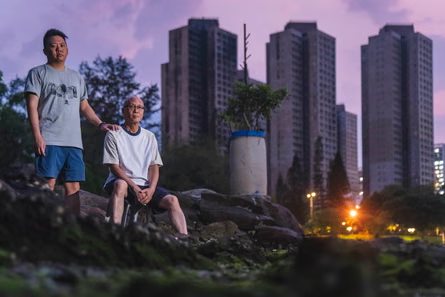
Yip Shun-Ting Carbon and his father Yik Ka-Kui in front of the fire-ravaged Wang Fuk Court in Hong Kong. Both had spent decades in the estate where Yip grew up, met his wife and built a life; the deadly blaze last November claimed his mother and destroyed their family home.
Yip Shun-Ting Carbon and his father Yik Ka-Kui in front of the fire-ravaged Wang Fuk Court in Hong Kong. Both had spent decades in the estate where Yip grew up, met his wife and built a life; the deadly blaze last November claimed his mother and destroyed their family home. Photograph: Fung Hoi Kin/The Guardian

The authorities issued each household a strict three-hour time slot to salvage what the could from their homes, and the clock starts on entry. Yip took a few minutes to gather himself amid his grief and anger before stepping into the chaos. But nothing prepared him for the sight at the open doorway where their front door used to be.

Everything was covered in soot. Some items had melted into piles of hardened plastic, unrecognisable. They were careful not to shake up more dust and metal particles, glimmering under their torches.

The family had devised a strategy to work under the time pressure. They divided up the sixth-floor flat by zone, with a mental map of where valuables and items of personal significance might be. First: the crystal bracelet and brooch his mother gave to his wife, Karen, as a gift.

Yip’s mother had stayed behind to knock on neighbours’ doors, saving the lives of four people. Her body was found back inside her flat, in another block of the same complex.
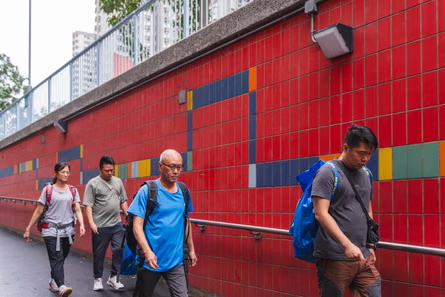
The Yip family (from left) – Lam Ka-Wan Karen, Yip Shun-Ting Carbon and father Yik Ka-Kui and elder brother Yip Shun Yin – walk to the government-arranged coach pickup point to return to Wang Fuk Court and retrieve belongings from their fire-ravaged flat.
The Yip family (from left) – Lam Ka-Wan Karen, Yip Shun-Ting Carbon and father Yik Ka-Kui and elder brother Yip Shun Yin – walk to the government-arranged coach pickup point to return to Wang Fuk Court and retrieve belongings. Photograph: Fung Hoi Kin/The Guardian

As they continued their search, a crystal block commemorating their pet dog, computers, diplomas and years-worth of collectible Gundam figurines were all thrown into bags and a few charred suitcases. The family stuffed decades of their life into grey cubicles at a mini storage.

“It’s a little bit of comfort, knowing we found everything we really cared about,” Yip says, as he and his wife wipe soot off of each other. It will take much longer to sift through possessions, so they’re taking it slowly.

The visit on Friday felt like a rehearsal, he says, as the family prepares to revisit their parents’ flat in the next block in just a few days, where the boys grew up and where their mother died.
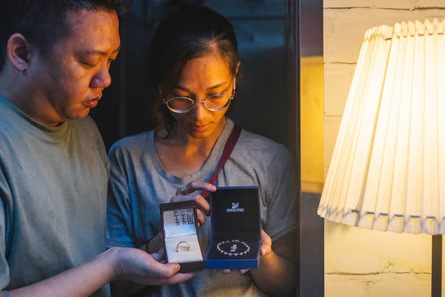
Yip Shun-Ting Carbon and his wife, Karen, display a ring and the Swarovski bracelet – a gift from his mother who died in the fire – recovered from their fire-ravaged flat at Wang Fuk Court.
Yip Shun-Ting Carbon and his wife, Karen, display a ring and the Swarovski bracelet – a gift from his mother who died in the fire – recovered from their flat. Photograph: Fung Hoi Kin/The Guardian

‘I’ve lived here all my life’

Yip and his father are among the thousands displaced from their former homes in the north-eastern suburb of Tai Po.

Hong Kong is still reeling from the shock of the blaze, and is searching for answers to what could have caused a disaster comparable to the London’s Grenfell Tower fire, unimaginable in a financial hub known for its skyscrapers, safety and wealth.
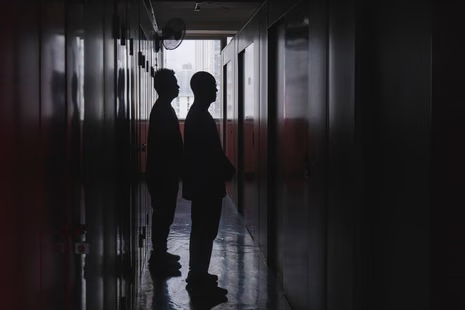
Yip Shun-Ting Carbon (left) and father Yik Ka-Kui (second from left) stand solemnly together inside the unit.
The Yip family returns to a mini-storage unit in Tai Po to sort and clean salvaged belongings. Photograph: Fung Hoi Kin/The Guardian

Residents were led back into the buildings in small groups, flanked by a social worker and a police officer. The buildings are 31 storeys high, and only the stairs can be used. Elderly residents came with canes and walking frames. A man arrived in crutches and a cast on one foot.

Charities, moving companies and volunteers who had offered their help withdrew after officials announced restrictions on entry. At least one flat had been burgled in previous weeks, causing further trauma to residents already fretting about the few worldly possessions they may still have. The government-arranged flat visits will go on for two weeks.

Yip grew up in the neighbourhood after his parents first moved to Wang Fuk Court over two decades ago. It’s where he met Karen, when they both served as the district’s volunteer paramedics. After they married, they bought a flat in the same compound in 2021. His brother, his wife and their children settled in another housing estate a stone’s throw away.
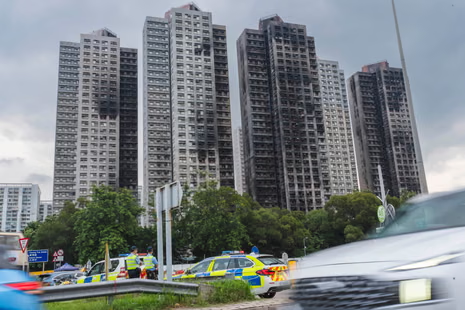
The estate’s exterior walls are heavily charred and damaged, with most units reduced to empty window frames.
The estate’s exterior walls are heavily charred and damaged, with most units reduced to little beyond the empty window frames. Photograph: Fung Hoi Kin/The Guardian

His mother often helped with the grandchildren in the afternoon. For dinner Yip and his wife would head to the parents’ place just two elevator rides away, twice a week. Strolling along the estuary near home offered a sense of peace, and the easterly evening breeze coming in from the harbour was comforting, Yip recalls.

“I’ve lived here all my life,” Yip says. “It’s hard to find somewhere else that can replace where I’ve lived for 20, 30 years.”
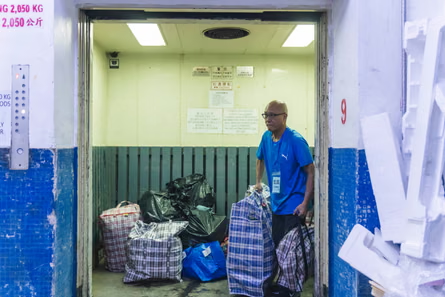
Yik Ka-Kui carries bags of salvaged belongings from his son Yip Shun-Ting Carbon’s fire-ravaged flat at Wang Fuk Court to a mini-storage facility in the nearby Tai Po industrial area.
Yik Ka-Kui carries bags of salvaged belongings from his son Yip Shun-Ting Carbon’s fire-ravaged flat to a mini-storage facility in the nearby Tai Po industrial area. Photograph: Fung Hoi Kin/The Guardian

After the fire Yip resigned from his job. “I’m not in a state of being able to simultaneously handle family and work,” he says. During the day he applies for aid programs and handles endless paperwork. He and his wife are staying in his brother’s flat about 2km away, and sleep in their niece’s single bed. Seven family members are crammed into the three-bedroom flat.
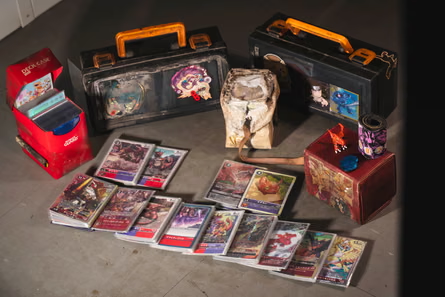
Among the belongings salvaged by the Yip family are treasured collectible game cards. Some protective boxes melted and warped in the blaze, yet Yip was surprised that these companions — which had been with him from childhood through adulthood in Wang Fuk Court — survived the deadly fire that killed 168 people.
Among the belongings salvaged by the Yip family are treasured collectible game cards. Some protective boxes melted and warped in the blaze, yet Yip was surprised that these companions — which had been with him from childhood through adulthood in Wang Fuk Court — survived the deadly fire that killed 168 people. Photograph: Fung Hoi Kin/The Guardian

For the past month, Yip has commuted daily to the independent inquiry hearings into the fire. His father, Yip Ka-kui, now a vocal survivor, alleged in his testimony that authorities took no action on his series of complaints about problems with the buildings’ renovation works, until the fire engulfed them with his wife inside. He has vowed to seek justice for the remainder of his life.

Immediately after the fire authorities warned against “destabilising forces” that slandered relief efforts and “used disaster to stir up chaos”. They rejected calls for an ownership association meeting to decide the future of the complex, claiming some of the 400 signatures of property owners submitted on a petition may be fraudulent. Instead, authorities presented a plan to repurchase their homes, at rates that residents said are undervalued.
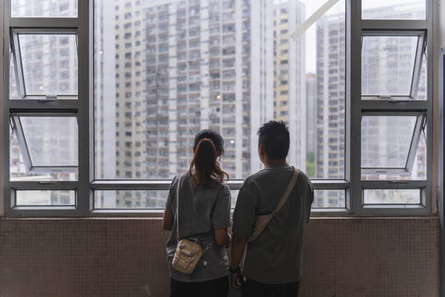
Lam Ka-Wan Karen (left) and her husband, Yip Shun-Ting, Carbon gaze out the window at the dense high-rise residential buildings.
Lam Ka-Wan Karen (left) and her husband, Yip Shun-Ting, Carbon gaze out the window at the dense high-rise residential buildings. Photograph: Fung Hoi Kin/The Guardian

“I don’t dare to think what life in the next two or three years will look like,” Yip says. “Maybe the city will forget what happened, then the government won’t have to care about our voices and feelings any more.”