


In 2005, enough of a storm seemed to be brewing in northern British indie music that NME tried to coin a new genre to encompass it all: New Yorkshire. “Forget LA, New York or London,” the feature read. “New Yorkshire is the best new band scene in Britain.” The magazine lumped together a bunch of disparate bands such as Sheffield’s Arctic Monkeys, the Long Blondes, Milburn, Harrisons and Bromheads Jacket, along with a Leeds and Wakefield bunch comprised of Kaiser Chiefs, the Cribs, Black Wire, the Research, ¡Forward, Russia!, the Ivories and the Sunshine Underground.
The New Yorkshire tag, though, had overlooked a fairly noticeable split in Sheffield at the time between the artier indie bands, often students, and the more traditional local indie outfits.
The Long Blondes, who formed in 2003, wrote something of a mantra that was used on early press materials when introducing them: “Our shared influences include the Mael Brothers, Marx Brothers and the Bewlay Brothers. We do not listen to the Beatles, the Rolling Stones, Jimi Hendrix, the Doors or Bob Dylan. We chose an instrument each and learned to play it.”
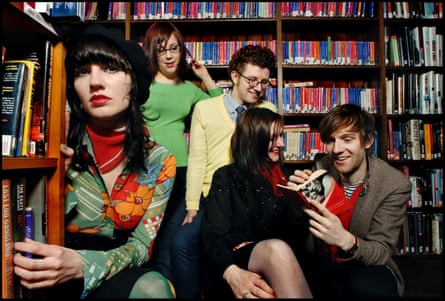
The intentional pomposity was perceived as arrogance by some. “We did like to needle people,” says bassist Kathryn “Reenie” Hollis. “We went into it slightly prickly and did see ourselves as above the local scene – we were both insecure and arrogant.” Much like another Sheffield band at the time, Pink Grease, they wanted to inject a little bit of fun, glam and flair. “It was a clear rejection of what we saw as the problem with lots of music around at the time,” drummer Mark Turvey says. “It was staid, heavily male, overly serious and earnest. We were setting ourselves up as the direct opposite: pretentious, trashy, feminine and pop. If you liked the sound of that, we were for you : if not, fuck off.”
The Sheffield split was often heightened geographically too. “Culturally, it’s different,” says Jon “Reverend” McClure of Reverend and the Makers, who is from north Sheffield where “the accent is different. It’s a lot thicker and harder, and the people are more brusque.” Joe Carnall from Milburn echoes this feeling of enmity. “It was very regional,” he says. “We were suspicious of other bands. Like, [arty band] the Long Blondes, what’s that? I’m not proud of it but that fuelled what we did.”
Formed in 2001, Milburn were a very young bunch of lads in their mid teens made up of Joe Carnall, Louis Carnall, Tom Rowley and Joe Green. Fresh into the new millennium, they did not feel connected to previous Sheffield bands. “If you had said Longpigs to me, I’d have gone, what?” recalls Carnall. “And if you’d have said Pulp, I’d have been like, he’s a bit poncey isn’t he? We were just angry young lads, so everything was shit. Which I think is great because it means you try and do something new. Every new generation of band needs that fuck-you energy of: I don’t want to do it like you.”
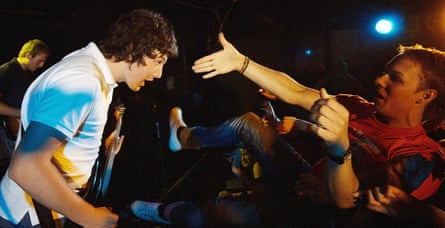
They released a demo in 2001 called Steel Town. Musically, it didn’t quite live up to their “tearing down the walls” ethos, but they quickly built a huge following. “We sold out the Boardwalk,” recalls Carnall, of the 500-capacity city-centre venue which used to be called The Black Swan (or by its local nickname, The Mucky Duck). “And then we would go to school the next day and I’d have GCSE maths.” One group of lads that was paying attention would become Arctic Monkeys.
“Milburn were the first people we saw doing it that were kids our age,” says Monkeys drummer Matt Helders. “We didn’t think it was a thing that people did where we were from. We had this naive, or even maybe cynical attitude that all bands were just put together in London and that it doesn’t happen to people like us.”
Arctic Monkeys were made up of childhood friends Alex Turner, Helders and Andy Nicholson (and soon to be joined by Jamie Cook) from High Green, a suburb of north Sheffield close to the Barnsley border. The Monkeys were archetypal lads from the era who, carrying on a now rich vein of Sheffield tradition, were young, bored and looking to create their own entertainment. “This band came about from us hanging out on the street,” Helders recalls. “Instead of deciding which house to go and egg that night, we were like, why don’t we start a band? It really came from those kinds of conversations when you’re on a field somewhere and people are smoking and drinking cider.”
However, before the world was properly introduced to Arctic Monkeys, Helders and Turner found themselves briefly playing in an ensemble outfit that Jon McClure had put together called Judan Suki (Japanese for “being kicked in the weak spot”). “We were fucking horrendous,” McClure laughs. “It was like funk but it was just fucking dog shit.” Turner was on guitar – McClure met him on a bus and invited him to join – but Helders was relegated to bongos because they already had a drummer. “I wasn’t even mic’d up,” recalls Helders. “I was just an accessory on stage.” However, as slapdash as the group were – known for playing a cover of Brothers on the Slide by the British funk group Cymande – it was a foundational experience for the young Monkeys. “I can see why Jon looks back and cringes but for me it was really important,” says Helders. “And also for Al, because we’d never played onstage before. So it made it seem more accessible and realistic.” The Monkeys got to work and practised hard for pretty much a year straight before they would play publicly.
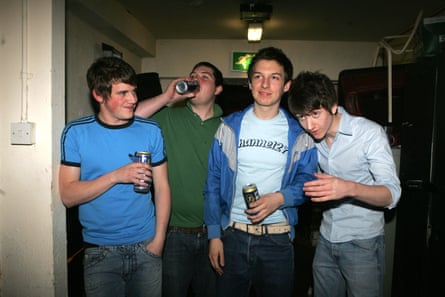
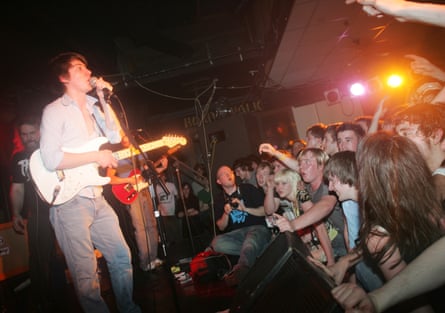
As the Monkeys crew carried on doing their thing, McClure, along with long-term guitarist Ed Cosens, splintered off to form another band, 1984, while other north Sheffield bands – such as Harrisons – began popping up too. The Boardwalk became a hugely significant venue for this little growing movement. McClure, Turner, Cosens and Nicholson all had jobs working behind the bar there. Chris Wilson, who was running the venue at the time, recalls turning the venue into an on-the-spot gig night for everyone after a band cancelled at the last minute. “The bar became the stage and we provided an honesty box so people just sorted their own drinks,” says Wilson. “A young Alex Turner, as he was due to be working that night, sat on the bar with an acoustic and started singing. That’s when we first heard some of the songs that went on to be huge hits. I got the feeling everyone there knew we were listening to something truly amazing.”
The interest around Arctic Monkeys began to brew and bubble from pretty early on. A run of early gigs landed them a manager, Geoff Barradale, and soon they were the local band to watch. However, not everyone could immediately see the talent. “Arctic Monkeys performed regularly at The Boardwalk,” recalls Wilson. “On one occasion a young chap from a major label came [to see them] but only stayed for only a couple of numbers and said very snootily that he couldn’t see what the fuss was about, and left. He was fired not long after.”
This period around 2004 was the last in which a tight-knit group of pals would remain in such a contained world. “There was a little pocket where we were just playing gigs for each other,” recalls Carnall. McClure also recalls a period of innocence and naivety among a group of close friends. “It’s a bit of a cliche now, but it did become a bit of a scene,” he says. “It was dead exciting. But, honestly, the ceiling of ambition at the time was that I wanted to be on the front cover of [local music magazine] Sandman.”
However it was becoming obvious that there was one group leading the pack, and McClure recalls seeing Turner’s lyrical skills sharpen. “John Cooper Clarke used to play The Boardwalk a lot,” he recalls. “I could see it had a profound effect on Alex. That interrogation of language. He would learn a word and then you would hear it in a song the week after. I distinctly remember him saying to me, what does totalitarian mean? I told him and the next thing is he’s written From the Ritz to the Rubble. You get an energy off people and it was like: this geezer is gonna be a fucking superstar.”
McClure recalls a flurry of secret shows in “cellars, rehearsal spaces and basements” around this time, but there is one that remains firmly in the minds of those who attended it. Harrisons had a practice space in Neepsend – a now increasingly hip area of Sheffield that was basically a red-light district at the time – that had a huge space in it that they used for gigs and parties, and one night things got out of hand. The events of the evening would soon be immortalised in the Arctic Monkeys song A Certain Romance with lines about lads fighting with pool cues in their hands.
A mild rivalry had been building up between Harrisons and the Monkeys. Harrisons’ Jubby Taylor recalls it all being jovial, daft stuff initially, like texting in messages to the giant screen in The Leadmill venue, winding up the other band’s set of fans. But one gig with both bands on the bill at their space went sour. “It kicked off horribly,” recalls Taylor. “My best friend, Tim, who was the singer in Gas Club, was quite handy and was one-punch knocking people out, while another mate of mine was hitting people with a pool cue.” McClure recalls his bandmate being attacked in the midst of it all. “We had this bass player at the time called Karl Kelly, a Rasta with a gold tooth, and he got bashed in the mouth and his gold tooth went flying,” he recalls. “He was unconscious and for a moment we thought he was dead.” Taylor can still recall the silent, shocked face of a young Turner watching the chaos unfold around him with fists, legs and insults shooting through the air as bodies landed into the sea of crumpled beer cans strewn all over the carpet. “He just looked like he’d never seen anything like it before,” he says. “I think it was a culture shock for him to see such brainless violence. But we were used to it because our mates were idiots.”
However, McClure remembers that once the dust had settled, the blood had dried up and the fighters had fled, something special happened. “Everybody fucked off, but then the Monkeys played,” he says. “It was like when people go on about that Manchester Free Trade Hall Sex Pistols show – it was one of those. One of the best gigs I’d ever seen. That’s when I knew. This was before they had released anything but I was like, fuck me, lads, this is on another level.”
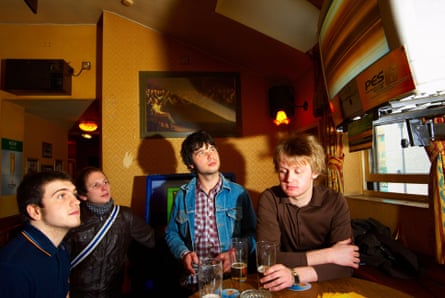
The fight had occurred the night before a joint tour and so things were a little strained between Harrisons and Monkeys. It was also an indicator for the future trajectory of both bands. “They were very professional, two or three pints, but we treated it as a piss-up,” says Taylor. “By gig three we were looking really worn out, our voices were going and they’re fresh as a daisy. It was silly. They’d travel home and we’d get a Travelodge and our mates would be jumping off the bridges into the river in York in the dark. The next morning, we woke up and there were scaffolding poles sticking out of the water. It was mad – acting like Happy Mondays before you’ve even made it.”
However, when it came time for bands to be thrown together on a national level, McClure was not remotely interested in taking part in any of NME’s made-up scene. “I got offered to do that photoshoot and turned it down,” he says. “So did the Monkeys, because we were like: we don’t want this. We don’t want to be part of this shit. It’s not what it is. Because then it becomes an aspirational thing where bands who weren’t part of it wanted to be part of it, or would make out they were. It was really just an extraordinary friendship group and it so happened some of us were in bands.”
The close-knit connection between the bands even stretched to family. Some of the mums of the bands all got together and formed their own band, Mother Superior. “They would go down to my studio,” recalls McClure. “And Penny, Alex’s mum, would rework the lyrics to our songs and my mum would be lead singer.” Helders recalls them being a tight bunch. “They did all kinds of weird shit,” he says. “They filmed their own fake Come Dine With Me once. They got someone to do a voiceover and everything. The whole band thing definitely brought them all really close together.” In fact, it wouldn’t be uncommon to later find Helders’s mum in the queue outside venues or record shops giving out homemade baked goods to fans.
However, while things were harmonious and familial in Sheffield, the whole New Yorkshire thing overlooked a stark Sheffield and Leeds divide. “Leeds, no chance,” says Milburn’s Joe Carnall, when asked if it felt like a wider scene that involved them. “My abiding memory of Leeds at that time is the Kaiser Chiefs, who have made some of the worst music known to man. They were everything we despised.”
By this point, the hype around Arctic Monkeys was building to something of a frenzy. The demos they had made had been collected on a CD which they burned copies of and gave away to fans for free at shows. An unofficial release, this became known as the Beneath the Boardwalk album. While just a collection of rough-and-ready demos, there was an urgency, grit and singularity to the band, with Turner’s depictions of Sheffield life – which felt intimate and detailed yet also detached and voyeuristic – clearly setting them apart from their peers. The music had been spreading rapidly on websites and filesharing platforms, with one fan, Mark Bull – who also shot all the bands’ early gigs and did music videos for them – playing a significant role in this. With this period aligning with the rise of social media, especially Myspace, the band were being deemed an internet sensation.
Some were hailing the Monkeys as a revolutionary band who had been democratically chosen by a newly empowered generation of young, eager, online audiences, as the first real band to break through in the internet and social media age. However others sensed something was off. The Guardian’s Alexis Petridis declared: “Rumours persist that their success involved tactics more commonly associated with manufactured pop artists, including employing a ‘street team’ of diehard fans to venture on to other artists’ message boards and talk the band up.”
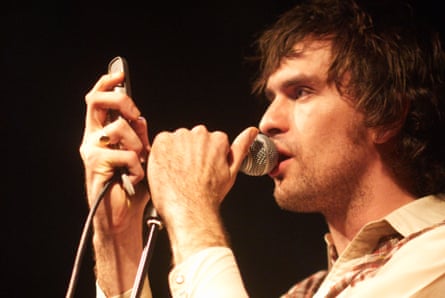
By this point, Barradale was managing the Monkeys and McClure, as the latter was transitioning into forming Reverend and the Makers. McClure says he was involved in helping spread buzz around the band in an official capacity. “Geoff said to me, with the Monkeys, the tunes are amazing but it’s boring,” McClure says. “So I need you to make them sound interesting. So he used to get me to write blurbs online. I was on the dole, so that was my first paid job in music. He was like: they need a story because otherwise it’s just four lads from High Green, who gives a fuck?”
While management may have been smart in generating online hype, the narrative around all of it being the work of the internet was beginning to grate. “We wrote the tunes and we played them and we tried to push on musically and do something a bit different, and put a lot of thought and work into it,” Turner said at the time. “So when people pass it off as sort of this internet phenomenon, it right gets under the skin.” Helders echoes this today. “We were a bit pissed off,” he says. “We were very much from the school of we need to be really good at this thing and we felt at the time that part was getting overlooked because it was like, oh you’re an internet band. But there’s plenty of people with songs on the internet – but people liked these ones.”
This narrative took charge perhaps because it transpired the band were not the most talkative or responsive. They didn’t have much in the way of a backstory or an obvious selling point. And it was soon very clear that despite Turner’s clear lyrical gifts, he was an oddly monosyllabic interviewee. “There just wasn’t that much to talk about,” reflects Helders. “It was all hype, and everyone wanted to know how it felt. And it’s like, I don’t know, because this is completely alien to all of us. We were just stubborn teenagers and we didn’t want to be famous. We were sceptical and cynical but also realistic. We were good at not getting caught up in it, because a lot of it is nonsense.”
A&Rs were falling over themselves to sign the band, who by now had released the Five Minutes With Arctic Monkeys EP, recorded in Liverpool with Mike Crossey. The band’s attitude towards the shallowness of rock’n’roll, espoused before they had even had a chance to fully experience it, is there from the off via Fake Tales of San Francisco with Turner’s lyrics prodding at empty scenesters who are from Hunter’s Bar or Rotherham, rather than the slightly more fashionable San Francisco or New York.
The band were trying to shut out the noise from the industry, quite literally. At one show they boarded up doors to keep them out; the band’s tour manager at the time, Timm Cleasby, later recalled sweat-drenched label executives fighting to get into the dressing room to speak to the band. In the end they signed with Domino, an independent record label they felt would offer greater creative control and fewer industry bullshitters to deal with.
The mismatch between Turner, the flowering lyricist of a generation, spoken about alongside the likes of Ray Davies, and the aloof, phlegmatic person that journalists met, even caused some to suggest that the band must be an industry plant. “Some journalists questioned whether Alex Turner actually wrote his own lyrics at the start,” recalls Jodie Banaszkiewicz, who was Domino’s international promotions manager before becoming their UK senior publicist. McClure saw this too. “I had people saying, did you write the Arctic Monkeys songs?” he says. “Because they couldn’t believe that a young kid could write like this. I said, you’re devaluing him, he’s a fucking clever boy.”
The idea of Arctic Monkeys being some kind of industry creation is especially laughable in hindsight: finding someone to write a bunch of songs behind the scenes that would be considered decade-defining and then finding a bunch of uncommunicative, press averse, awkward lads from Sheffield who don’t want fame, and will refuse to even go on Top of the Pops, to front it all. It’s perhaps also worth pointing out that the London-centric media may well have been exposing some of their own prejudices in all of this, unable to fully take in that people as ordinary as these Sheffield lads were capable of creating music of this calibre.
It was not an easy transition for the band to become so successful so quickly. Banaszkiewicz recalls taking them to Paris for a promo trip. “Things went sideways on the first day,” she recalls. “I’d spent weeks carefully crafting the interview schedule, working tirelessly with their management to fine-tune every detail. But when we got to Paris, the band simply disappeared. They literally ran off to the Eiffel Tower. They said that, for the first time, everything had felt out of their control and it was all a bit overwhelming.”
Humour became a way to deal with, and deflect, a lot of the overwhelming feelings. “It still is in my everyday life,” says Helders. “It’s a defence mechanism. Without going too deep into men and mental health, I think it is part of that as well. Like, I don’t have to talk about it if I deflect it.” Helders remembers one such moment as being a key example of this. When the band went to No 1 with I Bet You Look Good on the Dancefloor in October 2005, they had arranged a get-together in their local pub, The Pheasant. “We all decided not to find out beforehand and just listen to the chart countdown,” he says. “We listened to the radio with all our friends and family in the pub in High Green. Once it got announced, I was like I’m either gonna cry now or say something funny. I think I ended up quoting Anchorman or something. It was like, this can go one way or the other, and I’m not gonna cry in front of all these people I went to school with. That attitude and feeling was still a thing.”
By 2006, Arctic Monkeys had gone from being a buzzy new band to a genuine sensation. With the imminent release of their debut album, Whatever People Say I Am, That’s What I’m Not, a local branch of HMV opened at midnight to welcome the queues of hundreds of people through the door. Then when the tills were open, they couldn’t stay shut. On the first day the album was out the band shifted nearly 120,000 copies, selling 82 copies a minute. It became the fastest-selling debut album in British history.
Initially the explosion of Arctic Monkeys had been a benefit to many of the other connected bands in the city, a kind of “rising tide carries all boats” phenomenon, with many garnering significant interest from labels as a result. Artists such as Stoney, a local singer-songwriter, who had a slightly more folk-pop sound, was supporting the band on tours and ended up on a major label, riding out a trajectory that he describes as “critically acclaimed, yet commercially challenged”. On the other hand, Little Man Tate were a band that were pummelled critically by many, including the original north Sheffield contingent, as being a bunch of Johnny-come-latelys who were trying to ride the Monkeys wave. They also ended up signed to a major and were pushed, unsuccessfully, as being the next indie hopes out of Sheffield.
McClure now can accept how challenging it was to see your peers succeed so enormously, so quickly. “I was jealous as fuck,” he says. “Of course I was. And anybody who pretends they’re not is fucking having themselves on. You’ve got to understand, this is like being in a football academy with Lionel Messi.”