


Driven hard, driven fast is very much the norm in Formula One, on and off track, but even by the sport’s own standards the development of Red Bull’s in-house engine project has been exceptional. As is what it has delivered.
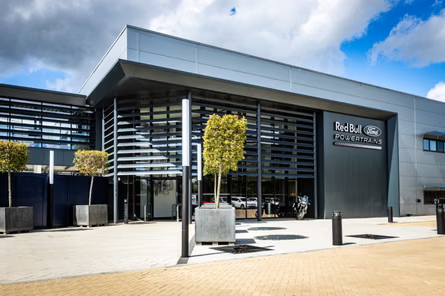
Walking through the gleaming corridors of the team’s bespoke engine manufacturing department at their Milton Keynes headquarters, it is all but impossible to conceive that only four years ago the area where the buildings stand was just empty space peppered with rubble.
The decision to build their own engines rather than continuing to buy customer units from other manufacturers ranks among the boldest steps Red Bull have ever undertaken. It is no little feat even for a team who have long revelled in carving their own path in F1.
When the project began in 2022, with the team under the leadership of Christian Horner, it was a step into the unknown with no guarantee of success, but with the promise of making the team entirely the master of every aspect of their cars and how they go racing. It is an advantage that cannot be overstated, with the design of engine and chassis playing to each other’s strengths rather than a chassis being built around a customer engine.
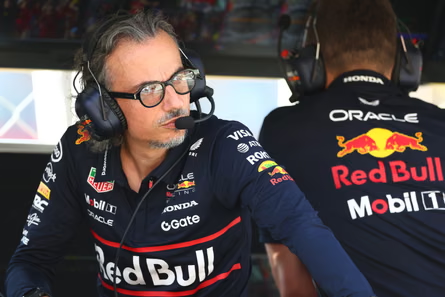
Their venture was greeted with scepticism, in some quarters with an anticipation of failure or at very least a long, painful learning curve. It was the “ghost” that haunted the project, as the team principal, Laurent Mekies, refers to it. After all, the long-experienced and previously successful engine manufacturers Renault and Honda had been found very publicly wanting under new regulations and Red Bull were coming at it as a startup.
At the team’s headquarters, as F1 readies to return to action from its enforced break with the Miami Grand Prix on 3 May, Mekies observes that they completely understood the risks and the rewards. “As much as it was a crazy decision, a crazy investment, now it put us into an incredible situation for the next five to 10 years,” he says. “The power unit decision of four years ago that puts you in a position of being completely independent … for years to come, with the support of [engine partners] Ford.
“I was not involved in those decisions, just credit to the guys before,” he says, having taken over as Red Bull team principal last year. “The fact that we have this wind tunnel coming some time next year also puts you at a completely different level. So it’s true that the opposition may have shot ahead compared to us in some respects but globally, in terms of the legs of the project, it put us into an incredible position.”
Mekies acknowledges then that this season Mercedes – by far the class of the field – have as much as a two-to-three 10ths advantage over his team from the engine. That Red Bull are so close at their very first attempt is remarkable. They have been off the pace of Mercedes, Ferrari and McLaren in the opening three rounds this season but, as Mekies admits, the real deficit is in the chassis.
In terms of harnessing the horsepower, Red Bull have hit the ground at a gallop. It becomes clear quite how much in a rare opportunity to visit the engine manufacturing facility in the company of Red Bull Ford Powertrain’s technical director, Ben Hodgkinson, who was headhunted from Mercedes to lead the project and has 27 years of experience in building engines. He describes the project as bold and audacious and believes that it attracted characters with similar attributes to join it.
When it began he was taking on 25 personnel a month and the team he leads is now 700 strong. For all the noise around high-profile departures, Red Bull are maintaining no little momentum in recruitment, having taken on 120 new employees across engine and chassis in the first quarter of this year alone.
From that barren patch of ground at the Milton Keynes campus, Hodgkinson had one major advantage for his task in that he was building a unique facility from scratch – and it shows. Even given the haste with which it has been built – including the engine dynos being housed in large, imported pre-built steel units picked specifically because they could be on site and up in the shortest possible time – it is a technological marvel.
The romantic picture of engine assembly involving spanners and oily overalls has long gone from modern F1, but the assembly rooms at Red Bull are another experience altogether even compared with those of rival teams. There is an air of pristine, precise, perfectionism amid an almost disarming, preternatural quiet. Were an actual spanner to drop it would echo like thunder in this meticulous atmosphere.
The cleanliness and order is observed for good reason as potential contaminations of parts with even minute particles is taken incredibly seriously. Pieces arriving from outside are unboxed in a room entirely separate from the assembly area and then cleaned before entry. Computers abound as do immaculately dressed engineers. It has the air of an especially sparkling kitchen run by a decidedly fastidious chef. Certainly there would be no concerns eating from any of these surfaces.
The same attention to detail applies in the area where engines at the end of their life are disassembled in detail to identify any areas of weakness that could help to prevent a failure in future models. There is an entire room for cleaning crank shafts before use and another for oil analysis – a process that identifies particulate elements that may be wearing the engine with undue haste.
The focus on creating a coherent organisation with an overarching sense of purpose and direction is evident everywhere and it is impossible not to be impressed by how singularly it has been achieved given the sheer scale of the task that began four years ago. Indeed for all Red Bull’s current travails, including Max Verstappen’s dissatisfaction with the new rule set and his recalcitrant car, their engine has proved an undoubted success story.
“It has clearly exceeded expectations,” says Mekies. “We were gearing up from a much further away starting point. It’s something that could have put the project at big risk for two or three years.
“But now the ghost of the power unit – is Oracle Red Bull Racing going to have a strong enough power unit for the years to come? – has disappeared. We have our own issues. We need to get these tenths back, we need to fix what we need to fix with the car. This, we know how to do. It’s going to happen, not in Miami, but it’s going to happen.”