











There may currently be no less fashionable music than the hyper-romantic symphonies and orchestral works of Arnold Bax. The British composer’s music featured in pretty well every Proms season throughout the 1930s and 40s and early 50s, yet he has been the rarest of visitors to the Royal Albert Hall since then. When was the last Bax symphony heard at the Proms, you ask? 2011! Far too long for a fan like me (and Ken Russell), and – well, perhaps not long enough for others.
Bax was born in 1883 in London to a family so wealthy that he was able to devote himself to the single-minded pursuit of his passions. He was a brilliant pianist and, as a composer, he could transform his creative and personal obsessions into every bar of his music. That meant the exoticism of Russia in his early years and, later, the romance and fantasy of the Celtic Twilight (Bax even assumed a pseudonym, Dermot O’Byrne, to write Irish-inspired poetry), and the landscapes of north-west Scotland. His romantic infatuations were just as intense and colourful.
Because Bax didn’t have to be bound by the rites or responsibilities of earning a living (and he avoided serving in the first world war due to a heart complaint), he was free to write exactly what he wanted, how he wanted. For better, his fans would say – and for worse, according to his many detractors.
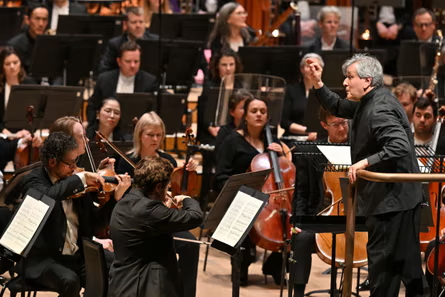
The decline of interest in the composer – who was master of the king’s music for the last 10 years of his life – is easily observed by checking out the BBC’s Proms archive, which lists details of everything played at the festival since it began in 1895. Bax’s seven symphonies had their heyday in the 1930s and 40s, since when they’ve hardly been heard. Andrew Litton was the last person to conduct one (the borderline expressionist Second Symphony) in 2011, and John Wilson was the last conductor to put Bax on any orchestral programme at the Proms, when in 2022 he performed his Cornish-inspired tone-poem Tintagel.
Ah, Tintagel! Antonio Pappano has just released a fantastic recording of this sea-swept quarter of an hour of orchestral Technicolor with the London Symphony Orchestra. Tintagel, the castle of Arthurian myth and legend and the place where cultural tourists like Bax could indulge their dreams of wild seas and wilder emotions. It’s music that holds nothing back, and neither does Pappano’s performance.
Which is why my plea to Pappano is to make the symphonies his next priority. Bax’s seven symphonies owe next to nothing to polite ideas about structural cohesion, nor worthy notions of making music for the people from the creative commons of folk tunes or other national traditions. Instead, Bax’s world is a place of fertile imagination, a landscape of ancient myths and legends.
For Bax, the watchword was excess: above all, an excess of sensation. The opening movement of the First Symphony is a microcosm of his project: a snarl of woodwind sonority – including the contrabass sarrusophone, before a brass fanfare, and orchestral sighs and surges that stretch tonal harmony to its limits, but which never break it. That’s just the start: even when the music gets into its stride, Bax’s style is essentially restless, committed to the moment, the intensity of colour and feeling rather than the logical construction of argument. You can hear the music as a soup of influences, such as Debussy, Strauss, Sibelius and the visionary Holst. But there’s really no one like him in the sublimely unfettered imagination that created such soundscapes as the opening of the Second Symphony, in which dragons breathe and mountains heave, or the radiant epilogues of the Third or Fifth Symphonies.
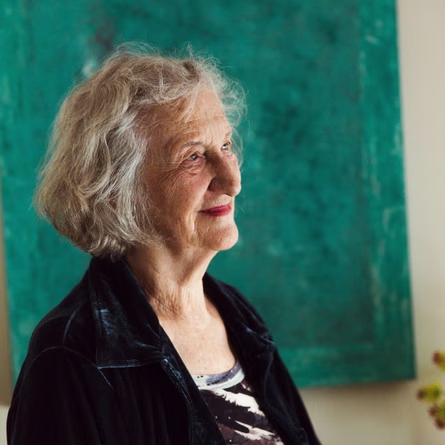
Talking of adventures at the Proms, my pick of the new music this season has to include the world premiere of Thea Musgrave’s Bassoon Concerto, Out of the Darkness, written for and played by Amy Harman on 23 August: yet more music, no doubt, of sumptuous originality and drama by the astonishing 97-year-old musician. There’s the Mexican composer Gabriela Ortiz’s Revolución Ddiamantina, her coruscating score, originally a ballet, that’s a ferocious and scintillating cry against female oppression, part of Gustavo Dudamel’s second Prom with the Los Angeles Philharmonic on 12 August. The night before, the LA Phil will play the dazzlingly hell-bound first part of Thomas Adès’s ballet Dante, Inferno; and Adès conducts the National Youth Orchestra in another of his own Dante-inspired tableaux, Purgatorio, on 8 August. There’s the UK premiere of Édith Canat de Chizy’s Skyline, her concerto for three percussionists and timpani, the first time the French composer’s music has been heard at the Proms, to look forward to in August, and on 21 July, Betsy Jolas celebrates turning 100 with the British premiere of her Tales of a Summer Sea from the BBC Philharmonic.
This week, Tom has been listening to: Louise Bertin’s 1831 Fausto, the first opera on Faust in France, in Les Talens Lyriques’ brilliant world premiere recording. Bertin’s uncompromising commitment to sustaining dramatic tension grips you from the overture and does not let go; the way she frames the story as Margarita’s, not Faust’s; the soundworld of diabolical vapours and angelic visions she conjures from her orchestra – it’s all jaw-dropping. This is a piece that opera houses need to stage.