


It’s hard to imagine now, but there was a time when rooftop bars weren’t really a thing. A time before pop-ups and contemporary outdoor sculpture parks. A time even, if you can bear to think of it, before immersive art. Way back in 2007, there was none of that – the UK was an experiential art wasteland. And then Bold Tendencies showed up, chucked a whole load of sculptures in a multi-storey Peckham car park, painted a staircase bright pink, built a cocktail bar on the roof, and changed everything.
Now going into its 20th summer season, Bold Tendencies is celebrating two decades of sometimes sun-drenched, often windswept and drizzly arts programming. In that time, it has welcomed more than 3 million visitors into its concrete edifice behind Peckhamplex cinema, commissioned dozens of new artworks, hosted countless recitals and performances, built an auditorium and a concert hall, and drawn the roadmap for countless art experiences that have come in its wake.
And the art’s not been too bad, either. Anthea Hamilton built a doorway to heaven through a man’s splayed legs in 2010. Jess Flood-Paddock parked Del Boy’s three-wheeled van on the roof in 2011. James Bridle flew a black balloon filled with wifi routers from the roof in 2014. Adam Farah-Saad installed a decorative retro water fountain in 2024. There have been piles of raw pigment, fluttering flags, wobbly walkways, heads on spikes. Almost all newly commissioned, and all free to see.
“Part of our responsibility in doing a project like this is to offer up the joy of feeling welcome to as many people as possible,” says Hannah Barry, the driving force behind Bold Tendencies and owner of Peckham’s longstanding Hannah Barry Gallery. “People come here for all sorts of different reasons and they may stay for a short time or stay for a long time. What matters is that they’re curious enough to come.”
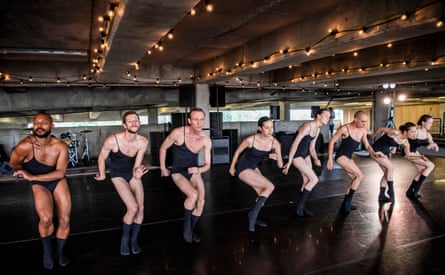
You can’t overstate just how different, not only Peckham was in 2007, but the whole cultural landscape of the country. This was years before the likes of The Vinyl Factory or Frameless, and long before the Hayward and Tate were racing to the bottom to find the most TikTok-ready, Instagram-friendly exhibitions possible.
The only large-scale sculptural commissions around back then were the fourth plinth and the Tate’s annual Turbine Hall and Duveen projects. There wasn’t really anywhere else to see new sculptural work by young artists.
There also wasn’t a lot going on in Peckham at the time. But what the area did have was a handful of project spaces, a single dive bar called Bar Story, seriously cheap rents and – thanks to being squeezed between Camberwell College of Arts and Goldsmiths – a lot of artists. Combined with a relative sense of isolation in the days before the London Overground, it boasted a fairly unique set of circumstances. “I found it to be a place of great possibility,” says Barry. “And it still feels like that.”
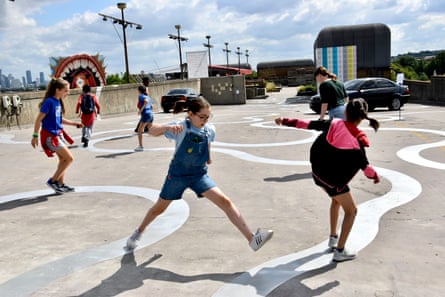
Barry had been putting on exhibitions in a semi-derelict house on nearby Lyndhurst Way, and struck up a relationship with the people responsible for property in Southwark council. The council realised that artists could act as caretakers of empty, derelict buildings awaiting redevelopment, and Barry figured that those buildings could be used for art exhibitions. It’s a model still followed today by other cultural charities, one that some consider the forward battalion in a wave of gentrification that has engulfed the city ever since.
“We looked at a lot of really interesting buildings, but none of them were really usable. Then one wintry afternoon, we went up to the top of the car park and I saw how long and how tall the building was,” says Barry. “It’s so simplistic, but it was a really good expanse of space with a very spectacular and particular context. And you got all sorts of different challenges: changing light conditions, changing weather conditions, the outdoors, the surrounding life of the city – all of that was pretty exciting.”
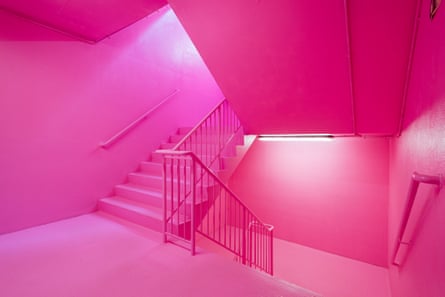
There are two permanent installations at the heart of Bold Tendencies: a rooftop bar called Frank’s Cafe, and Simon Whybray’s now iconic pink staircase. Frank’s was a simple solution to the question of how you get Londoners to hang around a cold, windy sculpture park in Peckham. You serve them cocktails on the roof, obviously. But it was also about providing an opportunity that didn’t really exist at the time. “Why were there no big public projects in the cultural realm going to early career architects?” Barry asks. “And why was it that if you designed a building, you couldn’t also build it? Frank’s was about trying create an opportunity.”
Whybray’s bubble-gum pink staircase, titled hi boo i love you, was also well ahead of the curve. Countless galleries these days try to crowbar “Instagram moments” into their programmes, but Whybray’s work was among the first properly viral, everyone-has-to-take-a-selfie-here art installations in London. The public reaction, which Whybray describes as “utterly overwhelming”, was huge. “No other large institution has been brave enough to commission me,” he says. “Bold Tendencies is a powerful reminder that transcendent experiences are possible in non-traditional spaces.”
Possible, but not necessarily easy. “The honest truth is it has been hard since the beginning and it remains hard,” says Barry. “Starting at the beginning every year is difficult. Wanting to make it better is difficult. The logistical challenges are difficult.”
One of the main challenges, clearly, is financial. Does Barry see Bold Tendencies continuing for another 20 years? “The sensible answer is that if I had the reserves for at least five years of operational running and programme costs, then yes, of course there’s five years, and another five years, and another five. But we don’t have any reserves.” She takes a long, pained pause. “There are lots of considerations and lots of difficulties. But what supersedes those difficulties is the joy of doing it. And I’ve kept doing it because I felt every year it could always get better. And when there is the possibility of progress ahead, I find it very difficult to not want to get there.”