


惯性聚合 高效追踪和阅读你感兴趣的博客、新闻、科技资讯
阅读原文 在惯性聚合中打开

推荐订阅源

P
Privacy & Cybersecurity Law Blog
aimingoo的专栏
aimingoo的专栏
Microsoft Azure Blog
T
Tailwind CSS Blog
P
Proofpoint News Feed
T
The Blog of Author Tim Ferriss
WordPress大学
WordPress大学
GbyAI
GbyAI
Engineering at Meta
Engineering at Meta
I
InfoQ
U
Unit 42
小众软件
小众软件
阮一峰的网络日志
阮一峰的网络日志
Martin Fowler
Martin Fowler
博客园 - Franky
钛媒体:引领未来商业与生活新知
钛媒体:引领未来商业与生活新知
G
Google Developers Blog
Security Archives - TechRepublic
S
Security Affairs
Jina AI
Jina AI
Google DeepMind News
M
MIT News - Artificial intelligence
cs.CV updates on arXiv.org
The Last Watchdog
The Last Watchdog
H
Hacker News: Front Page
MongoDB | Blog
MongoDB | Blog
A
About on SuperTechFans
Y
Y Combinator Blog
The GitHub Blog
The GitHub Blog
N
News and Events Feed by Topic
cs.AI updates on arXiv.org
SecWiki News
SecWiki News
V
V2EX
MyScale Blog
MyScale Blog
V2EX - 技术
V2EX - 技术
www.infosecurity-magazine.com
G
GRAHAM CLULEY
博客园 - 司徒正美
L
LangChain Blog
F
Fortinet All Blogs
Scott Helme
Scott Helme
量子位
Recent Announcements
Cyberwarzone
Cyberwarzone
C
CERT Recently Published Vulnerability Notes
Cloudbric
Cloudbric
W
WeLiveSecurity
The Register - Security
NISL@THU
NISL@THU
博客园_首页

The Guardian

Rory McIlroy surges into six-shot Masters lead with stunning second-round flourish ‘That’ll be the end’: actor Sam Neill joins fight to stop controversial goldmine near his New Zealand vineyard Roberto De Zerbi targets ‘Ange-ball’ revival to save Spurs from relegation Bath hit back to reach semi-final after stunning Northampton in 11-try epic Secret Garden to Outcome: the week in rave reviews Zebras, wealth and power: Hungary’s election tests Orbán’s grip on power ‘TikTok effect’ brings sellout crowds and younger fans to Grand National meeting The war over Omagh’s gold: the £21bn mine plan tearing a community apart Britain’s shadow workforce is paid as little as 65p an hour. Who cares for the carers? From You, Me & Tuscany to Euphoria: your complete entertainment guide to the week ahead Six great reads: the man who let snakes bite him, masked heavy metal and the brutal reality for foreign students in the UK American Classic review – I defy you not to fall in love with Kevin Kline and Laura Linney’s tender comedy Cuba’s doctors were a lifeline for the world. Now the Caribbean is shamefully complicit in the US drive to expel them An environmental disaster in Moldova has Russia’s fingerprints all over it RMIT drops misconduct case against student who accused university of being ‘complicit in Gaza genocide’ Ichiro Suzuki statue unveiling goes awry as bronze bat snaps during ceremony Survivors of Epstein’s abuse accuse Melania Trump of ‘shifting burden’ on to victims European football: Real Madrid held at home by Girona to extend winless run Arne Slot insists he is ‘aligned’ with Liverpool board and fans as squad is rebuilt Kamala Harris ‘thinking about’ running for president again in 2028 JD Vance warns Iran against trying to ‘play’ the US in peace talks West Ham double up twice to thrash Wolves and put Spurs in relegation zone Trump administration releases new renderings of so-called ‘Arc de Trump’ Crispin Odey drops £79m libel claim against FT over sexual misconduct allegations Bafta apologises for events surrounding John Davidson’s Tourette’s outburst Cocktail of the week: Bar Shrimp’s la rosita – recipe New drug may extend survival in aggressive ovarian cancer, trial shows One dead and 27 injured after bus with British passengers crashes in Canary Islands Pope adds to Smith’s mass of Surrey runs with England woes a world away OpenAI CEO Sam Altman’s home targeted with molotov cocktail Reform UK local election candidate was twice disciplined by Tories over ‘racist comments’ Remaining in Nato is in best interests of US, says Keir Starmer Prince Harry sued for defamation by charity he co-founded Anthropic’s new AI tool has implications for us all – whether we can use it or not Concerns raised about motorbike tourist trail after death of British teenager in Vietnam The Guardian view on Trump’s civilisational threats: the words that fuel war must be condemned The Guardian view on dystopias for our times: the American nightmare Doctors’ leader claims new reduced pay offer killed chances of ending strikes in England Netanyahu-ism has achieved nothing for Israelis – and come at a monstrously high price Deborah Levy: ‘CS Lewis’s White Witch terrified me – but I wanted to meet her’ How I Shop with Michelle Ogundehin: ‘We grownups have enough stuff already’ Trump’s war and Melania’s Epstein statement, with US editor Betsy Reed – The Latest We have to stop killer motorists on Britain’s roads UK starts crackdown on EU citizens’ post-Brexit rights Londoners aren’t unfriendly – but don’t compare us to New Yorkers The religious right and the perversion of faith Artemis II images reignite moon mission memories Orbán and Magyar trade accusations in last days of Hungary election campaign Reckonwrong: How Long Has It Been? review | Safi Bugel's experimental album of the month Martin Rowson on Middle East peace talks – cartoon Masters magic, the Grand National and Premier League drama – follow with us Fears of UK and EU flight cancellations as airports warn of jet fuel shortages Reform’s petulance over slavery reparations shows it just doesn’t grasp Britain’s place in the modern world Peers vote to ban pornography depicting sex acts between stepfamily members Starbucks’s retail arm gets £13.7m tax credit even as sales increase Flyby review – interstellar musical is a voyage of epic strangeness Grand National preview: Jagwar can deny Irish cohort in Aintree classic Week in wildlife: an ostrich on the lam, a tortoise crossing a road and surfing seals Anger as swifts’ nesting holes in Derbyshire rail viaduct ‘blocked up’ Peter Mandelson faces fixed-penalty notice for urinating in public ‘There’s no shortage of terrifying technology’: how AI became TV drama’s new go-to villain ‘Fresher than anything in a shop’: the best recipe boxes and meal kits for time-poor foodies, tested Who was Hilma? Af Klint exhibition to highlight exclusion of women from abstract art Critics assemble! Here’s my list of the greatest superhero movies of all time US inflation soars in March as war on Iran drives economy into uncertainty Amazon to finally launch Leo satellite internet in ‘mid-2026’, says CEO Grand National 2026: horse-by-horse guide to all the runners Pete Hegseth’s holy war: the militant Christian theology animating the US attack on Iran Add to playlist: the beautifully dazed, countrified indie-rock of Tracey Nelson and the week’s best new tracks Not just about Gaza: the Muslim voters turning from Labour to the Greens ‘I’m worried there’s too much of me,’ says a birch: inside the interspecies council giving nature a voice Why is anyone surprised by the US and Israel’s latest war? It’s only what the world allowed them to do in Gaza Tori Amos review – fans hang on every note of this dramatic deep dive into her back catalogue Coachella 2026: Justin Bieber launches a major comeback in the desert Super Mario what?! The seven best obscure Mario games ‘An abomination’: the Lancashire town kicking up a stink over reopened landfill Pillion to Roofman: the seven best films to watch on TV this week Holly Humberstone: Cruel World review – Taylor Swift fave trades gothic melancholy for pop glow-up Thrash review – cursed shark thriller sinks like a stone on Netflix Gulf states rethink security in light of US-Israel war on Iran Go Gentle by Maria Semple review – a joyfully clever New York romcom Welcome to Y’all Street: bullish Dallas aims to steal New York’s financial crown Margo’s Got Money Troubles to Beef: the seven best shows to stream this week I baulked at the idea of ‘friction-maxxing’. But there’s more to it than meets the eye Reich: The Sextets album review – Colin Currie celebrates the minimalist master’s joy of six Benjamina Ebuehi’s sweet and salty chocolate chip cookies recipe Experience: my house was taken over by 70,000 bees Malcolm in the Middle: Life’s Still Unfair review – the TV magic they’ve created here is absolutely miraculous Lava bursts forth as Hawaii’s Kilauea volcano erupts Sonos review: Are these the best portable speakers that money can buy? I tested to find out Buy bread in the evening, hit the sales on a Tuesday: retail workers’ top tips to cut your shopping bill The best water flossers in the UK, tested for that dentist-clean feeling Where to start with: Muriel Spark You be the judge: should my girlfriend stop mixing gold and silver jewellery? The best carry-on luggage in the UK, tested on an assault course How games capture the awe and terror of cosmic isolation I never text back – and it’s ruining my relationships The pet I’ll never forget: Beau, the labrador who saved my life Life Is Strange: Reunion review – a decade-long story comes to an impassioned close Why is gaming becoming so expensive? The answer is found in AI
‘They said: You’re out of your mind’: Luca Guadagnino on directing controversial opera The Death of Klinghoffer
Ben Miller · 2026-04-19 · via The Guardian

In a rehearsal room perched above the labyrinthine backstage of Florence’s starkly contemporary Maggio Musicale Fiorentino theatre, Luca Guadagnino is showing the women of the chorus how to make a second-act entrance. Dressed in a slouchy cardigan and slacks, the Italian director runs forward and stops short at a line of tape indicating the rim of the stage. A little out of breath, he turns past stretching dancers to conductor Lawrence Renes and asks if he minds the sound of stamping feet. “I never mind when we hear them talk, walk, breathe,” Renes says. “It’s live theatre.”

Better known for films like After the Hunt, Challengers and Call Me By Your Name, Guadagnino still sometimes punctuates stage rehearsals with instinctive cries of “Cut!” and “Action!”. But today he is directing an opera. It’s his second ever and his first in more than 15 years – and a highly controversial one to boot. The Death of Klinghoffer, a 1991 opera with music by John Adams and libretto by Alice Goodman, has sparked accusations of antisemitism whenever and wherever it has been performed. It depicts the 1985 hijacking of the cruise ship Achille Lauro by the Palestinian Liberation Front, their murder of disabled Jewish American tourist Leon Klinghoffer, and the grief and rage of his wife, Marilyn. The story is placed in a historical, even mythic, context.

This is the first new production of Klinghoffer to be conceived since the Hamas atrocities of 7 October 2023 and the Israeli bombardment of Gaza that followed. “The invisibility of victims is violent, odious and definitely fascistic,” Guadagnino says. “One of the great successes of not only autocracies but also so-called democracies has been to create a mirror where you do not see what is behind it. One of the great qualities of Klinghoffer is that it destroys that mirror and transforms the invisible, the unspeakable, the unsayable, into something you have to see, be confronted by and think about.”
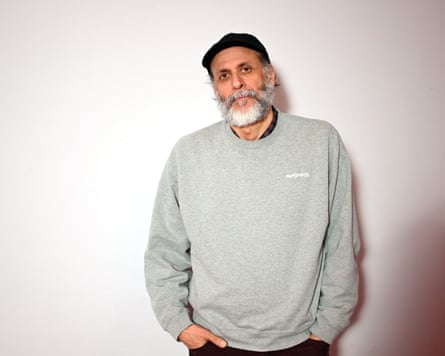
‘There is a lot of scope for interpretation’ … Luca Guadagnino.
‘There is a lot of scope for interpretation’ … Luca Guadagnino. Photograph: Kate Green/Getty Images for BFI

Along with Nixon in China, its predecessor by the same creative team, Klinghoffer is sometimes called a “CNN opera”. But Guadagnino rejects the characterisation, saying it’s a work of art that “elevates itself from the banality of the immediate”. The opera is constructed like a Bach passion in which monologues by the ship’s captain, the Klinghoffers, other hostages, and the PLF are studded with six chorales, starting with a Chorus of the Exiled Palestinians and followed by a Chorus of the Exiled Jews.

“You start with the catastrophic destruction of humanity, and with Nakba,” says Guadagnino, using the Arabic word for “catastrophe” which also refers to the mass displacement of Palestinians during the founding of the State of Israel. “And the catastrophe that the Palestinians sing about is the catastrophe to which Marilyn Klinghoffer, at the end, is subject. The opera is a two-faced mirror. There is always duality. The choruses are in the first person, and the Klinghoffers come to contain multitudes.”

Guadagnino got hooked on Adams’ music after being given a CD in the mid-2000s. “This music somehow preceded me within me,” he says. “I felt my unconsciousness was inhabited by it.” He built his 2009 film I Am Love – a meditation on class and eroticism in patrician Milan starring Tilda Swinton – around Adams’ music, and would listen to it while shooting scenes before convincing the composer to give him the rights.

It’s lovely to listen to but difficult to perform, due to Adams’ complex, repetitive rhythms and melismatic choral writing. Renes, an experienced conductor of Adams’ operas, is conducting his first Klinghoffer. He calls it “infinitely harder for the chorus, for the soloists, for the musicians” than other Adams works. “There is a lot of scope for interpretation,” he says. “Not in how you play the first five notes, maybe, but in how you build the architecture.”
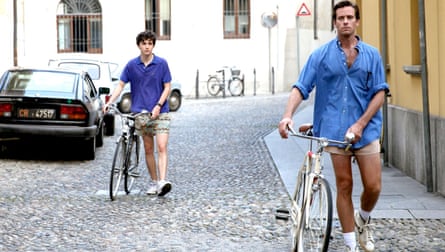
Timothée Chalamet and Armie Hammer in Guadagnino’s 2017 film Call Me By Your Name.
Timothée Chalamet and Armie Hammer in Guadagnino’s 2017 film Call Me By Your Name. Photograph: Sony Pictures Classics/Sundance

In Florence, the Klinghoffers are being played by the French bass-baritone Laurent Naouri and the British soprano Susan Bullock, who is now focusing on new music after a career spent singing the largest dramatic soprano parts in the repertoire. Central to Guadagnino’s concept is choreography, though, which he says will “bleed out” of the chorales, accompanying them as well as selected monologues. Dance, he says, can “defy the need for clarity”. Ella Rothschild, who is choreographing this production with 12 dancers assembled for the occasion, describes the score as “never repetition for repetition’s sake, but accumulation. You feel the weight as you go in”. She has developed a vocabulary in which specific movements and gestures become extended, almost endless. “In a contrast between the movement and the text and music,” she says, “a space can open up in which people can understand in a new way.”
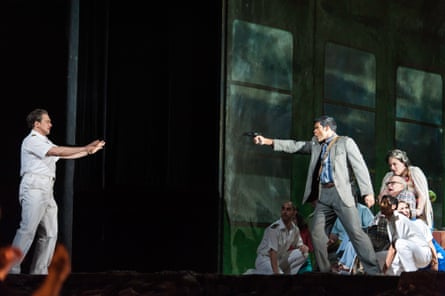
The 2014 Metropolitan Opera production.
‘False moral equivalencies’ … the 2014 Metropolitan Opera production. Photograph: Jack Vartoogian/Getty Images

Guadagnino made his first foray into opera in 2011, with a production of Giuseppe Verdi’s Falstaff, but he seems to have been so unhappy with the result that it’s as if he has scrubbed it from his CV. Having been approached by several opera houses to direct in recent years, he is determined to get it right this time. “Every time, I proposed doing Klinghoffer,” he says. “I said I’d happily do a Traviata or Rigoletto one day – but my debut had to be Klinghoffer. Every time, it was various degrees of, ‘We don’t know what you’re talking about’ to, ‘You’re completely out of your mind’. It was the end of the conversation, just bringing it up.”

The piece has been hotly debated since its 1991 premiere. A 1992 revival at the San Francisco Opera was subject to protests, and planned performances at Glyndebourne and the Los Angeles festival were cancelled. For a 2014 revival at the Metropolitan Opera in New York, Leon Klinghoffer’s daughters Lisa and Ilsa wrote in a programme note that the piece “presents false moral equivalencies without context” and “rationalises, romanticises and legitimises the terrorist murder of our father”. That revival was met with protest from Jewish groups as well as former mayor Rudy Giuliani, and a planned simulcast was cancelled.

In 2001, in the months after 9/11, the musicologist Richard Taruskin accused the opera of “romanticising terrorists”. His criticism centred on a prologue scene – set between the two “exile” choruses but cut since the work’s premiere in 1991 – that featured the Klinghoffers’ bickering neighbours. In the scene, Taruskin wrote, “the portrayal of suffering Palestinians in the musical language of myth and ritual was immediately juxtaposed with a musically trivial portrayal of contented, materialistic American Jews”.

The scene has never been performed since the work was recorded, without it, in 1992, and will not feature in Florence. But librettist Goodman says she would have preferred it to have remained part of the work. The scene doesn’t mock its characters, she insists, but instead serves as the work’s moral centre, “positioning the human moral decency of ordinary life, of ordinary people, as opposed to the grand romantic nationalism that chews ordinary people up”. To her, she says, “romantic nationalism is the great evil of our age”.
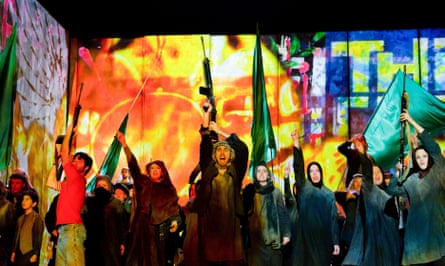
An English National Opera and New York Metropolitan Opera co-production.
‘Best thing I’ve written’ … an English National Opera and New York Metropolitan Opera co-production. Photograph: Donald Cooper/Alamy

“I think Klinghoffer is the best thing I’ve written,” she adds. “It’s about human beings. All the people who have objected to it have objected to their enemy being shown as human. One was not supposed to make the terrorists human beings.” Goodman, who was raised Jewish, converted to Christianity in adulthood, and after the furore over the piece, she found a new career as an Anglican minister. “The audience receives the opera, and by receiving it contributes to what that work is,” she says. “And in that respect it’s a bit like the work I do now. It’s an oral, formal medium.”

Taruskin argued that the opera favours the Palestinians musically, ennobling their sentiment while mocking its Jewish characters until they are ennobled by an encounter with death. “That is a false claim,” Guadagnino responds. “Who can say that with a straight face, knowing that the opera has the incredible aria where Marilyn is reminded of her husband before she knows he’s dead, or the Chorus of the Exiled Jews, which is one of the great arias?”

Carlo Fuortes, the general manager of the Maggio Musicale, says the theatre has not yet received any political pressure or been informed of protest plans. “Theatre has to take risks,” he says. “We have to do something real, something that speaks to people, not just tradition or entertainment.”

For Guadagnino, the criticism of the opera evinces “false consciousness and moral hypocrisy. Goodman is able, like every great writer, to understand human nature and the intricacies of how we perceive the Other.” The opera, he believes, is about pain, and the dignity of pain. “The attacks this opera has received,” he says, “are immoral. They are a testament to the decadence of our time, and to the constant freefall into immorality in the decades since the piece first premiered.” He pauses then adds: “I don’t know how this opera is going to be welcomed here. But so far, so good.”