

惯性聚合 高效追踪和阅读你感兴趣的博客、新闻、科技资讯
阅读原文 在惯性聚合中打开

推荐订阅源

G
Google Developers Blog
Apple Machine Learning Research
小众软件
小众软件
Recent Announcements
阮一峰的网络日志
阮一峰的网络日志
IT之家
IT之家
A
About on SuperTechFans
量子位
Engineering at Meta
Engineering at Meta
B
Blog
The Cloudflare Blog
博客园 - 【当耐特】
Hugging Face - Blog
Hugging Face - Blog
Y
Y Combinator Blog
J
Java Code Geeks
D
DataBreaches.Net
aimingoo的专栏
aimingoo的专栏
T
Tailwind CSS Blog
H
Help Net Security
钛媒体:引领未来商业与生活新知
钛媒体:引领未来商业与生活新知
V
V2EX
Stack Overflow Blog
Stack Overflow Blog
C
Check Point Blog
酷 壳 – CoolShell
酷 壳 – CoolShell

The Guardian

Rory McIlroy surges into six-shot Masters lead with stunning second-round flourish ‘That’ll be the end’: actor Sam Neill joins fight to stop controversial goldmine near his New Zealand vineyard Roberto De Zerbi targets ‘Ange-ball’ revival to save Spurs from relegation Bath hit back to reach semi-final after stunning Northampton in 11-try epic Secret Garden to Outcome: the week in rave reviews Zebras, wealth and power: Hungary’s election tests Orbán’s grip on power ‘TikTok effect’ brings sellout crowds and younger fans to Grand National meeting The war over Omagh’s gold: the £21bn mine plan tearing a community apart Britain’s shadow workforce is paid as little as 65p an hour. Who cares for the carers? From You, Me & Tuscany to Euphoria: your complete entertainment guide to the week ahead Six great reads: the man who let snakes bite him, masked heavy metal and the brutal reality for foreign students in the UK American Classic review – I defy you not to fall in love with Kevin Kline and Laura Linney’s tender comedy Cuba’s doctors were a lifeline for the world. Now the Caribbean is shamefully complicit in the US drive to expel them An environmental disaster in Moldova has Russia’s fingerprints all over it RMIT drops misconduct case against student who accused university of being ‘complicit in Gaza genocide’ Ichiro Suzuki statue unveiling goes awry as bronze bat snaps during ceremony Survivors of Epstein’s abuse accuse Melania Trump of ‘shifting burden’ on to victims European football: Real Madrid held at home by Girona to extend winless run Arne Slot insists he is ‘aligned’ with Liverpool board and fans as squad is rebuilt Kamala Harris ‘thinking about’ running for president again in 2028 JD Vance warns Iran against trying to ‘play’ the US in peace talks West Ham double up twice to thrash Wolves and put Spurs in relegation zone Trump administration releases new renderings of so-called ‘Arc de Trump’ Crispin Odey drops £79m libel claim against FT over sexual misconduct allegations Bafta apologises for events surrounding John Davidson’s Tourette’s outburst Cocktail of the week: Bar Shrimp’s la rosita – recipe New drug may extend survival in aggressive ovarian cancer, trial shows One dead and 27 injured after bus with British passengers crashes in Canary Islands Pope adds to Smith’s mass of Surrey runs with England woes a world away OpenAI CEO Sam Altman’s home targeted with molotov cocktail
Capacity of lifts not kept up with UK obesity levels, stu...
Anna Bawden · 2026-05-13 · via The Guardian

Lifts are no longer big enough to fit the UK’s larger citizens, according to researchers.

A study of maximum capacity in elevators in the UK and mainland Europe found lifts have not kept up with increasing obesity levels, raising concerns about safety and equity.

The research, presented at the European Congress on Obesity in Istanbul, Turkey, used photos of weight limits for 112 lifts manufactured between 1972 and 2024 in the UK, France, Germany, Italy, Spain, Austria and Finland.

Prof Nick Finer, the president and chair of the International Prader-Willi Syndrome Organisation and lead author of the study, compared the average maximum weight allowance (total weight allowance divided by maximum passenger limits) with the average adult weight in the year the lift was manufactured.

The research found that despite adults’ continued growing weight, total lift limits have not increased since about 2004. In the mid-1970s, the average British man weighed 75kg and a woman 65kg, but that has swelled to 86kg and 73kg respectively.

Maximum allowances rose from about 62kg a person in 1972 to 75kg in 2002, broadly in line with average body weight increases during this time. But most lift manufacturers assumed average weight remained at 75kg, 4kg lighter than the average adult.

“What seems to have happened is there was a shift to manufacturers calculating the amount of room you take up on the floor [rather than weight],” said Finer. “But they assume the shape of a person is an oval rather than a circle. They have completely failed to recognise that if obesity is increasing then so is the amount of room you take up.”
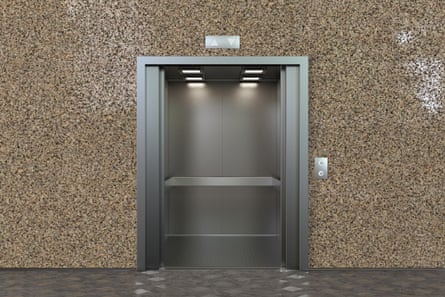
Empty elevator cabin with open doors: it is metallic silver inside and set in a pale brown stone wall.
Most lift manufacturers have assumed average weight has remained at 75kg. Photograph: Dmitriy Moroz/Alamy

Lifts that are too small caused potential safety issues, with designs based on “flawed calculations”, Finer said. “The ability to transport people up floors in a speedy time is impacted if you can only get half the number of people in the lift that you designed them for.”

Lifts could cut out, for example, if the passengers exceeded the total weight limits. “But perhaps even more important than that is the stigma that [people with obesity] may experience on entering lifts – a form of everyday weight discrimination.”

Finer added that “we need sadly, to super-size many of the things in life” to be suitable and safe for people living with obesity, as otherwise they would be excluded from society. “If we don’t recognise growing trends in obesity and body size then we’re really making it hard for those people to function in our society.”

Responding to the study’s findings, Jane DeVille-Almond, the president of the British Obesity Society, said: “We need to accept that society is unlikely to revert to sizes from 50 years ago, and start developing facilities for the 21st century.”

Louise Payne, a registered nutritionist, said: “It’s clear public spaces aren’t always designed with larger bodies in mind. This is not simply an issue of comfort, it’s about dignity, accessibility, and inclusion.

“Nobody should feel embarrassed, unsafe, or excluded when using public transport or accessing everyday services.”