
惯性聚合 高效追踪和阅读你感兴趣的博客、新闻、科技资讯
阅读原文 在惯性聚合中打开

推荐订阅源

G
Google Developers Blog
Jina AI
Jina AI
大猫的无限游戏
大猫的无限游戏
Martin Fowler
Martin Fowler
博客园 - 司徒正美
云风的 BLOG
云风的 BLOG
C
Cybersecurity and Infrastructure Security Agency CISA
CTFtime.org: upcoming CTF events
S
Securelist
S
Security Affairs
freeCodeCamp Programming Tutorials: Python, JavaScript, Git & More
L
LINUX DO - 热门话题
博客园 - 三生石上(FineUI控件)
T
Threatpost
T
The Blog of Author Tim Ferriss
C
CERT Recently Published Vulnerability Notes
IT之家
IT之家
P
Palo Alto Networks Blog
Microsoft Azure Blog
Spread Privacy
Spread Privacy
Cyberwarzone
Cyberwarzone
腾讯CDC
L
LangChain Blog
Know Your Adversary
Know Your Adversary
C
CXSECURITY Database RSS Feed - CXSecurity.com
GbyAI
GbyAI
Threat Intelligence Blog | Flashpoint
I
Intezer
T
Tor Project blog
AWS News Blog
AWS News Blog
T
Tenable Blog
NISL@THU
NISL@THU
Security Latest
Security Latest
cs.CL updates on arXiv.org
H
Hackread – Cybersecurity News, Data Breaches, AI and More
人人都是产品经理
人人都是产品经理
MongoDB | Blog
MongoDB | Blog
MyScale Blog
MyScale Blog
D
DataBreaches.Net
Microsoft Security Blog
钛媒体:引领未来商业与生活新知
钛媒体:引领未来商业与生活新知
量子位
美团技术团队
The Cloudflare Blog
酷 壳 – CoolShell
酷 壳 – CoolShell
罗磊的独立博客
The GitHub Blog
The GitHub Blog
阮一峰的网络日志
阮一峰的网络日志
OSCHINA 社区最新新闻
OSCHINA 社区最新新闻
Stack Overflow Blog
Stack Overflow Blog

The Guardian

Rory McIlroy surges into six-shot Masters lead with stunning second-round flourish ‘That’ll be the end’: actor Sam Neill joins fight to stop controversial goldmine near his New Zealand vineyard Roberto De Zerbi targets ‘Ange-ball’ revival to save Spurs from relegation Bath hit back to reach semi-final after stunning Northampton in 11-try epic Secret Garden to Outcome: the week in rave reviews Zebras, wealth and power: Hungary’s election tests Orbán’s grip on power ‘TikTok effect’ brings sellout crowds and younger fans to Grand National meeting The war over Omagh’s gold: the £21bn mine plan tearing a community apart Britain’s shadow workforce is paid as little as 65p an hour. Who cares for the carers? From You, Me & Tuscany to Euphoria: your complete entertainment guide to the week ahead Six great reads: the man who let snakes bite him, masked heavy metal and the brutal reality for foreign students in the UK American Classic review – I defy you not to fall in love with Kevin Kline and Laura Linney’s tender comedy Cuba’s doctors were a lifeline for the world. Now the Caribbean is shamefully complicit in the US drive to expel them An environmental disaster in Moldova has Russia’s fingerprints all over it RMIT drops misconduct case against student who accused university of being ‘complicit in Gaza genocide’ Ichiro Suzuki statue unveiling goes awry as bronze bat snaps during ceremony Survivors of Epstein’s abuse accuse Melania Trump of ‘shifting burden’ on to victims European football: Real Madrid held at home by Girona to extend winless run Arne Slot insists he is ‘aligned’ with Liverpool board and fans as squad is rebuilt Kamala Harris ‘thinking about’ running for president again in 2028 JD Vance warns Iran against trying to ‘play’ the US in peace talks West Ham double up twice to thrash Wolves and put Spurs in relegation zone Trump administration releases new renderings of so-called ‘Arc de Trump’ Crispin Odey drops £79m libel claim against FT over sexual misconduct allegations Bafta apologises for events surrounding John Davidson’s Tourette’s outburst Cocktail of the week: Bar Shrimp’s la rosita – recipe New drug may extend survival in aggressive ovarian cancer, trial shows One dead and 27 injured after bus with British passengers crashes in Canary Islands Pope adds to Smith’s mass of Surrey runs with England woes a world away OpenAI CEO Sam Altman’s home targeted with molotov cocktail Reform UK local election candidate was twice disciplined by Tories over ‘racist comments’ Remaining in Nato is in best interests of US, says Keir Starmer Prince Harry sued for defamation by charity he co-founded Anthropic’s new AI tool has implications for us all – whether we can use it or not Concerns raised about motorbike tourist trail after death of British teenager in Vietnam The Guardian view on Trump’s civilisational threats: the words that fuel war must be condemned The Guardian view on dystopias for our times: the American nightmare Doctors’ leader claims new reduced pay offer killed chances of ending strikes in England Netanyahu-ism has achieved nothing for Israelis – and come at a monstrously high price Deborah Levy: ‘CS Lewis’s White Witch terrified me – but I wanted to meet her’ How I Shop with Michelle Ogundehin: ‘We grownups have enough stuff already’ Trump’s war and Melania’s Epstein statement, with US editor Betsy Reed – The Latest We have to stop killer motorists on Britain’s roads UK starts crackdown on EU citizens’ post-Brexit rights Londoners aren’t unfriendly – but don’t compare us to New Yorkers The religious right and the perversion of faith Artemis II images reignite moon mission memories Orbán and Magyar trade accusations in last days of Hungary election campaign Reckonwrong: How Long Has It Been? review | Safi Bugel's experimental album of the month Martin Rowson on Middle East peace talks – cartoon Masters magic, the Grand National and Premier League drama – follow with us Fears of UK and EU flight cancellations as airports warn of jet fuel shortages Reform’s petulance over slavery reparations shows it just doesn’t grasp Britain’s place in the modern world Peers vote to ban pornography depicting sex acts between stepfamily members Starbucks’s retail arm gets £13.7m tax credit even as sales increase Flyby review – interstellar musical is a voyage of epic strangeness Grand National preview: Jagwar can deny Irish cohort in Aintree classic Week in wildlife: an ostrich on the lam, a tortoise crossing a road and surfing seals Anger as swifts’ nesting holes in Derbyshire rail viaduct ‘blocked up’ Peter Mandelson faces fixed-penalty notice for urinating in public ‘There’s no shortage of terrifying technology’: how AI became TV drama’s new go-to villain ‘Fresher than anything in a shop’: the best recipe boxes and meal kits for time-poor foodies, tested Who was Hilma? Af Klint exhibition to highlight exclusion of women from abstract art Critics assemble! Here’s my list of the greatest superhero movies of all time US inflation soars in March as war on Iran drives economy into uncertainty Amazon to finally launch Leo satellite internet in ‘mid-2026’, says CEO Grand National 2026: horse-by-horse guide to all the runners Pete Hegseth’s holy war: the militant Christian theology animating the US attack on Iran Add to playlist: the beautifully dazed, countrified indie-rock of Tracey Nelson and the week’s best new tracks Not just about Gaza: the Muslim voters turning from Labour to the Greens ‘I’m worried there’s too much of me,’ says a birch: inside the interspecies council giving nature a voice Why is anyone surprised by the US and Israel’s latest war? It’s only what the world allowed them to do in Gaza Tori Amos review – fans hang on every note of this dramatic deep dive into her back catalogue Coachella 2026: Justin Bieber launches a major comeback in the desert Super Mario what?! The seven best obscure Mario games ‘An abomination’: the Lancashire town kicking up a stink over reopened landfill Pillion to Roofman: the seven best films to watch on TV this week Holly Humberstone: Cruel World review – Taylor Swift fave trades gothic melancholy for pop glow-up Thrash review – cursed shark thriller sinks like a stone on Netflix Gulf states rethink security in light of US-Israel war on Iran Go Gentle by Maria Semple review – a joyfully clever New York romcom Welcome to Y’all Street: bullish Dallas aims to steal New York’s financial crown Margo’s Got Money Troubles to Beef: the seven best shows to stream this week I baulked at the idea of ‘friction-maxxing’. But there’s more to it than meets the eye Reich: The Sextets album review – Colin Currie celebrates the minimalist master’s joy of six Benjamina Ebuehi’s sweet and salty chocolate chip cookies recipe Experience: my house was taken over by 70,000 bees Malcolm in the Middle: Life’s Still Unfair review – the TV magic they’ve created here is absolutely miraculous Lava bursts forth as Hawaii’s Kilauea volcano erupts Sonos review: Are these the best portable speakers that money can buy? I tested to find out Buy bread in the evening, hit the sales on a Tuesday: retail workers’ top tips to cut your shopping bill The best water flossers in the UK, tested for that dentist-clean feeling Where to start with: Muriel Spark You be the judge: should my girlfriend stop mixing gold and silver jewellery? The best carry-on luggage in the UK, tested on an assault course How games capture the awe and terror of cosmic isolation I never text back – and it’s ruining my relationships The pet I’ll never forget: Beau, the labrador who saved my life Life Is Strange: Reunion review – a decade-long story comes to an impassioned close Why is gaming becoming so expensive? The answer is found in AI
Could key climate talks mark ground zero in global push to ditch fossil fuels?
Fiona Harvey · 2026-05-01 · via The Guardian

Looking out to sea from the grey sandy beaches of Santa Marta, on Colombia’s Caribbean coast, it is never hard to spot evidence of the country’s thriving fossil fuel export trade. Oil tankers ride at anchor on the horizon, and sometimes, locals say, lumps of coal wash up on the shore, blown off the collier ships that carry cargos from the nearby mines.

It was here, on Wednesday evening, that the Colombian government took a bold step to shift its economy – and that of the rest of the world – away from dependence on coal, gas and oil and into a new era of clean energy. With the first ever conference on “transitioning away from fossil fuels”, the host joined nearly 60 countries determined to loosen of the grip of petrostates on the world’s future.
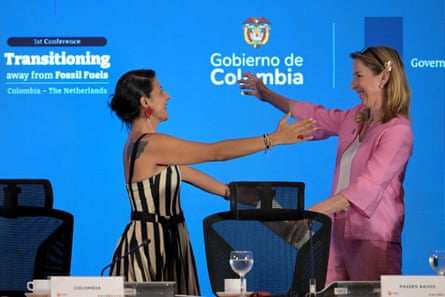
Torres and Van Veldhoven stand and make to embrace on stage
Colombia’s Irene Vélez Torres, left, greets the Dutch minister of climate and green growth, Stientje van Veldhoven. Photograph: Raúl Arboleda/AFP/Getty Images

“This is the beginning of a new global climate democracy,” Irene Vélez Torres, Colombia’s environment minister and chair of the talks, said in closing remarks that celebrated a “new method” of bringing together high-ambition governments, parliamentarians and civil society groups to accelerate the decarbonisation of their economies.

At this moment in history, the conference may also mark a new global divide between “electro-democracies” and petro-dictatorships.

The initiative has come at a pivotal moment in the climate fight. Oil and gas prices have soared since the US-Israel attacks on Iran, the second such crisis within five years, after the price rises that followed Russia’s invasion of Ukraine. Households across the world are spiralling into debt, farmers cannot afford fertiliser and governments are remembering that a dependency on volatile fossil fuels is holding them hostage to geopolitical forces they cannot control.

The global economy faces a triple whammy: rising energy costs; rising food costs that follow; and the spectre of rampant inflation that will raise interest rates and add to the cost of servicing debt. Both rich and poor nations are feeling the impact, but the poor with their higher levels of debt and lower reserves are suffering more.
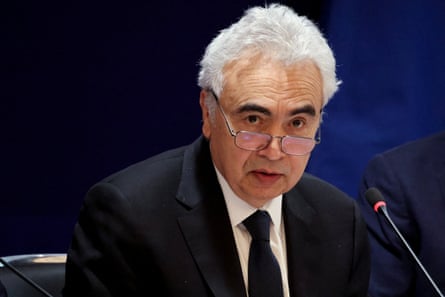
Fatih Birol speaks during a conference on energy transition ahead of the 2026 United Nations conference on climate change COP31 at the IEA in Paris on 30 April 2026.
Fatih Birol: ‘This is bigger than all the biggest crises combined, and therefore huge.’ Photograph: Ludovic Marin/AFP/Getty Images

Repeated oil shocks blighted the 1970s, and the current crisis is not only greater than those but more impactful than all previous crises combined, according to Fatih Birol, the world’s leading energy economist and chief of the International Energy Agency, the gold standard in energy research. “This is bigger than all the biggest crises combined, and therefore huge,” he said in an exclusive Guardian interview. “I still cannot understand that the world was so blind-sided, that the global economy can be held hostage to a 50km strait.”

What is different today from previous oil shocks is the ready availability of a viable alternative: cheap, reliable and plentiful renewable energy from the wind and sun, with modern battery technology to smooth over any intermittency; while electric vehicles and heat pumps can shunt transport and heating off fossil fuels and on to far more efficient electricity.

For those reasons, Birol predicted the current shock would mark a permanent change for the global energy industry, leading consumer countries to lose trust in fossil fuels. “Their perception of risk and reliability will change,” he said. “Governments will review their energy strategies. There will be a significant boost to renewables and nuclear power and a further shift towards a more electrified future. And this will cut into the main markets for oil.”

These changes would be lasting, he added. “The vase is broken, the damage is done – it will be very difficult to put the pieces back together. This will have permanent consequences for the global energy market for years to come.”

It is an irony not lost on Simon Stiell, the UN’s climate chief, that it is the oil industry’s dominance of global economies that has finally woken governments to the dangers. “The fossil fuel cost crisis now has its foot on the throat of the global economy,” he said. “Those who have fought to keep the world hooked on fossil fuels are inadvertently supercharging the global renewables boom.”

Nugent, Torres, Van Vledhoven nad Talia on stage
Philip Nugent, director general for EU, international and marine affairs; Colombia's environmental minister, Irene Vélez Torres; Stientje van Veldhoven, minister of climate policy and green growth of the Netherlands, and Maina Talia, minister of home affairs, climate change and environment of Tuvalu, talk onstage at the end of the conference in Santa Marta, Colombia. Photograph: Iván Valencia/AP

Renewables overtook coal in global electricity generation last year for the first time, according to the thinktank Ember, generating 33.8% of power compared to coal’s 33%. Interest from consumers in solar panels and batteries, from Pakistan to the UK, has leapt further since the Iran war.

“The economic logic of renewables [is] impossible to ignore,” said Stiell. Military advisers have weighed in too, pointing out that renewables offer a better route than fossil fuels to national security. Stiell noted: “Governments are pushing renewables plans into overdrive: to restore national security, economic stability, competitiveness, policy autonomy and basic sovereignty.”

But no one should write off the petrostates just yet. The world’s biggest gas producer, the United States is increasingly flexing its military muscle to assert the Trump administration’s goal of “energy dominance”. Russia, the second biggest gas supplier, is waging war against its democratic neighbour Ukraine. Fossil fuel interests are pouring huge sums into the political campaigns of far right candidates in the Americas and Europe.

The Santa Marta vision of a “new global climate democracy” sets people power against this. Polls constantly show an overwhelming majority of people in the world want their governments to take stronger action against the climate crisis, but at many international meetings their voices are drowned out by corporate lobbyists or shut down by petrostate vetoes.
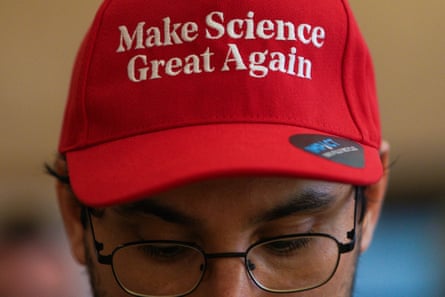
Man wears a red cap that reads 'Make Science Great Again'
A delegate at the conference in Santa Marta that was for many a shining example of science-led decision-making. Photograph: Iván Valencia/AP

At Santa Marta, by contrast, science led the way on the opening day, followed by a “people’s summit” and gatherings of parliamentarians. All of these groups sent representatives to the high-level sessions in the final two days, where there were no vetoes, no fractious negotiations over minutae, only intensive and constructive dialogue on how to move forward. Many participants called the gathering historic but few were under any illusions that it was anything more than a strong start.

Claudio Angelo, of the Observatorio do Clima, a thinktank in Brazil, said: “I don’t think the Santa Marta process represents any immediate threat to the fossil fuel industry. This is more about countries organising to draw up a plan. Even within the ‘doers’, the fossil industry landscape is diverse: national oil companies in Latin America, private oil majors in Europe and parts of Africa. These folks will fight for lenient transition calendars until they’re either outcompeted by Chinese electricity or forced by governments to diversify.”

Though shifting to renewables will work out cheaper for all countries in the long-term, there is an upfront cost to the switch. Fossil fuel producer nations will also need finance to invest in new industries to replace lost oil, gas and coal export revenue.

The Santa Marta conference was not intended for new finance pledges – rich countries offered a settlement of $300bn a year by 2035 at the Cop29 conference in 2029, and that will not be improved on now the US has withdrawn its dollars.
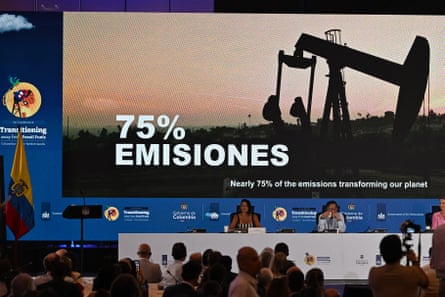
Image behind speakers on stage shows nodding donkey oil well with headline figure: 75% Emisiones
A debate at the conference. Photograph: Raúl Arboleda/AFP/Getty Images

But there could be other routes to finding cash. Diverting some of the $1.5 trillion currently spent each year on subsidising fossil fuels around the world would help, and raising money from the companies that have profited from the climate crisis, through windfall taxes and other mechanisms, is always an option. David Hillman, director of the Make Polluters Pay coalition, said: “Fossil fuel giants are figuratively making a killing from this war. Their excessive unearned profits need to fund the transition to renewables to hasten the end of our fossil fuel dependence.”

Almost all of the 59 nations participating at Santa Marta are democracies, which is both a strength and a vulnerability. Colombia will hold a presidential election at the end of May, in which the ruling party’s candidate, Iván Cepeda, faces a fierce challenge from the far-right populist Abelardo de la Espriella, who wants to increase fracking and oil production. If the latter wins, the global energy transition movement would lose one of its most important nations.

Back of Sikulu wearing green shrt and headpiece as he faces audience
Joseph Sikulu, an activist from Tuvalu, talks during the conference. Photograph: Iván Valencia/AP

Colombia is not the only country facing difficulties. The Netherlands, co-host of Santa Marta, announced new drilling in the North Sea just before the conference. The UK is mulling new North Sea fields too, and other countries present, from Brazil to Tanzania, also have fossil fuel expansion plans. Those decisions will have to be reversed for this to become the hoped-for “conference of doers”.

Before the next conference, to take place early next year on the Pacific island of Tuvalu, which is co-hosting with Ireland, countries are supposed to start the process of drawing up national roadmaps to the phaseout of fossil fuels. The organisers want these plans to feed into the broader UN climate negotiating process and to spur others to join the transition movement.
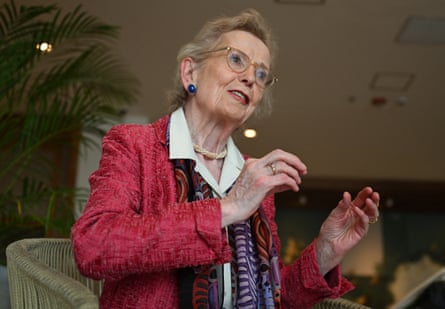
Robinson gesticulating as she speaks
Mary Robinson on the sidelines of the Santa Marta conference: ‘We need three transitions: out of fossil fuels, into renewable energy for all, and into a world that cares for nature. All must be grounded in justice.’ Photograph: Raúl Arboleda/AFP/Getty Images

Roadmaps offer a way for countries to attract investors, and also provide guidance for their industries to help ensure the transition to a low-carbon world is fair to workers and the most vulnerable people. Mary Robinson, former president of Ireland, said: “We need three transitions: out of fossil fuels, into renewable energy for all, and into a world that cares for nature. All must be grounded in justice.”

Santa Marta, a historically coal-fuelled town at the heart of a coal- and oil-fuelled country, may eventually be regarded as ground zero for the demise of fossil fuels. Fernanda Carvalho, head of policy for climate and energy at WWF International, said: “It is here that the seeds of a new, implementation-focused initiative have been planted.

“In times of an exhaustion of multilateral processes and a gap in delivering the system change we need, what is emerging offers a different approach. This could be a real bottom-up process that centres the voices of communities most affected by fossil fuel extraction and consumption.”

But despite the “contagious” hope felt by many involved in the Santa Marta talks, there remains a long road ahead.