









The sailors aboard the navy vessel Hashidate know what’s for lunch long before the telltale aromas escape from the galley.
Yosuke Oyama, the ship’s chef, has been up since dawn, softening onions and occasionally stirring a pot of chicken stock that has been simmering for several hours.
He slices carrots and potatoes, places strips of beef on a tray and performs a quick inventory of the other ingredients – among them a selection of spices, apple puree, ginger and garlic and, for extra umami, a red wine and honey reduction.
After a chorus of “Itadakimasu” – bon appétit – the mess deck is silent except for the appreciative noises made by the ravenous men and women of Japan’s maritime self-defence forces (SDF).
“The crew love hamburgers, steak, sushi and ramen … they eat a lot like children,” jokes Oyama, a navy chef for three decades who is more accustomed to cooking for up to 500 sailors at a time. “And curry is always a winner.”
With each spoonful, they are upholding a tradition of eating curry for lunch every Friday – once a way to track the passage of time on long voyages – and keeping rival SDF vessels around Japan on their culinary toes as they continue their search for the perfect curry recipe.
Despite its south Asian origins, it’s no exaggeration to describe curry as Japan’s de facto national dish: a soupy, mild version beloved of schoolchildren and office workers, and generations of SDF personnel for whom kaigun kare – or navy curry – is a source of fierce pride as well as sustenance.
The 10 crew members aboard Hashidate, a special services vessel used to host international VIPs that lies at anchor in Yokosuka, a naval base south of Tokyo, are among thousands of sailors eating their ship’s version of the same dish.
Chef Oyama says variety is the key to keeping his diners interested in their Friday curry week in, week out. “We mix things up, like making keema or seafood curry, or keeping the leftover sauce and serving it with udon noodles the next day. The other day I fried up some apple puree and added it to the curry … it was delicious.”
‘If I don’t eat curry it messes around with my body clock’
Tradition dictates that Yokosuka curry – one of many variations on the navy curry theme – must be accompanied by salad, pickles and a glass of milk for nutritional balance.
As Japan expanded its influence in Asia in the late 1800s, large numbers of soldiers fell ill or died from beriberi, a vitamin B1 deficiency linked to their diet, which largely comprised plain white rice.
The solution came in the form of curry powder thought to have been introduced by Anglo-Indian officers in the Royal Navy who were among the first westerners to come into contact with Japan after Commodore Perry’s “black ships” forced it to end centuries of sakoku “locked country” isolation in the 1850s.
Curry powder, it turned out, contained enough vitamin B1 to keep soldiers and sailors healthy. Beriberi cases plummeted, and military personnel quickly developed a taste for anglicised curry and rice, made with meat and vegetables and a flour-thickened sauce that was less likely to splash around in rough seas.
A more romantic explanation claims that a party of British sailors who were shipwrecked off Japan’s coast came ashore with their rations, which included curry powder.
It didn’t take long for curry to establish a loyal following among civilians. The first Japanese recipe for curry was published in 1872, and restaurants began serving it five years later, according to Japanese food writer Makiko Itoh. In 1908, a recipe for curry appeared in the Navy Cooking Reference Book.
When the present-day maritime SDF was formed in 1954 – a postwar replacement for the imperial Japanese navy – the tradition continued, spurring “rival” bases to create their own recipes and lay claim to making Japan’s best navy curry. Together, Japan’s sailors get through 45 tonnes of curry a year – equivalent to 2.25m meals – according to the maritime SDF.
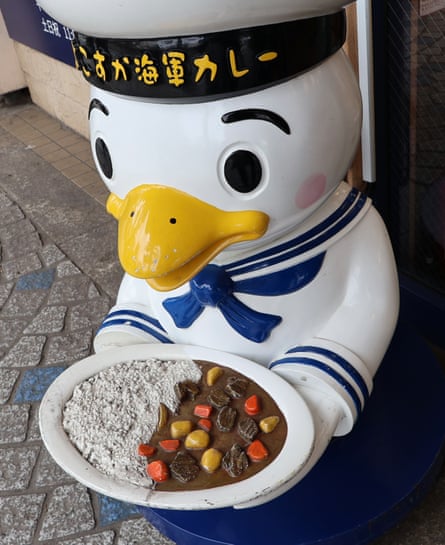
Sailors in Maizuru, on the Japan Sea coast, and in Kure, in the Seto Inland Sea, will disagree, but Yokosuka has a strong case for claiming the title of navy curry capital.
The city’s seagull mascot, Sucurry, greets visitors at the main railway station with a bowl of its signature dish; at Yokosuka Navy Curry Honpo, diners can eat kaigun kare- made according to the 1908 recipe and take home boil-in-the bag versions. Yokosuka’s annual curry festival, held in May, attracts tens of thousands of visitors eager to sample dozens of recipes.
However, the dish has landed some of its fans in hot water. In 2022, six Japanese sailors were suspended from duty after it was found that they had been helping themselves to curry without paying for up to three years at an SDF base. As visiting personnel, they were not entitled to gratis servings.
The previous year, curry was at the centre of diplomatic tensions after media reported on a seafood curry sold in Japan that included mounds of rice shaped to resemble the uninhabited Takeshima islands, which are administered by Japan but claimed by South Korea, where they are known as the Dokdo.
Aboard the Hashidate, Yosuke Ohtsuki, a first lieutenant, admits he rarely eats curry at home. “I’ve heard that some families wait until the sailor in the household is away on a voyage before they eat curry,” he says, adding: “If it’s Friday we know it’s going to be a good day.”
Their bowls empty, the sailors clear up and prepare for an upcoming voyage along the coast. “I never tire of eating curry,” says Hideaki Ito, the chief of operations. “In fact, if I don’t eat curry it messes around with my body clock.”