
惯性聚合 高效追踪和阅读你感兴趣的博客、新闻、科技资讯
阅读原文 在惯性聚合中打开

推荐订阅源

Threat Intelligence Blog | Flashpoint
Exploit-DB.com RSS Feed
The Last Watchdog
The Last Watchdog
K
KPMG report finds enterprise disconnect between AI and its ROI | CIO
T
Troy Hunt's Blog
L
LINUX DO - 最新话题
C
Check Point Blog
T
Threat Research - Cisco Blogs
OSCHINA 社区最新新闻
OSCHINA 社区最新新闻
罗磊的独立博客
V
Vulnerabilities – Threatpost
cs.CV updates on arXiv.org
J
Java Code Geeks
Apple Machine Learning Research
大猫的无限游戏
大猫的无限游戏
S
Security @ Cisco Blogs
IT之家
IT之家
T
The Exploit Database - CXSecurity.com
The GitHub Blog
The GitHub Blog
D
Docker
Engineering at Meta
Engineering at Meta
AWS News Blog
AWS News Blog
S
Security Affairs
U
Unit 42
P
Palo Alto Networks Blog
V
Visual Studio Blog
Y
Y Combinator Blog
D
DataBreaches.Net
Forbes - Security
Forbes - Security
阮一峰的网络日志
阮一峰的网络日志
美团技术团队
Security Latest
Security Latest
aimingoo的专栏
aimingoo的专栏
Simon Willison's Weblog
A
Arctic Wolf
博客园_首页
钛媒体:引领未来商业与生活新知
钛媒体:引领未来商业与生活新知
H
Hacker News: Front Page
博客园 - 司徒正美
博客园 - Franky
宝玉的分享
宝玉的分享
TaoSecurity Blog
TaoSecurity Blog
Latest news
Latest news
Scott Helme
Scott Helme
MongoDB | Blog
MongoDB | Blog
量子位
cs.AI updates on arXiv.org
C
Cisco Blogs
P
Privacy International News Feed
Application and Cybersecurity Blog

The Guardian

Rory McIlroy surges into six-shot Masters lead with stunning second-round flourish ‘That’ll be the end’: actor Sam Neill joins fight to stop controversial goldmine near his New Zealand vineyard Roberto De Zerbi targets ‘Ange-ball’ revival to save Spurs from relegation Bath hit back to reach semi-final after stunning Northampton in 11-try epic Secret Garden to Outcome: the week in rave reviews Zebras, wealth and power: Hungary’s election tests Orbán’s grip on power ‘TikTok effect’ brings sellout crowds and younger fans to Grand National meeting The war over Omagh’s gold: the £21bn mine plan tearing a community apart Britain’s shadow workforce is paid as little as 65p an hour. Who cares for the carers? From You, Me & Tuscany to Euphoria: your complete entertainment guide to the week ahead Six great reads: the man who let snakes bite him, masked heavy metal and the brutal reality for foreign students in the UK American Classic review – I defy you not to fall in love with Kevin Kline and Laura Linney’s tender comedy Cuba’s doctors were a lifeline for the world. Now the Caribbean is shamefully complicit in the US drive to expel them An environmental disaster in Moldova has Russia’s fingerprints all over it RMIT drops misconduct case against student who accused university of being ‘complicit in Gaza genocide’ Ichiro Suzuki statue unveiling goes awry as bronze bat snaps during ceremony Survivors of Epstein’s abuse accuse Melania Trump of ‘shifting burden’ on to victims European football: Real Madrid held at home by Girona to extend winless run Arne Slot insists he is ‘aligned’ with Liverpool board and fans as squad is rebuilt Kamala Harris ‘thinking about’ running for president again in 2028 JD Vance warns Iran against trying to ‘play’ the US in peace talks West Ham double up twice to thrash Wolves and put Spurs in relegation zone Trump administration releases new renderings of so-called ‘Arc de Trump’ Crispin Odey drops £79m libel claim against FT over sexual misconduct allegations Bafta apologises for events surrounding John Davidson’s Tourette’s outburst Cocktail of the week: Bar Shrimp’s la rosita – recipe New drug may extend survival in aggressive ovarian cancer, trial shows One dead and 27 injured after bus with British passengers crashes in Canary Islands Pope adds to Smith’s mass of Surrey runs with England woes a world away OpenAI CEO Sam Altman’s home targeted with molotov cocktail Reform UK local election candidate was twice disciplined by Tories over ‘racist comments’ Remaining in Nato is in best interests of US, says Keir Starmer Prince Harry sued for defamation by charity he co-founded Anthropic’s new AI tool has implications for us all – whether we can use it or not Concerns raised about motorbike tourist trail after death of British teenager in Vietnam The Guardian view on Trump’s civilisational threats: the words that fuel war must be condemned The Guardian view on dystopias for our times: the American nightmare Doctors’ leader claims new reduced pay offer killed chances of ending strikes in England Netanyahu-ism has achieved nothing for Israelis – and come at a monstrously high price Deborah Levy: ‘CS Lewis’s White Witch terrified me – but I wanted to meet her’ How I Shop with Michelle Ogundehin: ‘We grownups have enough stuff already’ Trump’s war and Melania’s Epstein statement, with US editor Betsy Reed – The Latest We have to stop killer motorists on Britain’s roads UK starts crackdown on EU citizens’ post-Brexit rights Londoners aren’t unfriendly – but don’t compare us to New Yorkers The religious right and the perversion of faith Artemis II images reignite moon mission memories Orbán and Magyar trade accusations in last days of Hungary election campaign Reckonwrong: How Long Has It Been? review | Safi Bugel's experimental album of the month Martin Rowson on Middle East peace talks – cartoon Masters magic, the Grand National and Premier League drama – follow with us Fears of UK and EU flight cancellations as airports warn of jet fuel shortages Reform’s petulance over slavery reparations shows it just doesn’t grasp Britain’s place in the modern world Peers vote to ban pornography depicting sex acts between stepfamily members Starbucks’s retail arm gets £13.7m tax credit even as sales increase Flyby review – interstellar musical is a voyage of epic strangeness Grand National preview: Jagwar can deny Irish cohort in Aintree classic Week in wildlife: an ostrich on the lam, a tortoise crossing a road and surfing seals Anger as swifts’ nesting holes in Derbyshire rail viaduct ‘blocked up’ Peter Mandelson faces fixed-penalty notice for urinating in public ‘There’s no shortage of terrifying technology’: how AI became TV drama’s new go-to villain ‘Fresher than anything in a shop’: the best recipe boxes and meal kits for time-poor foodies, tested Who was Hilma? Af Klint exhibition to highlight exclusion of women from abstract art Critics assemble! Here’s my list of the greatest superhero movies of all time US inflation soars in March as war on Iran drives economy into uncertainty Amazon to finally launch Leo satellite internet in ‘mid-2026’, says CEO Grand National 2026: horse-by-horse guide to all the runners Pete Hegseth’s holy war: the militant Christian theology animating the US attack on Iran Add to playlist: the beautifully dazed, countrified indie-rock of Tracey Nelson and the week’s best new tracks Not just about Gaza: the Muslim voters turning from Labour to the Greens ‘I’m worried there’s too much of me,’ says a birch: inside the interspecies council giving nature a voice Why is anyone surprised by the US and Israel’s latest war? It’s only what the world allowed them to do in Gaza Tori Amos review – fans hang on every note of this dramatic deep dive into her back catalogue Coachella 2026: Justin Bieber launches a major comeback in the desert Super Mario what?! The seven best obscure Mario games ‘An abomination’: the Lancashire town kicking up a stink over reopened landfill Pillion to Roofman: the seven best films to watch on TV this week Holly Humberstone: Cruel World review – Taylor Swift fave trades gothic melancholy for pop glow-up Thrash review – cursed shark thriller sinks like a stone on Netflix Gulf states rethink security in light of US-Israel war on Iran Go Gentle by Maria Semple review – a joyfully clever New York romcom Welcome to Y’all Street: bullish Dallas aims to steal New York’s financial crown Margo’s Got Money Troubles to Beef: the seven best shows to stream this week I baulked at the idea of ‘friction-maxxing’. But there’s more to it than meets the eye Reich: The Sextets album review – Colin Currie celebrates the minimalist master’s joy of six Benjamina Ebuehi’s sweet and salty chocolate chip cookies recipe Experience: my house was taken over by 70,000 bees Malcolm in the Middle: Life’s Still Unfair review – the TV magic they’ve created here is absolutely miraculous Lava bursts forth as Hawaii’s Kilauea volcano erupts Sonos review: Are these the best portable speakers that money can buy? I tested to find out Buy bread in the evening, hit the sales on a Tuesday: retail workers’ top tips to cut your shopping bill The best water flossers in the UK, tested for that dentist-clean feeling Where to start with: Muriel Spark You be the judge: should my girlfriend stop mixing gold and silver jewellery? The best carry-on luggage in the UK, tested on an assault course How games capture the awe and terror of cosmic isolation I never text back – and it’s ruining my relationships The pet I’ll never forget: Beau, the labrador who saved my life Life Is Strange: Reunion review – a decade-long story comes to an impassioned close Why is gaming becoming so expensive? The answer is found in AI
Inside Chornobyl: 40 years after disaster, nuclear site still at risk in Russia’s war
Pjotr Sauer · 2026-04-25 · via The Guardian

The dosimeter clipped to your chest ticks faster the moment you step off the designated path inside the Chornobyl nuclear power plant. Step back, and it slows again – an invisible line between clean ground and contamination.

Above rises the “new safe confinement” (NSC) – the largest, movable steel structure ever built, taller than the Statue of Liberty, wider than the Colosseum, its arch curving overhead like an aircraft hangar built for giant planes.
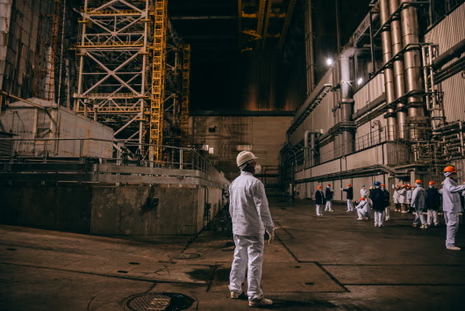
Workers in hard hats and overalls inside the huge safe confinement shelter
Chornobyl’s new safe confinement shelter is the largest, movable steel structure ever built. Photograph: Julia Kochetova/The Guardian

Completed in 2019 at a cost of $2.5bn (£1.85bn) and funded by 45 countries, the NSC was built to shield the world from what lies beneath it. It sits at the heart of a vast exclusion zone, a radioactive landscape the size of Cyprus, largely abandoned by humanity. Stray dogs roam the plant in packs – workers advise against petting them.

Map of Chornobyl and its exclusion zone

Inside is “the sarcophagus” – a grey concrete tomb erected in just 206 days to cover the ruins of reactor No 4, which exploded on 26 April 1986 in the worst nuclear accident to date.
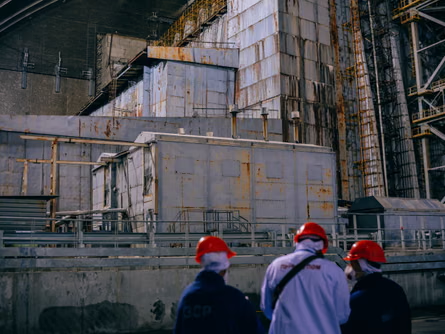
Three people in red hard hats inside the grey concrete safe confinement shelter
The sarcophagus inside the safe confinement shelter.

Up close, the sarcophagus looks almost makeshift – massive slabs stacked like giant building blocks, rust streaking the joins. Inside, 180 tonnes of nuclear fuel and four to five tonnes of radioactive dust remain trapped.

The NSC was constructed to buy time: to allow the unstable sarcophagus to be dismantled safely over decades, while shielding against the consequences in case it collapses.

A worker in white overalls and a white hat during his shift at Chornobyl. Screens showing security camera footage sit on a desk behind him
A worker during his shift at Chornobyl.

What its funders did not anticipate was a war – Chornobyl was occupied in the first weeks of Russia’s 2022 invasion of Ukraine – much less a drone strike on the facility three years later.

In the north-west corner of the roof, a temporary patch marks where a cheap $20,000 Russian drone tore through the structure on 14 February 2025, punching a hole in the arch and compromising the very function the arch was built for.

“If the sarcophagus collapses, over a hundred tonnes of nuclear fuel would be released into the air,” said the plant’s director general, Serhii Tarakanov.

A full repair is required within four years, Ukrainian officials and western experts say, or the NSC’s 100-year lifespan can no longer be guaranteed. It is estimated to cost up to €500m (£432m) – money that Ukraine’s cash-strapped government has not yet found.

Meanwhile, war continues in Ukraine, and Russia has repeatedly launched drones and missiles along flight paths near the Chornobyl nuclear plant, raising the risk of another disaster.

On the 40th anniversary of the Chornobyl disaster, one of the world’s most vulnerable sites remains under threat.
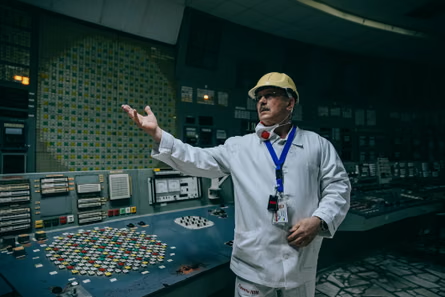
Oleksandr Skomarokhov in a yellow hard hat and overalls inside the control room
Oleksandr Skomarokhov, the deputy technical director for radioactive waste management at Chornobyl, inside the control room of reactor No 3.

The drone strike

Oleksandr Skomarokhov was woken by a security guard in the early hours of 14 February 2025. The grey-moustached deputy chief engineer, with thick-rimmed glasses and almost four decades’ experience at the plant, quickly realised the situation was bad. “We witnessed shelling before, but I knew they would only wake me if something critical had happened,” he recalled.

A Russian Geran-2 drone had struck the north-west face of the arch at about 85 metres above the ground – roughly the height of an eight-storey building.
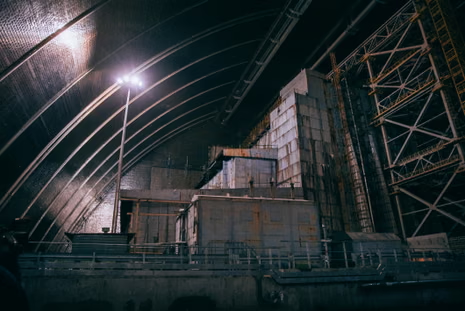
The arch of the huge metal safe confinement shelter
Inside the new safe confinement shelter, which was damaged after the Russian drone attack in February 2025.

The blast, which Ukraine said was intentional, punched a 15 sq metre hole through the NSC’s outer and inner walls and was powerful enough to register on the structure’s earthquake monitoring system.

“Then, the real problems started after the fire broke out,” Skomarokhov said.

Firefighters arrived within minutes, but a rubber sealing membrane within the roof had caught alight and kept smouldering deep inside the structure, out of reach. For three weeks, teams cut 332 holes into the outer wall to reach the hotspots with water hoses.
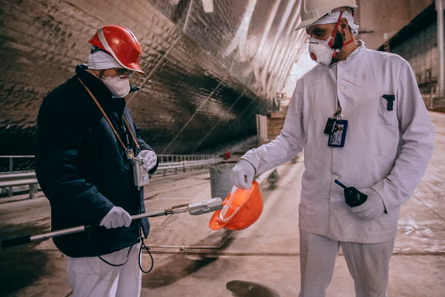
Workers check the radiation level of a helmet that accidentally fell on the floor inside Chornobyl’s safe confinement shelter.

When the fires were finally out, officials at Chornobyl said the strike had destroyed two key systems. The confinement function – the NSC’s ability to contain any radioactive release from the sarcophagus – had been compromised. So too had the humidity control system, which keeps the steel structure from corroding, and puts the arch itself at risk of failing.

“The Russian drone strike destroyed the main functions of the new safe confinement,” said Eric Schmieman, an engineer who led the conceptual design of the arch in the late 1990s, in a damage assessment commissioned by Greenpeace Ukraine.
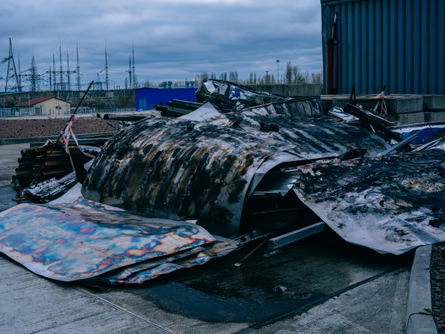
The remains of the new safe confinement shelter after it was severely damaged in a Russian drone attack
The remains of the new safe confinement shelter after it was severely damaged in a Russian drone attack in February 2025.

Should the sarcophagus collapse – whether from a strike, structural failure or age (built for 20 years, now standing for 40) – experts say it would release another cloud of radioactive particles into the air with no safeguard to contain it.

“The collapse of the sarcophagus would primarily be an enormous hazard for those working at the Chornobyl plant and set back dealing with the disaster for many more years,” said Shaun Burnie, a senior nuclear specialist with Greenpeace.

Beyond the financial costs and the war, there is the question of how the repairs of the confinement shelter are done at all. High radiation levels directly above the damaged section mean workers can legally spend no more than about 20 hours a year in that zone before hitting their annual dose limit.
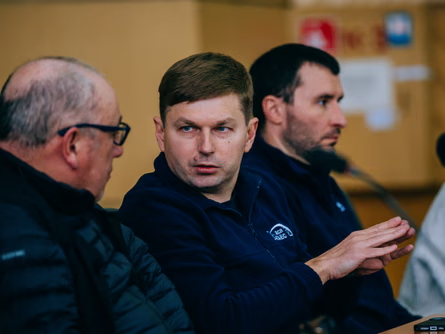
Serhii Tarakanov, Chornobyl’s director general, talks to a colleague
Serhii Tarakanov, centre, Chornobyl’s director general, says repair work to the confinement shelter will require about 100 qualified construction workers operating in short rotations.

“Workers will be able to perform their assignment there for a few hours, if not just a few minutes at a time,” said Tarakanov, adding that the work would require about 100 qualified construction workers operating in short rotations at height on a curved, contaminated surface.
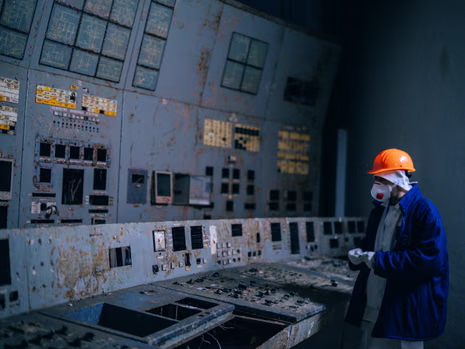
a person in a hard hat inside the control room of reactor No 4 where the disaster happened in 1986.
Inside the control room of reactor No 4 where the disaster happened in 1986.

There is something hard to fully absorb about all of this, reflected Skomarokhov, who came to work in Chornobyl in 1987, a year after the disaster. “I knew what happened here and wanted to make sure it would never be repeated,” he said, speaking in what remains of control room No 4 – where, at 1.23am on 26 April 1986, operators pressed the AZ-5 emergency button in a last attempt to shut down the reactor.

Instead, a fatal combination of design flaws and the unstable core triggered an explosion.

In the room, Soviet control panels, dials and switches are frozen in place, the paint peeling in long strips. But you can still make out where the button once was, a dark hole marking its place.
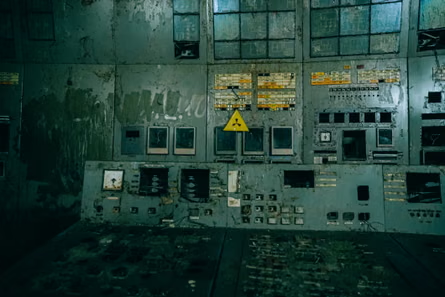
The control room of reactor No 4
The control room of reactor No 4, where operators pressed the AZ-5 emergency shutdown button in a last attempt to shut down the reactor.

Twenty-eight people died of acute radiation sickness in the weeks that followed. About 116,000 were evacuated. Radioactive particles drifted north-west across Europe. The disaster was first detected not in the Soviet Union but in Sweden, a few days later, when a worker at a nuclear plant set off radiation alarms on his way into work.
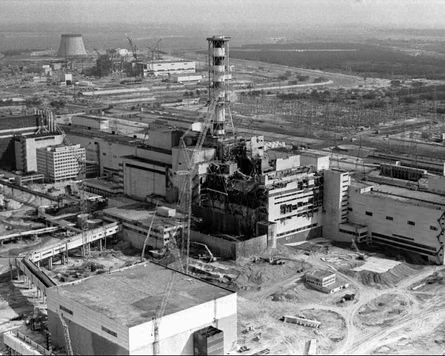
An aerial view in black and white of the Chornobyl nuclear plant shows the damage from the explosion on 26 April 1986.
An aerial view of the Chornobyl nuclear plant shows the damage from the explosion on 26 April 1986. Photograph: Volodymyr Repik/AP

In his book on Chornobyl, the Ukrainian historian Serhii Plokhy argues that the disaster helped forge a modern Ukrainian national consciousness by exposing the failures of the Soviet system. For many people, he writes, it was a moment of rupture: a sudden clarity about the nature of the system under which they were living.

Russia’s full-scale invasion in 2022 was another moment of national unity, and again Chornobyl was caught up in it. Russian forces crossed the border on 24 February 2022 and moved directly on the plant, using the route through Belarus that passes within kilometres of the exclusion zone.
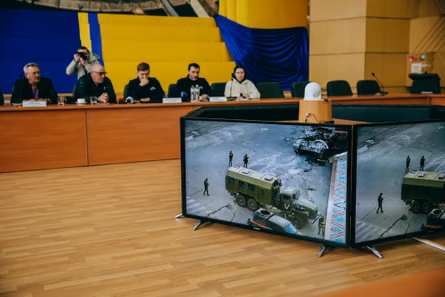
A committee watches archival videos of the Russian occupation in 2022 in Chornobyl.

The site became an active military zone within hours. Russian soldiers dug defensive trenches very close to the “red forest” – the stretch of land immediately west of the plant that received some of the heaviest contamination in 1986 and remains among the most radioactive areas in the exclusion zone.

Staff who arrived for scheduled shifts before the Russian attack were held and forced to work continuous rotations for nearly a month.
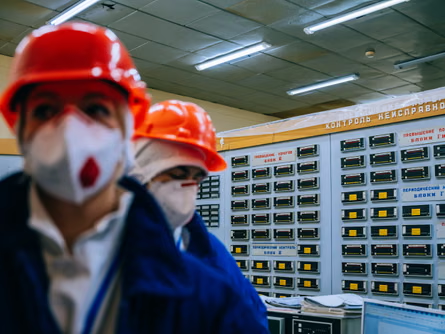
Two workers in red hard hats in one of the control rooms at Chornobyl.
Staff in one of the control rooms at the Chornobyl nuclear plant.

“I have seen a lot in my life, but I couldn’t imagine that war would come here,” said Natalia, who has worked at Chornobyl since 1980, making her one of the longest-serving staff members.

Natalia, who asked for her last name to be withheld, later moved to Slavutych, the last Soviet city built in 1987 to house plant workers when Pripyat – the original company town 4km from the reactor – was abandoned overnight.

During the town’s occupation, she and her colleagues were cut off from the rest of the country without internet or supply lines. “Local farmers had to smuggle in milk,” she said.
Damage and military remains from soldiers after Russian troops’ withdrawal in Chornobyl, Ukraine.
Damage and military remains from soldiers after Russian troops’ withdrawal in Chornobyl, Ukraine. Photograph: Anadolu Agency/Getty

When Russian forces withdrew from Chornobyl after 35 days, they left behind looted offices – computers, microwaves, fridges taken from the rooms where staff had worked for decades.

Posters around the site still bear the names of six Chornobyl workers taken during the occupation, who are believed to be still in Russia.
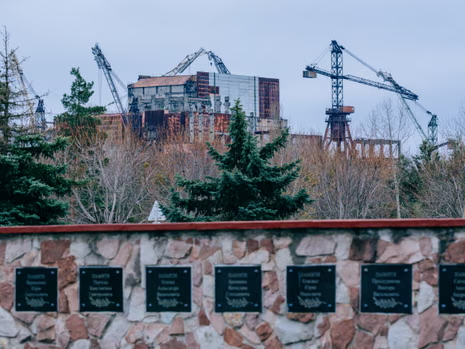
Stalled construction of reactors 5 and 6 in Chornobyl. The memorial wall shows plaques for participants in the liquidation of the site and victims of the disaster.

On entry to the 1,000 sq mile exclusion zone, the first thing you notice is the military – checkpoints, soldiers, the occasional armoured vehicle. Drive deeper and the forest takes over, pine trees pressing in on either side, small villages appearing through the treeline. The homes are abandoned and small signs on some of the doors record how many people used to live there.

Where humans can no longer live, other species have moved in. Stocky Przewalski’s horses graze and wolves and lynx hunt in forests that have grown back over former farmland. In the cooling pond beside the reactor, catfish have grown to extraordinary sizes.

But the exclusion zone’s isolation offers no protection from the war.

The plant has experienced four total blackouts since October 2024 caused by Russian strikes on the electricity grid, each requiring emergency diesel generators to keep the spent fuel cooling systems running.

Additional air defences and soldiers have been brought in, said Vadim Slipukha, the deputy director general for security at the site, though the threat has not gone away, he said. Even an unintentional strike from a drone knocked off course by electronic warfare could trigger a collapse of the sarcophagus.

“We are begging the international community to understand,” said Tarakanov. “There is a real risk of a new incident. It could happen any night, any day.”