






I cannot preface this recipe better than Skye McAlpine, who writes that, “as the name suggests, this risotto is a celebration of spring and all the glorious, verdant produce the season brings with it”. Verdant, certainly, but also pleasingly dense – this is a dish that champions the abundance of this time of year, while also acknowledging that it can still be bloody chilly once the sun goes down, both here in the UK and in north-east Italy, where risotto originates. It’s also a dish that’s versatile enough to incorporate whatever looks good in your local area over the coming weeks, as well as one that can be served in smaller portions as a primi piatti, or in more generous ones as a main course.
The rice
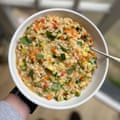
Marcella Hazan and Ina Garten both call for arborio, the easiest variety of risotto rice to find on British shelves; McAlpine for arborio or carnaroli, which is slightly harder to track down; and Giorgio Locatelli for vialone nano, for which you’ll probably need an Italian specialist. Arborio, though it makes a decent risotto, is the least favoured by aficionados, because, according to Jeffrey Alford and Naomi Duguid’s wonderfully titled Seductions of Rice, it’s stickier “and absorbs broth a little less well”. Vialone nano, is, in Hazan’s words, “a small, stubby, homely grain well endowed with amylose, the starch that does not soften easily in cooking … [it is] the nearly unanimous choice in the Veneto, where the preferred consistency is loose – rippling or all’onda, to use the Venetian expression – and where people are partial to a kernel that offers considerable resistance to the bite”. Not being from the Veneto, I have a rustic fondness for slightly softer rice, but I nevertheless find that the starchy, medium-grained carnaroli (available in major supermarkets or online) offers the best combination of texture and creaminess. Arborio, however, will do the job, if required.
The vegetables
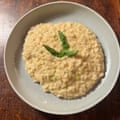
Spring vegetables will vary according to wherever you are in the world, and the particular point in spring that you’re living through, so to some extent this is a movable feast, so long as whatever you use is bursting with freshness … and, preferably, green, too, though Hazan includes tomato and carrot, and who am I to disagree with a book promising The Essentials of Classic Italian Cooking? To my mind, however, a focus on green things feels more explicitly seasonal, starting with the king of spring, asparagus, which puts in an appearance in almost all the recipes I try. In fact, the Locatelli recipe, from 2006’s Made in Italy, is solely asparagus-focused, but sneaks into my testing list thanks to its intriguing method, which features an asparagus and onion stock, made with the trimmings, and an asparagus and onion puree that is folded into the rice along with the fried stalks, while the tips are lightly blanched and placed on top. So far, so restauranty – my testers and I all agree that the onion slightly overpowers the main attraction, but the asparagus itself proves a big hit. Though I’ve borrowed the idea of a veg trimmings stock for my much simpler risotto, I’ve paired it with Katie Caldesi and Garten’s fresher-flavoured leeks; Caldesi calls for baby ones, but I’ll be chopping mine into ribbons, so I’d prefer a more robust victim.
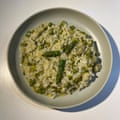
Asparagus suggests those other seasonal greatest hits, fresh peas and young, vibrant broad beans, both of which put in an appearance in Caldesi’s recipe: “You can make this risotto with frozen beans and peas,” she allows in her Italian Cookery Course, “but it won’t have that same marvellous freshness.” Neither will it provide you with any pods, of which more later, but it’s always better to use frozen peas than fresh if you have any doubts as to their age or freshness, because this vegetable begins to convert its natural sugars into starch the moment it’s picked, and mealy peas are fit only for mushing.
Of course, spring vegetables in Italy will also be a bit different, with McAlpine and Hazan both calling for courgette, and Garten fennel, but “you can dress it up with whatever greens you fancy”, McAlpine writes, admitting to a taste for the “more rarefied” likes of “agretti or monk’s beard, baby artichokes [and] samphire”. Whatever you choose, don’t spoil it with overcooking – some recipes keep the vegetables in the pan throughout the process, and some, like Hazan’s, scoop out half and stirs them back in at the end.’ But I think McAlpine’s decision to blanch them all separately and add them to the rice for just the last five minutes of simmering makes the most of their snappy sweetness.
The stock
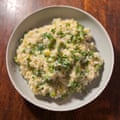
Hazan demands a beef stock, which feels rather too heavy for this dish; Garten chicken, which works better; and McAlpine vegetable, which should in theory be best of all, given the focus here … except that, to me, all commercial varieties taste principally of celery leaf. Far nicer, I think, to follow Caldesi and Locatelli’s lead and make your own stock with the trimmings of the vegetables you’re actually using. (This is another good reason to try to find fresh broad beans and peas, so you can stick the empty pods in the mix, too; the more flavour, the merrier.)
Herbs and seasoning
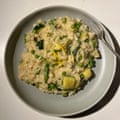
Though the fierceness of garlic seems, rightly in my view, to make it an allium non grata in spring risotto, I would recommend adding some of the milder, milkier wet sort while it’s in season and if you can find it, or garnishing with wild garlic, should that still be hanging around in your neck of the woods. If it isn’t, Caldesi’s mint or Garten’s chives will both finish the dish off nicely; Hazan’s basil to me tastes of summer, but that’s no doubt because I live at a latitude in which I can only dream of growing it at any time of year. I also rather like McAlpine’s lemon zest – “not canonical, but to me it tastes like the promise of sunny days, which encapsulates the hopeful spirit of springtime”.
The fat
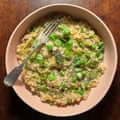
This feels to me like a dish for butter, rather than olive or vegetable oil – asparagus, in particular, is so very good with the stuff and, given that almost everyone beats a little in at the end for the traditional mantecatura, it makes sense to keep the flavours consistent. I say almost, because Garten goes for mascarpone and lemon juice instead, which somehow seems to mute the freshness of the vegetables; butter adds a cleaner richness while still allowing them to take centre stage. Cheese, however, does put in an appearance – parmesan is the most popular variety, of course, but, at the risk of provoking a riot in the comments, I happen to prefer the saltier, tangier pecorino romano for this recipe, not least because it is a match made in heaven with peas.
The method
If you’d prefer to go with the no-stir method (which gives perfectly decent results, though I still prefer to be able to assess the rice during cooking and adjust as necessary), then, after the wine has evaporated, pour 475ml hot stock into the pan, bring to a simmer, cover tightly, then turn down the heat. Leave to cook for 15 minutes, by which time the rice should be just tender, then add 150ml more stock, leave to cook until it’s almost as you like it, then finish off as in the recipe below.
Perfect risotto primavera
Prep 15 min
Cook 1 hr
Serves 4 as a starter, 2 as a main
110g peas in the pod, ideally, or 80g frozen peas
225g broad beans in the pod, ideally, or 80g frozen broad beans
4 asparagus spears
1 leek
3 wet garlic cloves (optional)
3-4 tbsp butter
200g risotto rice, preferably carnaroli
50ml white wine
25g pecorino, or parmesan or other Italian hard cheese, finely grated
A few mint sprigs, or chives or wild garlic, to serve
½ unwaxed lemon, to serve (optional)
Bring a large pan of salted water to a boil. Meanwhile, fill a large bowl with cold water. Shell the peas and beans, if necessary (retain the empty pods) and cut or snap off the woody ends of the asparagus (keep those, too).
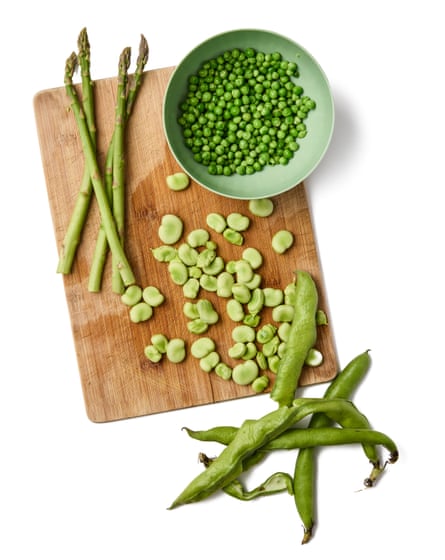
Chop the stems into short lengths, leaving the tips intact. Trim and wash the leeks, again retaining the trimmings.
Put the chopped asparagus and tips (but not the woody ends) in the boiling water, simmer for two minutes, then add the peas and beans (but not the pods) and cook for a further one to two minutes, until just tender. Retaining the cooking water, use a slotted spoon to scoop all the blanched vegetables into the bowl of cold water.
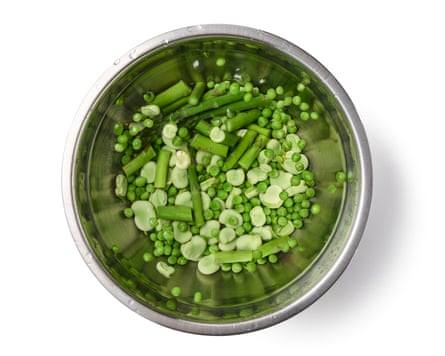
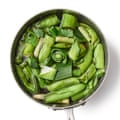
Put the asparagus and leek trimmings into the cooking water, and add the pods of the peas and broad beans, if you have them, roughly chopped if necessary. Bash one of the cloves of wet garlic, if using, drop that into the water, too, and bring to a simmer. Turn down the heat and leave to bubble away very gently for 30 minutes. Meanwhile, chop the leek into ribbons and slice the remaining wet garlic, if using.
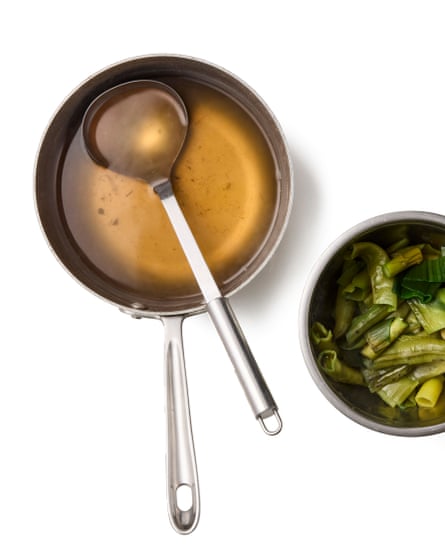
Once the stock is ready, scoop out and discard all the vegetable trimmings and garlic, then keep the stock warm on a low heat.
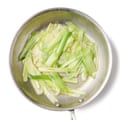
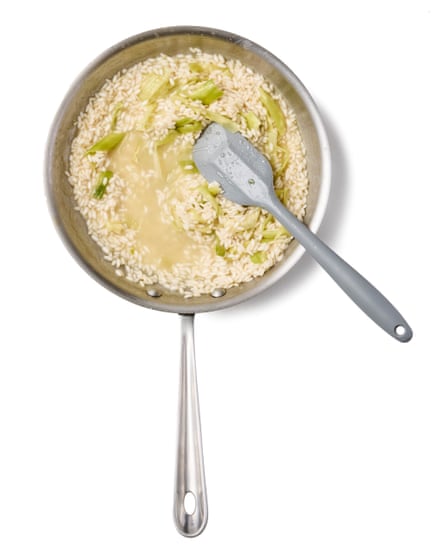
Melt two tablespoons of butter in a wide pan on a medium-low heat, then add the leeks and fry gently, stirring occasionally, for about five minutes, until they soften. Add the sliced wet garlic, if using, fry for another minute or so, then turn up the heat to medium-high, add the rice and stir until all the grains are coated with butter and turning translucent.
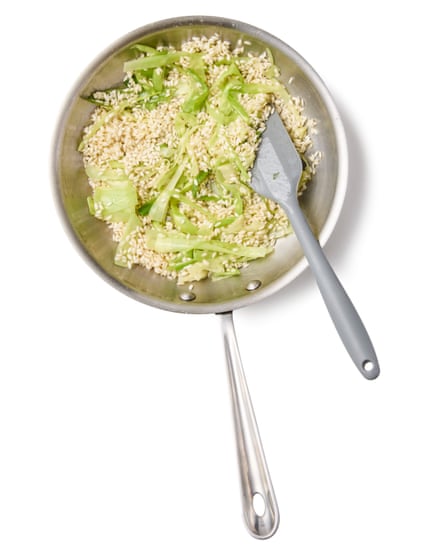
Pour in the wine, leave to bubble until it’s largely absorbed, then add a ladleful of hot stock and stir until that’s almost all absorbed. Repeat with more stock, ladleful by ladleful, until the rice is almost but not quite done to your liking, which should take about 15-20 minutes.
Stir in just enough extra stock that the risotto flows easily, rather than sitting in a solid lump in the bottom of the pan, then add the remaining butter, cheese and drained blanched vegetables. Cover, take off the heat and leave to sit for a couple of minutes, then stir. Check the seasoning (and add a little more stock, if necessary, to loosen the risotto) then serve with torn mint leaves, or chopped chives or wild garlic, and a fine grating of lemon zest, if using.
-
Risotto primavera: does it sing of spring to you, and how do you like to make it? Are you a no-stir devotee, or a fennel fanatic? And which other recipes would you recommend to readers to make the most of seasonal produce?
-
Felicity Cloake’s debut novel, The Underdog, is published by Fourth Estate at £16.99. To order a copy for £15.29, go to guardianbookshop.com