


Can a collective portrait of Britain hold together a country that feels as if it is splintering apart? That is the quietly radical hope behind Es Devlin’s new installation at the National Portrait Gallery: a living portrait comprised not of monarchs, politicians or celebrities but of thousands of ordinary faces drifting slowly into and out of one another.
Created in collaboration with Google Arts & Culture Lab, A National Portrait for the National Portrait Gallery invites people across the UK to upload a selfie, which is then transformed into a portrait rendered in Devlin’s smoky charcoal-and-chalk style before joining a constantly evolving and revolving carousel of portraits projected on to a framed screen.
The effect is strangely intimate: faces hover briefly at the surface before slipping away again; strangers fold into strangers; features surface and dissolve. Watching it feels less like looking at images than catching fragments of people as they pass in a crowd.
For Devlin, an artist best known for creating the dreamlike visual worlds of Beyoncé, Adele and the closing ceremony of the London Olympics, the work arrives at a moment when Britain feels increasingly atomised by political fury, algorithmic distraction and loneliness.
“I am in no way trying to erase the differences between us or suggesting that everyone can agree with each other,” she said. “But I’m hoping that if we can take the time to exist together in a non-verbal moment, perhaps we can accept that we can all coexist.”
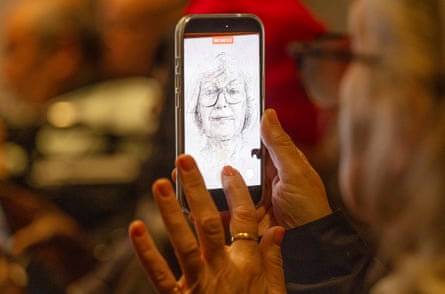
The installation is deliberately imperfect: faces do not blend cleanly into one another but snag and jar before separating again.
“There will be times in the collective portrait where one face merges into another and it looks terrible; where a beard meshes with a female face in a weird way before it resolves itself,” Devlin said. “But I find that aspect quite truthful when you’re speaking of the impossibility of crossing the boundaries between us. If we can accept imperfections, then perhaps we can accept each other.”
The project has taken three years to build. Working with engineers and technicians at Google, Devlin trained an image-generation model on her own hand-drawn portraits so that participants’ selfies could be translated into something closer to physical drawing than a digital filter.
The collaboration, however, sits inside another profound contradiction: that at a moment when artists across the world are fighting against the use of their work to train AI systems, Devlin has willingly offered up her own artistic “shadow” to a technology company.
“I’m very aware that my shadow – and the shadow of many other artists – is being put in the service of the system of industrial capitalism to make a few people very wealthy,” she said.
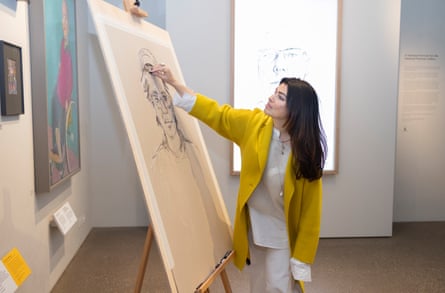
Yet Devlin says the project is intended not as surrender but reclamation. “I want to take the technologies and do what Wendy did for Peter Pan: I want to dance with my own shadow in an act of resistance. This is an act of reappropriation of technologies that are being used to separate us, distract us.”
Outside the gallery, Britain can feel loud with division: people sealed inside personalised feeds, arguments sharpened into identities, public life conducted at the pitch of permanent outrage. Devlin’s response is unexpectedly analogue in spirit. She speaks not about technology but about attention; about the increasingly rare experience of sitting quietly with another human being – and really looking at them.
“We’re in an age of destruction, fragmentation, separation, isolation,” she said. “I want to resist that. I want to invite people to consider ways that we can cease to be distracted and instead reimagine national identity as a process of always changing.”
The work also marks her attempt to throw open the doors of an institution that, she acknowledges, can still feel intimidatingly grand. Alongside the installation, Devlin will lead free portrait-drawing workshops at the gallery, while online classes will allow people to participate from elsewhere in the country.
She hopes eventually to take the collective portrait and the drawing workshops into town halls, libraries and schools around the UK. “I want people who can’t come to the gallery to have the chance to discover drawing and experience being drawn – the process of being seen in a moment of silence without judging or being judged over beliefs and life experiences,” she said.
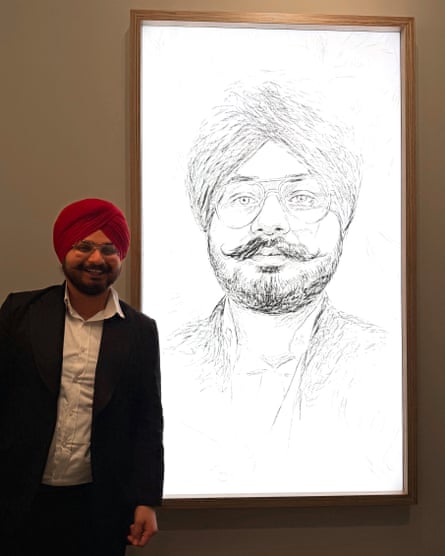
Among the first people to contribute a portrait was Ravinder Tagarh, a 26-year-old security guard at the gallery who arrived in the UK in 2023 to study. While grateful to Britain, he said the past few years had often felt lonely and that “people have not always been really very friendly”.
Seeing his own face appear on the walls of the National Portrait Gallery affected him more deeply than he expected. “It felt emotional to have my portrait on the wall of an institution like the National Portrait Gallery, next to the king and queen – and Harry Styles and Marcus Rashford,” he said.
“It felt good to be seen – to think someone might recognise me, a security guard, because they’d seen my portrait up there. It made me feel part of this country instead of an outsider.”
Then he paused. “It gave me a moment of hope.”