





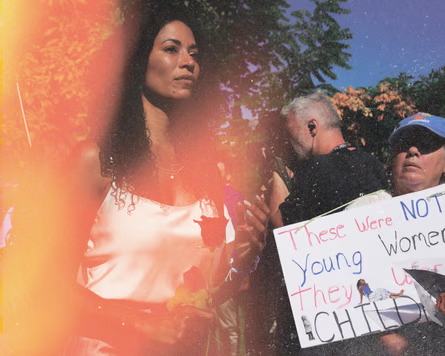
In September, dozens of survivors of Jeffrey Epstein and Ghislaine Maxwell stood shoulder to shoulder at a news conference on Capitol Hill. There was a sense of gravity in the air – part exhaustion, part resolve – as they recounted the abuse that had long been dismissed, buried or ignored. They asked for full transparency, public accountability and recognition of the harm done by their infamous abusers and traffickers. All of them demanded the release of the Epstein files.
For the first time in years, major media outlets like NBC and ABC carried the survivors’ voices live, broadcasting not just fragments but the full weight of their testimony. While the Epstein files – the trove of documents that detail the criminal activity and social web surrounding the convicted sex offender – have made headlines for years, much of the coverage centered on the powerful men who could be found in them, including Donald Trump. The conference felt like a breakthrough: the country finally seemed willing to listen to the women most affected by Epstein’s violence, advocates said.
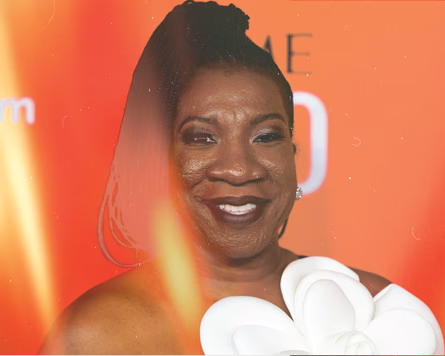
“This might really be another big moment,” Tarana Burke, founder of the #MeToo sexual violence survivors’ movement that went viral in 2017, recalled thinking while streaming the conference online. “The tide might be turning.”
Epstein victims reference #MeToo with giving them the courage to speak out and breathe new energy into the survivor’s movement. For many of them, the path to that press conference lectern stretched back decades – some say they were silenced and dismissed until they saw the power of women coming forward in numbers. It’s the same support and solidarity that recently gave women the courage to speak out about the abuse of other powerful men, such as former US representative Eric Swalwell and labor activist Cesar Chavez.
“I have come to understand that the only way to break powerful people down is for survivors to band together and speak,” said Lisa Phillips, a podcast host and Epstein survivor. “When survivors come together, and when we get powerful people behind us, something shifts. We are not scared anymore. We took our power back. And we are not done.”
A once-viral movement is still alive
To understand the state of #MeToo in 2026 – and the Epstein survivors’ relation to it – requires understanding what Burke calls the difference between the movement and the viral moment. Burke created the movement in 2006 to bring awareness to young Black survivors of sexual violence and foster empathy for their experiences.
Then, in 2017, after news reports detailed dozens of allegations of sexual abuse toward film producer and now convicted sex offender Harvey Weinstein, millions of people who had also experienced sexual abuse posted #MeToo online – the scale of the response stunned even longtime organizers. The phrase spread across continents in days, revealing what Burke and others had long argued: that sexual violence was not rare or isolated but deeply embedded in everyday life.
The viral surge “broke open the world to an awareness of the issue”, said Dani Ayers, who, with Burke, co-founded Me Too International, an organization that focuses on healing for survivors and action against sexual violence, in the wake of the viral moment. “The sheer number of people that raised their hands to say ‘Me too’ made it clear this is a massive global public health crisis”.
The 2017 wave produced undeniable consequences. Powerful men in politics, media and entertainment lost jobs, corporate policies changed, and workplace sexual harassment training multiplied. In the years after the viral moment, nearly two dozen states and Washington DC passed more than 70 workplace anti-harassment bills, according to a 2022 report. Survivors had found the language and courage to describe experiences that had long been minimized and, for the most part, were taken seriously.
In 2017, the movement briefly appeared capable of uniting women across class and racial lines – from agricultural workers to Hollywood actresses – creating a shared understanding of “gendered vulnerability”, according to Moira Donegan, who started a whisper-network-style list of “shity media men” and is now a columnist at the Guardian.
But, Donegan said, “the media was most interested in the stories of the rich and famous,”, narrowing the scope of public attention. And once #MeToo faded from the news cycle, many powerful men who had been accused changed course on their repentance.
“We live inside of a backlash,” said Burke. “It just comes with the territory.”
But perhaps the most sustainable impact of #MeToo was a cultural shift, she said. Young people who were teenagers during the viral moment are now entering adulthood with a different set of expectations about consent and accountability. “They grew up over the last 10 years in a MeToo era,” Burke said. “They don’t tolerate the same things. They have a language for it.”
What also has remained since #MeToo’s virality is the power in unity among survivors – a lesson that activists say can carry moments like the current one surrounding the Epstein files.
“You can feel alone in all of this. You can feel like you’re the only one that these things happened to,” said Liz Stein, a human trafficking specialist and survivor advocate who was abused by Epstein and Maxwell. “But to now have a group of women who have similar stories, there is something very healing in having that validation.”
Finding solidarity with other survivors
Epstein survivors first tried to report abuse in the 1990s, only to be ignored by the FBI. Others spent years navigating a legal system that failed to hold powerful figures accountable, incensed by the controversial plea deal Epstein secured in 2008 that allowed him to avoid federal charges for sex trafficking.
Over time, most survivors never spoke about the abuse they endured and independently filed lawsuits, submitted requests for records, and pressed law enforcement for justice.
It wasn’t until a few survivors took their stories publicly, namely Virginia Guiffre in 2011, that others began to process what had happened to them. Then in 2018, The Miami Herald’s investigation into Epstein’s sweetheart deal brought more women out of anonymity. Though Epstein died by suicide in 2019, it would still take many survivors years to speak out.
“Building this movement has required all of us,” said Stein. “For a long time, we were operating independently, and it’s easy to ignore one person’s voice. But it is really difficult to ignore a collective.”
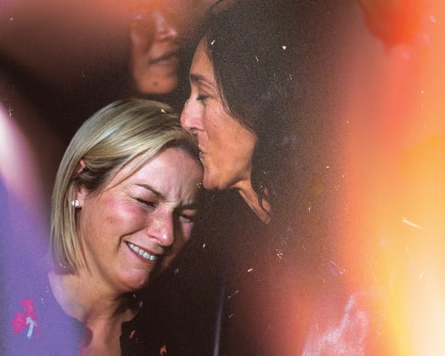
In 2025, Stein partnered with World Without Exploitation, the national coalition organization to end human trafficking and sexual exploitation, to bring more than 20 survivors together to share their stories on a stage and call for legislation that would support the release of all of the Epstein files. By the time Epstein survivors gathered at the Capitol in September, their demands had become clear and unified. The news conference was not the beginning of their fight, but the culmination of years of persistence. It was the first time many had even met each other.
“We are part of a sorority that none of us asked to join,” said Stein. “I wasn’t the only one, and this was a much larger thing that none of us could’ve controlled, no matter how much we wanted to.”
After survivors held their press conference, tides did shift. Survivors met with lawmakers, and congresspeople on both sides of the aisle pressured Trump to follow through on his campaign promise to release the files. In November, the Epstein Files Transparency Act was signed into law.
“The passage of the Epstein Files Transparency Act – nobody thought that was ever going to happen,” said Stein. “But when a group of women walks into a lawmaker’s office and tells their individual stories in a collective way, the impact is profound.”
In December, the Department of Justice started dropping 3.5m heavily redacted pages, just a small fraction of the total files. In a testament to how powerful a survivors’ movement is, even Epstein himself said he was asked every day for advice on #MeToo; in the Epstein files, there is evidence of elites strategizing about how the movement can be defeated.
However, Burke worries the public conversation around the Epstein files – one that often focuses on the famous perpetrators, elite corruption and political conspiracy – misses the deeper lesson. “It’s like the whole country is inside one big true-crime mystery,” she said. “People digging into the files and making conspiracy theories.”
The danger, she argues, is that the scandal becomes entertainment rather than a window into systemic abuse. “We’re looking at a huge web of child sexual abuse,” Burke said. “But people are treating it as a singular case.”
Jess Michaels, who survived Epstein’s abuse in the 1990s, said shining a light on the widespread nature of sexual abuse – nearly one in three women have been subjected to physical or sexual violence – is the reason she spoke out. “There’s a responsibility I feel, that people will listen to me because it’s Epstein, but by the time they’re done listening, they will find out it was never just about Epstein,” she said. “This is where we as white women can use our privilege to change something that actually happens in every single town and at every single economic level.”
The unfinished work must center survivors
Today, Epstein survivors continue to push for accountability, demanding the administration take action to deliver justice with a thorough investigation. Following Pam Bondi’s ouster from the Department of Justice, survivors are demanding that the Trump administration hold a hearing to examine the handling of the files.
Burke insists that the fundamental premise of the movement remains unchanged – that sexual and gender-based violence is not an intractable problem. “It’s a solvable issue,” she said. “The solutions exist – they’re just not being resourced or scaled.”
For example, Ayers pointed to specialized sexual violence courts in Nairobi with trauma-informed judges and lawyers as an example of innovations the US could learn from. “Seeing that broke open something new about what’s possible,” she said. The Survivors Justice Network advocates for a nationwide curriculum that would teach students about consent, beginning in the sixth grade.
With MeToo International, Burke and Ayers have launched the Survivors Vote campaign to mobilize survivors as a political constituency – there are an estimated 52 million survivors of sexual violence in the US alone, according to the organization.
Despite the visibility, Burke says Me Too International remains small and underfunded. The organization has 14 staff members and several contractors supporting its work around the world. “We’re funded by a very small number of institutional funders who keep our lights on,” she said. “People think we’re somehow Hollywood-supported and sitting on years of reserves. That’s not true.”
Burke said ebbs and flows are the nature of movements. However, #MeToo is strongest when survivors’ voices are at its center.
“While #MeToo may have helped change the landscape, it’s also the continuous efforts of these survivors that were unrelenting,” said Burke. “It’s never going to be one thing. It has to be one thing, building upon another, building upon another. That’s actually what movements are, until they break through and until there’s a moment when those efforts pay off.”