







For hundreds of years, he was known only as “Jersey”, an enslaved boy of about 11 rendered in oil on canvas by the great 18th-century portrait painter Sir Joshua Reynolds.
But now the life of the youngster, believed to be Reynolds’ earliest depiction of a person of colour, has begun to emerge, thanks to a research project.
Details found in admiralty records and other archives have unearthed information about Jersey’s identity, his military service and even hint he may eventually have found freedom.
The painting, thought to have been completed around 1748, shows the boy and his “master”, the naval officer and MP Paul Henry Ourry. While Ourry looks out into the distance authoritatively, the enslaved child gazes up at the officer tentatively.
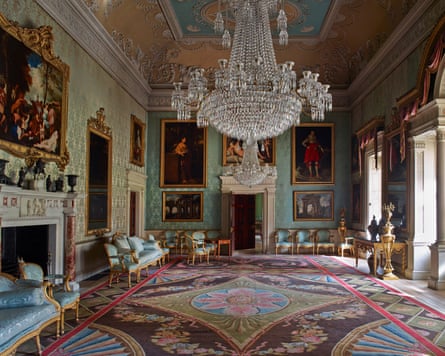
It was hung in the saloon at Saltram, a National Trust Georgian mansion, in Plympton, Devon, its title: Lieutenant, later Captain, Paul Henry Ourry, MP (1719-1783) with an enslaved child known as “Jersey” (dates unknown).
Though the painting is considered an early Reynolds masterpiece and there was plenty of information about Ourry, almost nothing was known about the child.
As part of an effort to highlight people whose voices and stories have been ignored or lost, the research project was launched by the National Trust, the National Gallery in London, and Royal Museums Greenwich, to try to find out more about Jersey.
Mark Brayshay, a volunteer researcher at Saltram, said: “A key motivation for our research was to explore whether more could be discovered about Jersey than merely his supposed name. Could we acknowledge and honour him as a distinct individual?”
Scouring admiralty records, letters, muster books (ships’ registers) and captains’ logs, Brayshay and Katherine Gazzard, a curator at Royal Museums Greenwich, found him named as “Boston Jersey” on ships that Ourry was attached to.
They believe he may have been given the surname Jersey because Ourry was born in the Channel Islands. It is possible he had his first name because he once lived in Boston, Massachusetts.
The researchers discovered Jersey was baptised as George Walker (possibly a name he had been known by earlier in his life) on 30 July 1752, probably in a chapel in Westminster.
The baptismal certificate describes: “A Certain Black Boy Called Boston Jersey Baptised by the name of George Walker aged fifteen.” This would mean he was about 11 when he was painted by Reynolds.
Another significant discovery was a muster in 1751 apparently describing him as being a member of the crew rather than Ourry’s servant.
Brayshay said: “Later, his name appears as one of 10 crew members due for discharge ‘per paybook’. This could imply that Jersey was in receipt of Royal Navy pay, but it is also possible that the sums owing actually went to Ourry.”
He was discharged from another ship in the summer of 1753 and then vanished from the records, not appearing on the musters of other ships Ourry served on. One theory is that he was sold on to someone else, another that he was given his freedom and joined another vessel.
David Olusoga, a historian, broadcaster and National Trust ambassador, said the research had helped bring Boston Jersey out of the shadows.
He said: “This project asks us to look more closely at a familiar past, revealing a life long obscured and reminding us that history is shaped as much by those rendered invisible as by those remembered.
“To tell Jersey’s story is to confront the silences within our history, and to recognise the individuals whose lives have too often been hidden from view.”
Alongside archival research, new technical examination of the portrait revealed details of Reynolds’ workings. He appears to have initially planned an elaborate natural setting, sketching in leafy branches, but this was abandoned for a plain brown background.
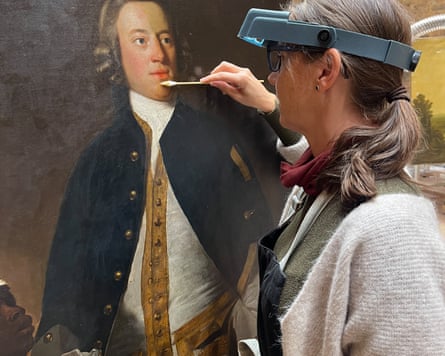
Old layers of varnish and non-original paint were removed and “reversible inpainting” techniques used to fill in missing or damaged areas of the painting, while preserving the original materials and intent.
Zoe Shearman, Saltram’s property curator, said this work meant details that had been lost could be seen again: “In particular, Jersey’s sensitively painted facial features are revealed more sharply, as are the beautiful details on his clothing.”
Shearman said an aim of the project had been to try to understand the painting through a more contemporary lens.
“We’ve been able to see Jersey more clearly – through what we now know of his life and naval career – but also through how he was portrayed on the canvas. In time we may discover more, but Boston Jersey is at last given recognition as a person and shown as more than just a trope.”
The painting will be on show from 9 May in Saltram’s saloon. It is being hung alongside a companion Reynolds portrait, Captain the Honourable George Edgcumbe, 1720-95, until 1 November, bringing the two artworks together for the first time in two centuries.
Both were commissioned by the Corporation of Plympton. The Edgcumbe portrait has HMS Salisbury – on which Ourry and Jersey served – at anchor in the distance.