






A Russian cargo ship that suffered a series of mysterious explosions before eventually sinking off the south-east coast of Spain 17 months ago may have been carrying nuclear submarine reactors destined for North Korea, according to reports.
The Ursa Major, a 142 metre-long, Russian-flagged ship owned by the state-linked Oboronlogistics company, was purportedly sailing from St Petersburg to Vladivostok in the far east of Russia when it sank 62 nautical miles off the coast of Murcia a little before midnight on 23 December 2024.
Eleven hours earlier, Spain’s maritime rescue and security service, Sasemar, had dispatched a helicopter, a fast rescue boat, and a tugboat to the Ursa Major, which put out a distress call at 12.53pm.
Other vessels in the area noted that the Russian vessel, which had slowed dramatically over the previous 24 hours, was listing badly and saw its crew abandoning ship. The crew members told rescuers that there had been three explosions in the ship’s engine room.
Spanish attempts to assist the Ursa Major were curtailed at 20.07 that evening when a Russian warship arrived, took over operations and ordered the two Sasemar boats to withdraw to a distance of two nautical miles.
According to a Spanish government document that was released three months ago in response to parliamentary questions over the incident, the Russian warship then launched flares over the Ursa Major. A report in the Murcia newspaper La Verdad said the flares could have been deployed to blind the infrared channels of the intelligence satellites that were monitoring the incident.
A CNN investigation into the sinking of the vessel noted that “four similar seismic signatures … the pattern of which resembled underwater mines or overground quarry blasts” were heard just afters the flares were fired. By 23.20 that night, the Ursa Major had sunk and now lies at a depth of 2,500 metres. Two crew members are thought to have died in the initial explosions, while 14 were rescued.
Although the vessel was officially transporting “non-dangerous merchandise” – including 129 shipping containers, two cranes, and two large maintenance hole covers – its route and sinking raised the suspicions of the Spanish authorities.
Under questioning, the captain of the Ursa Major eventually told Spanish investigators that the “manhole covers” onboard his ship were “nuclear reactor components similar to those used by submarines”, but that no nuclear fuel was being transported.
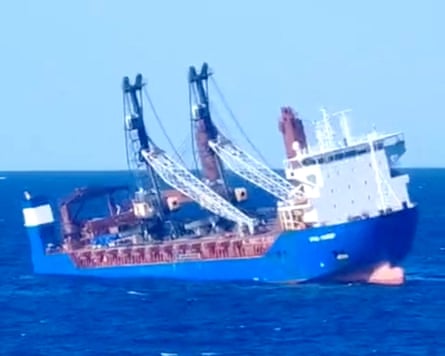
Investigators had also noticed two huge blue containers – each estimated to weigh about 65 tonnes – on the stern of the ship in satellite photographs.
“These would therefore be two loads almost impossible to transport along the winding roads of Russia, Kazakhstan, Uzbekistan, and Afghanistan between the two cities served by the Ursa Major,” said the report in La Verdad.
“That mysterious undeclared cargo would certainly justify a voyage of more than 15,000kms by sea between St Petersburg and Vladivostok.”
A source familiar with the investigation told CNN that the Russian captain believed he would be diverted to the North Korean port of Rason to deliver the two reactors.
While the incident remains a mystery, CNN suggested the sinking of the Ursa Major “may mark a rare and high-stakes intervention by a western military to prevent Russia from sending an upgrade in nuclear technology to a key ally, North Korea”. The network noted that the Russian ship set sail just two months after the North Korean leader, Kim Jong-un, had sent troops to assist with Vladimir Putin’s invasion of Ukraine.
CNN and La Verdad reported a 50cm by 50cm hole found in the vessel’s hull – with the damaged metal facing inwards – could have been made by a super-fast weapon known as a supercavitating torpedo.
“Only the United States, a few Nato allies, Russia and Iran are believed to have this kind of high-speed torpedo, which fires air ahead of the weapon to reduce the drag of the water,” said CNN.
“The source familiar with the [Spanish] investigation said it concluded the use of such a device would fit with the size of the hole in the Ursa Major’s hull, and that it could have made a noiseless impact resulting in the sudden slowing of the boat on December 22.”
CNN said there had been a “flurry of recent military activity” around the ship’s remains, with US nuclear “sniffer” aircraft overflying the scene twice in the past year, and a Russian spy ship setting off four further explosions in the wreckage a week after it sank.
A report by Oboronlogistics has claimed that the Ursa Major fell prey to what it termed “a targeted terrorist attack”.
Spain’s interior, foreign and defence ministries have been contacted for comment.