


惯性聚合 高效追踪和阅读你感兴趣的博客、新闻、科技资讯
阅读原文 在惯性聚合中打开

推荐订阅源

aimingoo的专栏
aimingoo的专栏
宝玉的分享
宝玉的分享
freeCodeCamp Programming Tutorials: Python, JavaScript, Git & More
WordPress大学
WordPress大学
V
V2EX
Apple Machine Learning Research
J
Java Code Geeks
腾讯CDC
奇客Solidot–传递最新科技情报
奇客Solidot–传递最新科技情报
Engineering at Meta
Engineering at Meta
L
LangChain Blog
Jina AI
Jina AI
博客园 - 叶小钗
B
Blog RSS Feed
Recent Announcements
H
Help Net Security
小众软件
小众软件
大猫的无限游戏
大猫的无限游戏
B
Blog
云风的 BLOG
云风的 BLOG
Blog — PlanetScale
Blog — PlanetScale
D
DataBreaches.Net
钛媒体:引领未来商业与生活新知
钛媒体:引领未来商业与生活新知
罗磊的独立博客

The Guardian

Rory McIlroy surges into six-shot Masters lead with stunning second-round flourish ‘That’ll be the end’: actor Sam Neill joins fight to stop controversial goldmine near his New Zealand vineyard Roberto De Zerbi targets ‘Ange-ball’ revival to save Spurs from relegation Bath hit back to reach semi-final after stunning Northampton in 11-try epic Secret Garden to Outcome: the week in rave reviews Zebras, wealth and power: Hungary’s election tests Orbán’s grip on power ‘TikTok effect’ brings sellout crowds and younger fans to Grand National meeting The war over Omagh’s gold: the £21bn mine plan tearing a community apart Britain’s shadow workforce is paid as little as 65p an hour. Who cares for the carers? From You, Me & Tuscany to Euphoria: your complete entertainment guide to the week ahead Six great reads: the man who let snakes bite him, masked heavy metal and the brutal reality for foreign students in the UK American Classic review – I defy you not to fall in love with Kevin Kline and Laura Linney’s tender comedy Cuba’s doctors were a lifeline for the world. Now the Caribbean is shamefully complicit in the US drive to expel them An environmental disaster in Moldova has Russia’s fingerprints all over it RMIT drops misconduct case against student who accused university of being ‘complicit in Gaza genocide’ Ichiro Suzuki statue unveiling goes awry as bronze bat snaps during ceremony Survivors of Epstein’s abuse accuse Melania Trump of ‘shifting burden’ on to victims European football: Real Madrid held at home by Girona to extend winless run Arne Slot insists he is ‘aligned’ with Liverpool board and fans as squad is rebuilt Kamala Harris ‘thinking about’ running for president again in 2028 JD Vance warns Iran against trying to ‘play’ the US in peace talks West Ham double up twice to thrash Wolves and put Spurs in relegation zone Trump administration releases new renderings of so-called ‘Arc de Trump’ Crispin Odey drops £79m libel claim against FT over sexual misconduct allegations Bafta apologises for events surrounding John Davidson’s Tourette’s outburst Cocktail of the week: Bar Shrimp’s la rosita – recipe New drug may extend survival in aggressive ovarian cancer, trial shows One dead and 27 injured after bus with British passengers crashes in Canary Islands Pope adds to Smith’s mass of Surrey runs with England woes a world away OpenAI CEO Sam Altman’s home targeted with molotov cocktail
AI will help make a Nobel prize-winning discovery within ...
Robert Booth · 2026-05-21 · via The Guardian

An AI system will work with humans to make a Nobel prize-winning discovery within 12 months and tradespeople will be helped by bipedal robots in two years, according to the co-founder of Anthropic.

Jack Clark described a “vertiginous sense of progress” in the technology and made a series of predictions, including that companies run solely by AIs would be generating millions of dollars in revenue within 18 months, and that by the end of 2028, AI systems would be able to design their own successors.

In a lecture at Oxford University on Wednesday, he also said there remained plausible scenarios in which the technology had “a non-zero chance of killing everyone on the planet” and that it was “important to clearly state that that risk hasn’t gone away”. Anthropic’s most popular model is called Claude, but it recently launched a version called Mythos that proved alarmingly capable at exploiting cybersecurity weaknesses.

Clark told students it would be better if humans could slow the development of the technology “to give ourselves more time as a species” to deal with the implications of its powers. But he said this wouldn’t happen, in the breakneck development “by a variety of actors and a variety of countries, locked in a competition with one another, where commercial and geopolitical rivalries are often drowning out the larger existential-to-the-species aspects of the technology being built”. This was “not ideal”, he said.
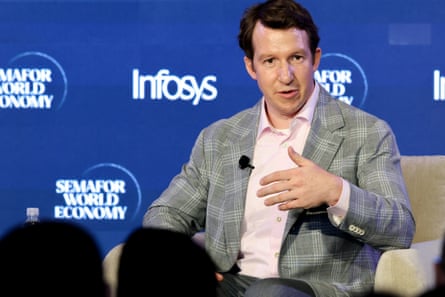
Jack Clark speaks at a summit in Washington.
Jack Clark said he wanted to encourage humanity to prepare for a technology that would ‘soon be more capable than all of us collectively’. Photograph: Samuel Corum/Bloomberg/Getty Images

Clark is one of the most senior figures at Anthropic, which was established by AI researchers who quit the rival firm OpenAI over disagreements on safety. The $900bn (£670bn) company has been accused by Donald Trump’s White House and other AI accelerationists of “fear-mongering” to encourage regulation that could cement its competitive position.

Anthropic disputes this, and Clark said many people appeared to be in denial about AI’s progress. He said he wanted to encourage humanity to prepare for a technology that would “soon be more capable than all of us collectively”. Comparing the failure to prepare for AI to the failure to prepare for pandemics such as Covid, he said: “If we stand by and let synthetic intelligence multiply, then we’ll eventually be forced into reactivity.”

Critics of the frontier AI companies such as Anthropic, OpenAI and Google fear over-reliance on their few AI models – which have been backed by huge amounts of profit-seeking capital – could create a “single point of failure” in global systems.

Prof Edward Harcourt, the director of the Institute for Ethics in AI, which co-hosted Clark’s lecture, separately warned that the rise of AIs that did more and more things for humans risked creating “cognitive atrophy” which could weaken humans’ decision-making and powers of judgment. He advocated for alternative AI models that ask humans to do more of the thinking, sometimes called “Socratic” AI.

Clark said his most conservative prediction was that “vast swathes of the economy and society will go through profound changes” – which could include a machine economy decoupling from the human economy, robots gaining brains, science progressing without humans, and scientific equipment that people hadn’t conceived of but which worked. He admitted some of this sounded “crazy”.