
惯性聚合 高效追踪和阅读你感兴趣的博客、新闻、科技资讯
阅读原文 在惯性聚合中打开

推荐订阅源

T
Threat Research - Cisco Blogs
Google DeepMind News
H
Help Net Security
H
Hackread – Cybersecurity News, Data Breaches, AI and More
MyScale Blog
MyScale Blog
Webroot Blog
Webroot Blog
Stack Overflow Blog
Stack Overflow Blog
T
The Blog of Author Tim Ferriss
D
Docker
L
LangChain Blog
Cyber Security Advisories - MS-ISAC
Know Your Adversary
Know Your Adversary
A
About on SuperTechFans
U
Unit 42
NISL@THU
NISL@THU
M
MIT News - Artificial intelligence
T
The Exploit Database - CXSecurity.com
K
Kaspersky official blog
Martin Fowler
Martin Fowler
freeCodeCamp Programming Tutorials: Python, JavaScript, Git & More
CTFtime.org: upcoming CTF events
Hacker News - Newest:
Hacker News - Newest: "LLM"
Engineering at Meta
Engineering at Meta
Blog — PlanetScale
Blog — PlanetScale
Scott Helme
Scott Helme
Microsoft Azure Blog
博客园 - 【当耐特】
WordPress大学
WordPress大学
Attack and Defense Labs
P
Proofpoint News Feed
cs.CV updates on arXiv.org
TaoSecurity Blog
TaoSecurity Blog
B
Blog RSS Feed
小众软件
小众软件
G
Google Developers Blog
D
Darknet – Hacking Tools, Hacker News & Cyber Security
S
SegmentFault 最新的问题
博客园 - 司徒正美
腾讯CDC
大猫的无限游戏
大猫的无限游戏
Threat Intelligence Blog | Flashpoint
Application and Cybersecurity Blog
S
Security @ Cisco Blogs
aimingoo的专栏
aimingoo的专栏
W
WeLiveSecurity
V
Vulnerabilities – Threatpost
N
News and Events Feed by Topic
Google Online Security Blog
Cisco Talos Blog
Cisco Talos Blog
C
Check Point Blog

The Guardian

Rory McIlroy surges into six-shot Masters lead with stunning second-round flourish ‘That’ll be the end’: actor Sam Neill joins fight to stop controversial goldmine near his New Zealand vineyard Roberto De Zerbi targets ‘Ange-ball’ revival to save Spurs from relegation Bath hit back to reach semi-final after stunning Northampton in 11-try epic Secret Garden to Outcome: the week in rave reviews Zebras, wealth and power: Hungary’s election tests Orbán’s grip on power ‘TikTok effect’ brings sellout crowds and younger fans to Grand National meeting The war over Omagh’s gold: the £21bn mine plan tearing a community apart Britain’s shadow workforce is paid as little as 65p an hour. Who cares for the carers? From You, Me & Tuscany to Euphoria: your complete entertainment guide to the week ahead Six great reads: the man who let snakes bite him, masked heavy metal and the brutal reality for foreign students in the UK American Classic review – I defy you not to fall in love with Kevin Kline and Laura Linney’s tender comedy Cuba’s doctors were a lifeline for the world. Now the Caribbean is shamefully complicit in the US drive to expel them An environmental disaster in Moldova has Russia’s fingerprints all over it RMIT drops misconduct case against student who accused university of being ‘complicit in Gaza genocide’ Ichiro Suzuki statue unveiling goes awry as bronze bat snaps during ceremony Survivors of Epstein’s abuse accuse Melania Trump of ‘shifting burden’ on to victims European football: Real Madrid held at home by Girona to extend winless run Arne Slot insists he is ‘aligned’ with Liverpool board and fans as squad is rebuilt Kamala Harris ‘thinking about’ running for president again in 2028 JD Vance warns Iran against trying to ‘play’ the US in peace talks West Ham double up twice to thrash Wolves and put Spurs in relegation zone Trump administration releases new renderings of so-called ‘Arc de Trump’ Crispin Odey drops £79m libel claim against FT over sexual misconduct allegations Bafta apologises for events surrounding John Davidson’s Tourette’s outburst Cocktail of the week: Bar Shrimp’s la rosita – recipe New drug may extend survival in aggressive ovarian cancer, trial shows One dead and 27 injured after bus with British passengers crashes in Canary Islands Pope adds to Smith’s mass of Surrey runs with England woes a world away OpenAI CEO Sam Altman’s home targeted with molotov cocktail Reform UK local election candidate was twice disciplined by Tories over ‘racist comments’ Remaining in Nato is in best interests of US, says Keir Starmer Prince Harry sued for defamation by charity he co-founded Anthropic’s new AI tool has implications for us all – whether we can use it or not Concerns raised about motorbike tourist trail after death of British teenager in Vietnam The Guardian view on Trump’s civilisational threats: the words that fuel war must be condemned The Guardian view on dystopias for our times: the American nightmare Doctors’ leader claims new reduced pay offer killed chances of ending strikes in England Netanyahu-ism has achieved nothing for Israelis – and come at a monstrously high price Deborah Levy: ‘CS Lewis’s White Witch terrified me – but I wanted to meet her’ How I Shop with Michelle Ogundehin: ‘We grownups have enough stuff already’ Trump’s war and Melania’s Epstein statement, with US editor Betsy Reed – The Latest We have to stop killer motorists on Britain’s roads UK starts crackdown on EU citizens’ post-Brexit rights Londoners aren’t unfriendly – but don’t compare us to New Yorkers The religious right and the perversion of faith Artemis II images reignite moon mission memories Orbán and Magyar trade accusations in last days of Hungary election campaign Reckonwrong: How Long Has It Been? review | Safi Bugel's experimental album of the month Martin Rowson on Middle East peace talks – cartoon Masters magic, the Grand National and Premier League drama – follow with us Fears of UK and EU flight cancellations as airports warn of jet fuel shortages Reform’s petulance over slavery reparations shows it just doesn’t grasp Britain’s place in the modern world Peers vote to ban pornography depicting sex acts between stepfamily members Starbucks’s retail arm gets £13.7m tax credit even as sales increase Flyby review – interstellar musical is a voyage of epic strangeness Grand National preview: Jagwar can deny Irish cohort in Aintree classic Week in wildlife: an ostrich on the lam, a tortoise crossing a road and surfing seals Anger as swifts’ nesting holes in Derbyshire rail viaduct ‘blocked up’ Peter Mandelson faces fixed-penalty notice for urinating in public ‘There’s no shortage of terrifying technology’: how AI became TV drama’s new go-to villain ‘Fresher than anything in a shop’: the best recipe boxes and meal kits for time-poor foodies, tested Who was Hilma? Af Klint exhibition to highlight exclusion of women from abstract art Critics assemble! Here’s my list of the greatest superhero movies of all time US inflation soars in March as war on Iran drives economy into uncertainty Amazon to finally launch Leo satellite internet in ‘mid-2026’, says CEO Grand National 2026: horse-by-horse guide to all the runners Pete Hegseth’s holy war: the militant Christian theology animating the US attack on Iran Add to playlist: the beautifully dazed, countrified indie-rock of Tracey Nelson and the week’s best new tracks Not just about Gaza: the Muslim voters turning from Labour to the Greens ‘I’m worried there’s too much of me,’ says a birch: inside the interspecies council giving nature a voice Why is anyone surprised by the US and Israel’s latest war? It’s only what the world allowed them to do in Gaza Tori Amos review – fans hang on every note of this dramatic deep dive into her back catalogue Coachella 2026: Justin Bieber launches a major comeback in the desert Super Mario what?! The seven best obscure Mario games ‘An abomination’: the Lancashire town kicking up a stink over reopened landfill Pillion to Roofman: the seven best films to watch on TV this week Holly Humberstone: Cruel World review – Taylor Swift fave trades gothic melancholy for pop glow-up Thrash review – cursed shark thriller sinks like a stone on Netflix Gulf states rethink security in light of US-Israel war on Iran Go Gentle by Maria Semple review – a joyfully clever New York romcom Welcome to Y’all Street: bullish Dallas aims to steal New York’s financial crown Margo’s Got Money Troubles to Beef: the seven best shows to stream this week I baulked at the idea of ‘friction-maxxing’. But there’s more to it than meets the eye Reich: The Sextets album review – Colin Currie celebrates the minimalist master’s joy of six Benjamina Ebuehi’s sweet and salty chocolate chip cookies recipe Experience: my house was taken over by 70,000 bees Malcolm in the Middle: Life’s Still Unfair review – the TV magic they’ve created here is absolutely miraculous Lava bursts forth as Hawaii’s Kilauea volcano erupts Sonos review: Are these the best portable speakers that money can buy? I tested to find out Buy bread in the evening, hit the sales on a Tuesday: retail workers’ top tips to cut your shopping bill The best water flossers in the UK, tested for that dentist-clean feeling Where to start with: Muriel Spark You be the judge: should my girlfriend stop mixing gold and silver jewellery? The best carry-on luggage in the UK, tested on an assault course How games capture the awe and terror of cosmic isolation I never text back – and it’s ruining my relationships The pet I’ll never forget: Beau, the labrador who saved my life Life Is Strange: Reunion review – a decade-long story comes to an impassioned close Why is gaming becoming so expensive? The answer is found in AI
Revealed: Russia’s top secret spy school teaching hacking and election meddling
Pjotr Sauer · 2026-05-07 · via The Guardian

Last April, Vladimir Putin visited the campus of Bauman Moscow state technical university, set on the banks of the Yauza River in the east of the city and home to some of the country’s brightest scientific minds.

He toured the campus, met undergraduates and boasted about Moscow’s ambitious plans for space missions to the moon and Mars. “You have everything it takes to be competitive,” Putin told the students.

What the Kremlin readout of Putin’s visit did not mention was a secret faculty inside the university, known simply as Department 4, or “Special Training”.

Here, a select group of students are quietly prepared for careers in the GRU – Russia’s military intelligence directorate, whose operatives have hacked western parliaments, poisoned dissidents on foreign soil and interfered in elections across Europe and the US.

Until now its role in preparing future intelligence operatives has remained largely secret, save among a select group of insiders.

“Sometimes you are first scouted from school, then go to Bauman and join the services … it is part of a pipeline,” said a former senior Russian defence official.

The existence of this path, from one of Russia’s most prestigious institutions directly into its military intelligence apparatus, is revealed for the first time in more than 2,000 internal documents from Bauman, obtained by a consortium of journalists from six outlets: the Guardian, Der Spiegel, Le Monde, the Insider, Delfi and VSquare.

The files, covering several years of activity up to 2025, include course syllabuses, exam records, staff contracts and the career assignments of individual graduates, tracing their path from classroom exercises in hacking and disinformation to postings in some of the most notorious cyber-units in the Russian military intelligence apparatus.
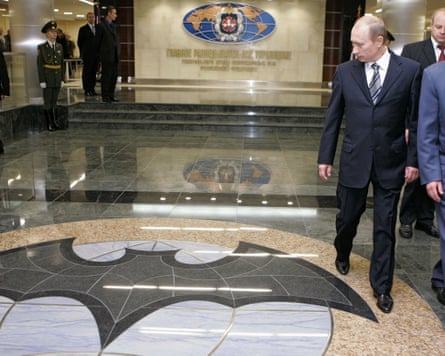
Russian president Vladimir Putin during a visit to a newly built headquarters of the GRU in Moscow on 8 November 2006.
Russian president Vladimir Putin during a visit to a newly built headquarters of the GRU in Moscow on 8 November 2006. Photograph: Dmitri Astakhov/AFP/Getty Images

Bauman, one of Russia’s leading technical universities, has never hidden its ties to the military. Founded in 1830, it later trained the engineers and scientists who built Soviet rockets, tanks and weapons systems and continues to do so today.

In a 2013 internal letter seen by the Guardian and addressed to the then defence minister Sergei Shoigu, the university’s rector wrote it carries out more research and development than any other higher education institution in Russia, with more than 40% conducted in the interests of the ministry of defence.

The curriculum

Embedded within the university’s military training centre, Department 4 is divided into three specialist streams, the documents suggest. The most prominent, bearing the code 093400, is titled the “Special Reconnaissance Service”.

The documents indicate that the GRU exerts direct control over the recruitment and grading process – sending its own officers to conduct exams, approve candidates and oversee placements. The picture that emerges is of a programme where the distinction between professor and handler and between teaching and recruitment is blurred.

The department is led by lieutenant colonel Lt Col Kirill Stupakov, a signals intelligence officer who, according to the documents, signed a three-year contract in 2022 with GRU Unit 45807, one of the agency’s key units. It is not clear if he is still in active service.

At Bauman, Stupakov’s subjects include training students to master electronic eavesdropping and covert surveillance. PowerPoint slides, apparently designed to accompany his lectures and viewed by the consortium, amount to a catalogue of deception: a smoke detector that is in fact a camera, a device that sits undetected between a keyboard and a computer logging every keystroke, a monitor cable that is also a silent screenshot machine storing its captures on a hidden flash drive.

Another teacher mentioned in the documents is Viktor Netyksho, a western-sanctioned major general who commanded Unit 26165 – a hacking group known as Fancy Bear – whose officers were indicted by the US Department of Justice for interfering in the 2016 presidential election.
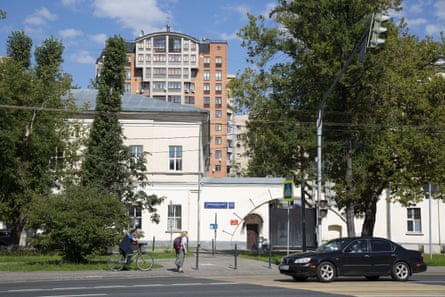
The entrance of the building of the Russian military intelligence service as home to GRU Unit 26165
Home of the hacking group Fancy Bear, in the building of the Russian military intelligence service in Moscow. Photograph: Alexander Zemlianichenko/AP

Among the core courses is one titled “Defence against technical reconnaissance”. Over 144 hours across two semesters, students are taught the full toolkit of modern hacking, including password attacks, software vulnerabilities and so called trojans – malicious programs disguised as legitimate software that can grant unauthorised access to a system.

To pass the course, students are required to carry out “practical penetration tests”, while one module is devoted entirely to computer viruses. As part of the assessment, they must develop one themselves.

Students are also taught the structure and organisation of US and British military intelligence agencies. Separate sessions cover the use of western intelligence in the war in Ukraine, and the development of enemy reconnaissance and strike drones on the Ukrainian battlefield.

Apart from hacking tasks, the curriculum also covers information warfare. Advanced students must complete a seminar on developing a disinformation campaign, the documents suggest, tasked with creating a social media video using “manipulation, pressure and hidden propaganda”.

Students are taught the mechanics of psychological manipulation and how to impose a “correct” perception of information on an audience.

The teaching materials, meanwhile, saturate students with Kremlin orthodoxy: the war in Ukraine was “inevitable”; “nationalists and neo-Nazis” are in power there; Russians in the Donbas face “genocide”, backed by European countries.

Western intelligence services have grown increasingly vocal about the scale of Russian cyber-activity in recent years.

In a report published in February, the Dutch intelligence services warned that Russia was increasing hybrid activities across Europe, combining cyber-attacks, sabotage and influence operations targeting critical infrastructure.

On 15 April, Sweden’s minister for civil defence, Carl-Oskar Bohlin, publicly accused Russia of regularly carrying out destructive cyber-attacks against EU institutions.

From lecture hall to Sandworm

The documents suggest that among the 69 students who graduated from Department 4 in spring 2024 was Daniil Porshin, who had spent six years at Bauman maintaining near-perfect grades while playing for the faculty football team. Upon graduation, he was assigned to Fancy Bear.

Not every student makes the cut: the files show that dozens have been dismissed or failed to graduate, and the assessments of some students, written by the senior GRU officers who oversee the programme can be withering. “Insufficient understanding of how to carry out a remote network attack,” reads one evaluation.

Many are deemed worthy of work inside the GRU, however: 15 others from Porshin’s cohort were similarly directed into GRU units.

Among them was a student who took up his first posting that summer, 900 miles (1,500km) from Moscow at Unit 74455 in the Black Sea town of Anapa – one of Russia’s most popular holiday resorts, and home to the hacker unit known as Sandworm by western governments.
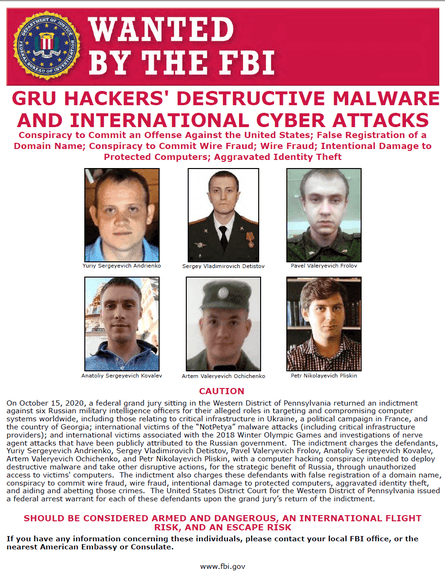
FBI wanted poster showing pictures of six members of GRU Unit 74455
FBI wanted poster from 2023 for six members of GRU Unit 74455, known as Sandworm. Photograph: FBI

Sandworm has been accused by western intelligence agencies of unleashing some of the most destructive cyber-attacks of the past decade including targeting Ukraine’s power grid in 2015, Emmanuel Macron’s French presidential campaign in 2017, the South Korean Winter Olympics in 2018, and the British investigation into the Salisbury nerve agent poisoning.

The consortium sent requests to comment on the allegations to Bauman University, and to Netyksho, Stupakov and Porshin, but had not received a response at the time of publishing.

As the war in Ukraine continues, intelligence experts suggest that Russia is ramping up its “hybrid” attacks on European allies of Ukraine, attempting a broad campaign of interference and sabotage to cause havoc in the west while remaining deniable and not crossing the threshold that could trigger a military response.

Hacking and cyber-attacks have been a key part of this strategy and the documents suggest the Bauman programme shows no signs of slowing. The latest cohort of trainees will not graduate until the end of the 2027 academic year.

While the trove of documents represent an unprecedented insight into the secretive and systematic training programme for Russia’s cyber-agents, insiders said it was only one part of the picture. Another Russian university, Mirea, was even more crucial in training hackers, according to the former defence official.

“Bauman is one of a handful of elite universities used to identify gifted students for recruitment into military and intelligence structures,” said the source.