







There is a documentary that I encourage everyone to watch called Long Night’s Journey Into Day. I first saw it when I was a student more than 20 years ago. The wordplay on the renowned Eugene O’Neill title was enough to pique my undergraduate-level interest when it began. What transpired over the next 90 minutes, however, never left me.
It follows four amnesty hearings from the Truth and Reconciliation Commission in post-apartheid South Africa. You watch family members of murdered loved ones sit face to face with the violent perpetrators. The purpose of these meetings was to see if the families could forgive them. The necessity of the meetings, which in some cases looked more like ritual given the catharsis that occurred, rested on the belief that only through forgiveness would the country truly heal.
I have carried this film with me. I believe I saw an inevitability in it – meaning that, one day, to some degree, this ritual would be available to me. I wouldn’t need to lose a loved one to violence to be faced with the bitter proposition of forgiving someone who hurt me. Likewise, I had certainly sought forgiveness enough times myself to know that I would again.
My daughter was born in 2016. It didn’t take long for me to worry about the world she was going to grow up in. While that world seems rather quaint now, the growing political polarisation compounded with the repetition of once unimaginable gun violence had become suffocating. This hit a breaking point for me on 14 February 2018, the day of the shooting at Marjory Stoneman Douglas high school in Parkland, Florida. The parents’ pain felt much closer now.
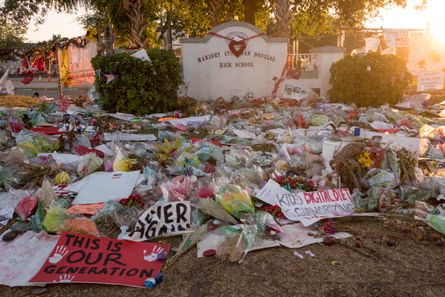
I tried to seek refuge in research. I thought that there might be some peace in better understanding the violence rather than just being horrified by it. There was no artistic intention at the time. I was just deeply troubled.
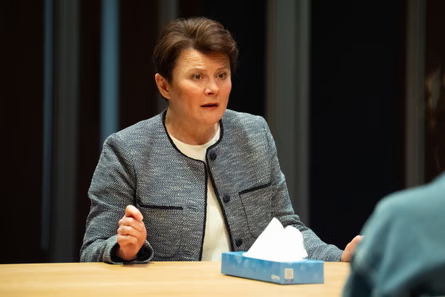
In my research, I came across something remarkable but familiar. Privately, in the aftermath of shootings, parents who had lost their child met with the parents of the shooter. Now being a father, I couldn’t help but put myself in their situation. I was equally moved by both sides. There was something so humbling and human about what they were looking for – a way forward. I recognised the core elements of restorative justice immediately. Once again, I was confronted with what it means to forgive, and the mysterious sense that the documentary had some purpose in store for me now revealed itself with a kind of calling.
This was the catalyst, or rather the synthesis, that inspired me to write Mass. Before this there was no script, but even after, the writing often felt more like an earnest examination of my own ability to forgive than a traditional story. I knew I wanted these characters to arrive somewhere but I didn’t know how or even if they could.
Forgiveness is a strange currency. Its value can’t be determined beforehand, especially when it is sincere. I’ve come to believe that it’s an act of real faith. The bold proposition that it can be placed ahead of punishment, anger or lasting resentment makes it an extraordinary sacrifice. It’s the trading in of a primal satisfaction on the hope of something better in return. That’s what makes it so hard. It can’t just be delivered in language. It must be, in the words of the Franciscan friar Richard Rohr, pain that is transformed not transmitted.
Perhaps a greater challenge, and the one I see facing us today, comes when the perpetrator is more elusive. Maybe they are no longer here. Maybe they are an entire people or political party. In crafting the Truth and Reconciliation Commission, Desmond Tutu said: “When there is no room for retributive justice there can only be restorative justice.” He proclaimed this a core principle because he understood this greater truth; sometimes we have to ask ourselves what else can justice look like? What can be placed in front of anger and resentment when punishment alone won’t restore a life that’s broken or a society that’s divided?
It’s been seven years since I completed writing Mass. It’s been seven years since the tragedy occurred in the story when the parents finally meet. One of the mothers in the play says: “Nothing has changed.” I hear it more acutely now than when I wrote it. The UK did the right thing about gun control after Dunblane. It’s demoralising as an American to watch how decisively reason prevailed here. This is not to say that Mass will be less relevant in the UK than in the US. I didn’t write Mass because of gun violence. I wrote it because of its persistence. I think there’s a distinction. Somewhere at the root of our inaction is a fundamental failing of empathy. It simply doesn’t extend far enough any more in our complex society. The tearing of its fabric could be less the result of angry rhetoric than simply our attention turned elsewhere. The fabric then wears naturally, like the clothing we no longer care for.
So I sought to build a bridge for our empathy. I attempted to put us all in a room; to sit, in real time, and listen. To watch four people, in great pain, use all the dignity at their disposal to better understand one another in order to heal. I once suspected this ritual had a purpose for me. Having the great fortune to watch Mass reach audiences as a film and now as a play, I can confirm this ritual has a purpose for all of us.