


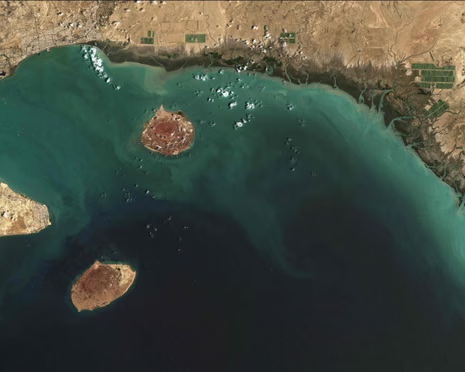
Trump plans to start anti-mine operations as part of a wider attempt to open the strait, but the clearance is laborious and dangerous
Donald Trump has said he plans to begin anti-mine operations in the strait of Hormuz as part of a wider attempt to reopen the waterway, which has in effect been closed to marine traffic by Iran since the US and Israel launched their war in late February.
What do we know about Iran’s minelaying?
In the absence of much of its fleet of large naval vessels, which have been destroyed by US and Israeli strikes, Iran has deployed small surface vessels to lay mines in parts of the strait of Hormuz. It is not known how many mines have been laid. Iran has left a path open to ships that are prepared to pay a toll.
According to US officials quoted by the New York Times, Iran has indicated that it cannot locate all of the mines that it has laid and lacks the capability to remove them.
The mines are just one strand in an array of offensive options available to Iran in the strait, including cheap drones, anti-ship missiles and fast-attack small vessels.
The Islamic Revolutionary Guard Corps (IRGC) displayed some of their small vessel and mine capacity in a propaganda video filmed in a naval bunker in January 2025:
What mines does Iran have?
Tehran is thought to have deployed two main types of mine: the Maham 3 and the Maham 7. Unlike earlier mines that relied on physical contact between a ship’s hull and trigger mechanisms on the mine itself, both are more modern varieties that use magnetic and acoustic sensors to detect when a ship is close before detonating warheads.
The Maham 3 is an anchored, 300kg mine that can be used in waters as deep as 100 metres. The Maham 7 is a bottom-resting 220kg mine for use in shallower waters. Its conical shape is designed to evade sonar detection as it sits on the seabed.
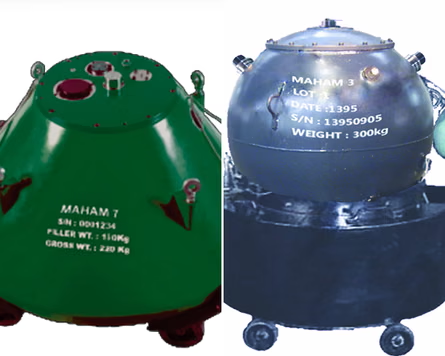
Analysis suggests that despite heavy attrition to its navy, Iran still retains upward of 80% to 90% of its small boats and mine-layers and could therefore lay more mines if the conflict continues.
What are the options for the US to clear mines and what are the risks?
Mines are quick and easy to lay, but their clearance is laborious and dangerous. Although the strait is narrow, the mined passage represents a large area and crewed US minesweepers would be easy targets in the event of a resumption of hostilities.
The best, and least risky, option for the US would be to use uncrewed marine mine-hunting vehicles. Those include the Knifefish undersea mine hunter, a submersible device, and the MCM anti-mine vessel, which looks like a speed boat.
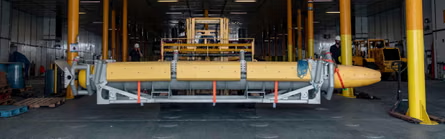
The US could also deploy the AN/ASQ-235 (Archerfish) airborne mine neutralisation system from an MH 60S helicopter. The system, controlled by the helicopter’s crew, uses vehicles with sonar to detect mines and then destroy them.
Although uncrewed anti-mine systems remove the danger to personnel from the mines themselves, they require relatively close proximity from US ships and aircraft to launch and control them. So US personnel could still be targeted by missiles or drone-swarms if the ceasefire ends.
Two US destroyers – the USS Frank E Petersen and USS Michael Murphy – transited the strait on 11 April in a development that US Central Command described as “setting conditions for clearing mines”. It is unclear what Tehran’s attitude to more sustained operations might be and what impact they would have on the ceasefire.
How effective are modern mines?
The global economy’s reliance on maritime trade gives countries deploying mines an outsized leverage compared with the relatively low cost of laying the mines. It takes only a small number of mines to close sea lanes, not least because some mines can be set to detonate after a certain number of ships have passed over, creating uncertainty.
Is Iran required to map where it has laid mines?
There are overlapping international laws and claims covering the strait that are complicated by the fact that neither Iran nor the US is a party to the 1994 UN Convention on the Law of the Sea.
International law stipulates that mines may not be used to close international straits for innocent passage. However, Iran claims part of the strait as its territorial waters.
It is not clear, in any case, whether Iran would be required to provide a detailed mine map to the US, with whom it is still engaged in an armed conflict (albeit suspended by a ceasefire), not least at a time when the US is imposing its own military blockade.